Blueberry Bush Lifespan Calculator
Estimate a blueberry planting's productive years from bush type, current age, soil pH, drainage, pruning renewal, winter fit, disease pressure, vigor, and yield decline.
📋Blueberry lifespan presets
Start with a realistic planting pattern, then adjust the pH, drainage, winter zone, pruning cycle, disease pressure, and productivity trend to match your field or garden.
🫐Bush type and current age
Blueberries are long-lived woody shrubs, but useful life depends on type, site fit, root health, and whether old wood is renewed before yield slides.
⚗Soil, water, and winter stress
Blueberry roots are shallow and fine. Soil pH, drainage, mulch, and winter exposure usually explain early decline better than age alone.
✂Pruning renewal and plant health
A blueberry bush can be old but productive if cane renewal stays active. The calculator weighs pruning interval, old-cane share, disease pressure, vigor, and yield decline.
Blueberry lifespan estimate
Calculated results will appear here.
Detailed lifespan breakdown
📊Stand condition snapshot
These secondary indicators summarize the planting's age stage, root-zone risk, renewal need, and productivity trend after the calculation.
📚Blueberry lifespan reference tables
| Type | Useful life | Peak years | Notes |
|---|---|---|---|
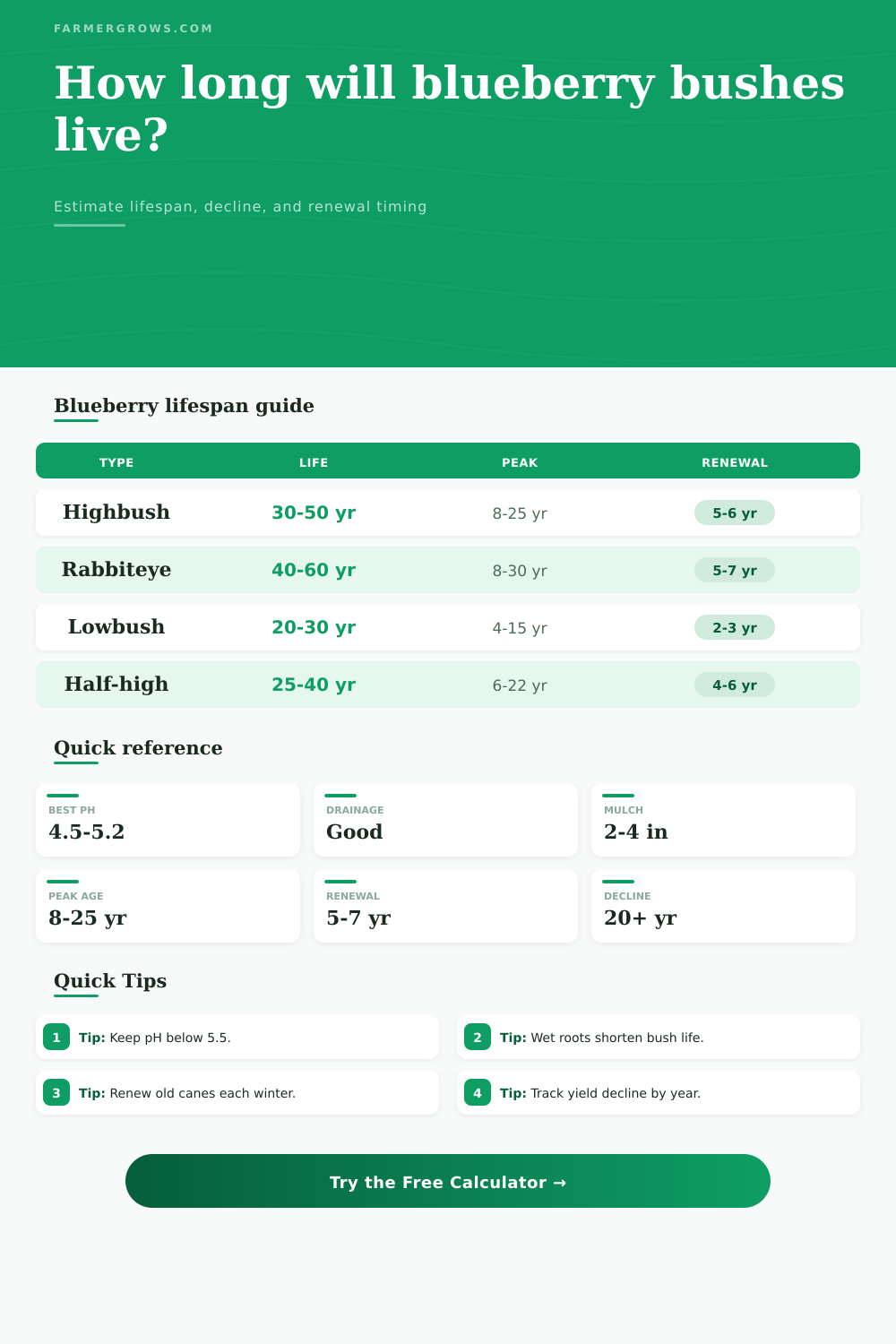
| Northern highbush | 30 to 50 years | 8 to 25 | Needs acidic, well drained soil and winter fit. |
| Southern highbush | 20 to 40 years | 6 to 20 | Heat adapted but sensitive to poor pH and wet roots. |
| Rabbiteye | 40 to 60 years | 8 to 30 | Long-lived in warm regions with good drainage. |
| Lowbush | 20 to 30 years | 4 to 15 | Managed by periodic mowing or burning style renewal. |
| Half-high | 25 to 40 years | 6 to 22 | Cold-hardy garden type with moderate longevity. |
| pH range | Status | Likely effect | Watch for |
|---|---|---|---|
| 4.2 to 5.2 | Best | Longest root function | Balanced growth |
| 5.3 to 5.7 | Watch | Moderate shortening | Yellow leaves |
| 5.8 to 6.3 | High | Strong decline risk | Low vigor |
| Over 6.3 | Severe | Early failure likely | Iron chlorosis |
| Type | Main renewal | Old wood signal | Goal |
|---|---|---|---|
| Highbush | Remove oldest canes yearly | Gray, twiggy, weak fruit wood | Mix young and mature canes |
| Rabbiteye | Thin old canes every year or two | Crowded tall older canes | Keep light inside canopy |
| Lowbush | Reset patch on a cycle | Short weak stems, weeds, low yield | Restart vegetative growth |
| Half-high | Light annual renewal | Dense, unproductive crown | Protect winter-hardy new wood |
| Symptom | Common cause | Life impact | Priority |
|---|---|---|---|
| Yellow leaves | pH too high | Major if chronic | Soil test |
| Dieback | Winter, canker, drought | Moderate to severe | Prune and inspect |
| Small berries | Old wood or drought | Moderate | Renew canes |
| Weak shoots | Root stress or overcrop | Major predictor | Fix roots first |
A healthy blueberry bush can outlive its peak production window. For gardens, a low but steady yield may be worth keeping; for a production block, replacement often happens earlier.
If pH is high, pruning harder rarely solves decline by itself. Correcting acidity and root-zone conditions usually matters before canopy renovation.
Highbush and rabbiteye plants stay younger when a portion of the oldest canes is removed each dormant season instead of waiting for a full collapse.
Severe root disease or repeated cane canker can shorten lifespan more than age. Replace badly affected plants if new shoots remain weak after site corrections.
Woody plant like blueberries may last decades if their wood’s managed and soils’ chemistry is right. But how many more years can a patch of berries continue to produce good-quality fruit? The math gets entered above and the calculator does its thing, removing guesswork from the equation so you know just how long the patch has got left.
It’s not always just age; most gardeners think it is, but they’re wrong. First: All these formulas takes into account the soil’s pH, which determines how long your blueberries will live. Because their roots aren’t deep (the shallow type), any kind of alkaline environment are problematic; anything above a pH of 5.2 slows nutrient uptake, starving the plant even if its fertilizer routine is perfect. That means yellow leaves, perhaps, if your pH is only a little higher than ideal. But a significantly high one can reduce productive life of the plant by years, as it fights a chemical war every day. You don’t need to prune if the soil isn’t right: It won’t help no matter what you do. Fixing it first make sense.
How to Make Your Blueberry Bushes Live Longer
Just behind the acidity: the drainage factor. Blueberries don’t like wet feet; if there’s water in the root-zone soil, they’ll rot out for lack of air. So raised beds (or sandy loam soils) prolong life of the planting. The calculator factors your drainage scenario into its calculations of expected life. Even impeccable pH won’t rescue your bush if it has poor drainage; eventually it will decline anyway. It’s a structural fix rather than a seasonal one. This might mean adding pine bark to soil or raising the level of the bed instead of just waiting for better weather.
The other half of the equation is pruning. Blueberries don’t produce fruit forever on old wood; typically, the most productive are two- to five-year-old canes. Beyond that point, they’re less fruitful and more twiggy and shaded out. Let go a few years without any pruning and you’ll have a dense thicket of unproductive old wood on your hands. This calculator considers your renewal cycle and how many old cane remain to assess whether it’s time for a hard cut.
Getting rid of some older stems each winter causes a new generation of basal shoots to grow… Resetting the crown’s biological clock, in effect. It is drastic at first but it keeps things vigorous long term. Still, the life expectancy vary from variety to variety. Lowbush kinds tend to be managed on a shorter cycle, burned back or mowed periodically to get them going again; rabbiteye bushes can live longer still, provided they’re kept that way; and highbush ones might last 30ish to 50ish years under optimum conditions, perhaps even more, though all are given their base difference as an average to avoid making a comparison between a patch of lowbush ten years old versus a stand of highbush thirty without context. It factors in things like disease pressure and hardiness to winter, too, which can knocks years off the upper range.
Bottom line: Growing a blueberry bush involve commitment over decades, and some work. You don’t buy one to forget about it. The calculator shows you realisticly how many more fruit-bearing years you can expect if you do the necessary work today. Not so good? First thing: Review your soil test. Next? Pick up your pruners.
Tending to the woody part (the canes) and tending to the root zone (with the help of compost and other additions) typically extends your “useful” lifespan far beyond what any new plants would offer. Keep both the young and old happy, and keep them young, and you’ll enjoy every bite for another blue summer.