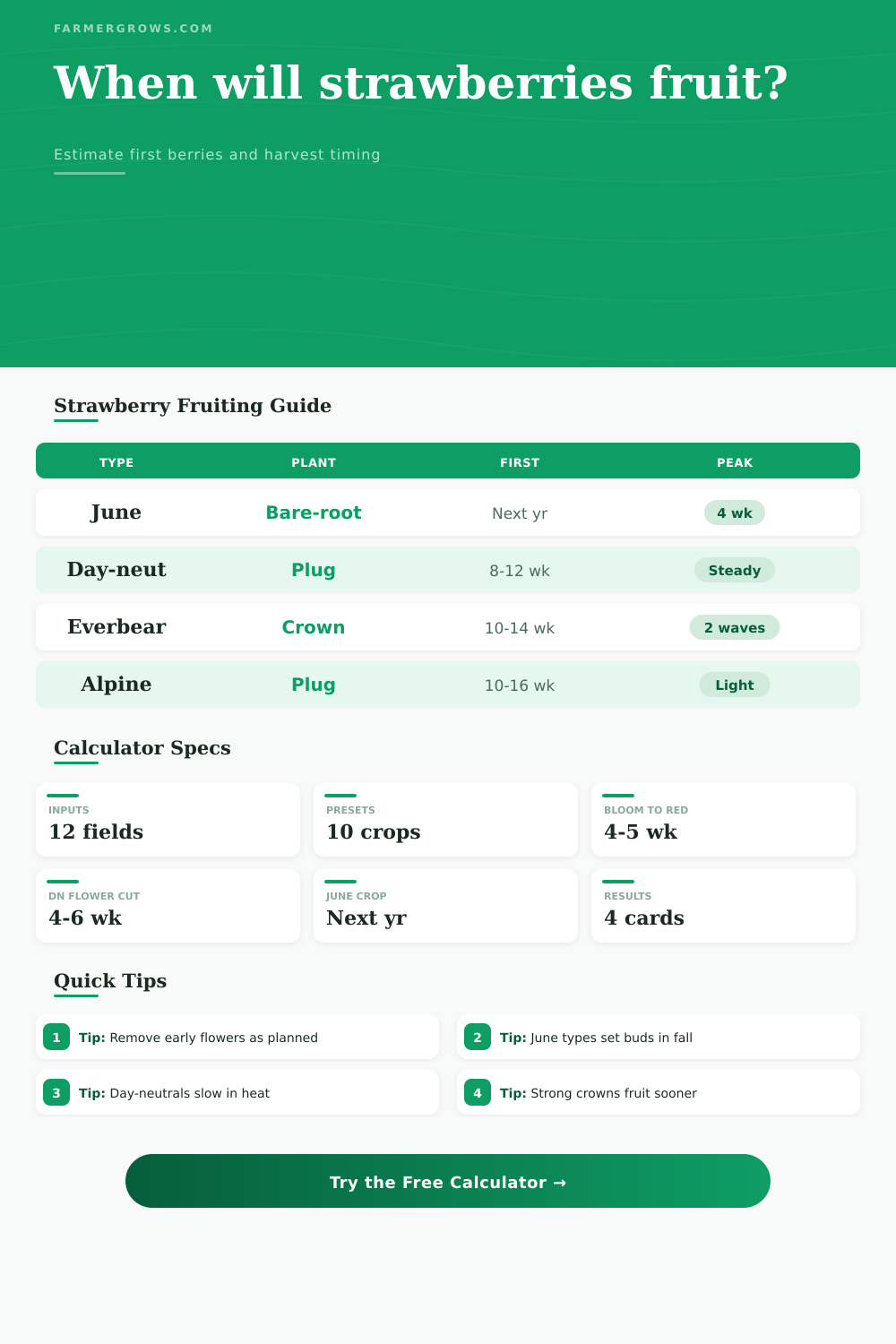
Strawberry Time to Fruit Calculator
Estimate when strawberry plants may flower, set their first ripe berries, reach peak harvest, and build a useful crop from planting date, plant type, cultivar bearing habit, chill fit, day length, flower removal, crown strength, and growing conditions.
Load a realistic planting, then adjust the planting date, plant form, bearing habit, zone, chill match, day length response, flower removal, and plant vigor for your bed, container, tunnel, or matted row.
Large plugs and potted plants often flower faster than small dormant crowns, while weak bare-root plants spend more time rebuilding leaves.
June-bearing types usually build next season's crop from fall buds; day-neutral types can fruit in the planting year after establishment.
Removing early flowers strengthens crowns but moves the first ripe berry later, especially for day-neutral and everbearing plantings.
Short fall days and winter chill drive many June-bearing buds, while day-neutral cultivars depend more on temperature and plant strength.
Estimated Strawberry Fruiting Window
Adjust the inputs and calculate to estimate first flowers, first ripe berries, peak harvest, and crop confidence.
| Bearing habit | Typical first fruit pattern | Best flower removal | Harvest character |
|---|---|---|---|
| June-bearing | Usually the spring after planting; same-year fruit is normally sacrificed for establishment | Remove first-year flowers on new spring plantings | Large, concentrated 2 to 4 week crop |
| Day-neutral | Often 8 to 12 weeks after spring planting when flowers are removed for 4 to 6 weeks | Remove flowers during early establishment, then allow bloom | Steady flushes, with heat slowdowns |
| Everbearing | Often 10 to 14 weeks after planting if plants are strong | Remove first flush or first cluster for stronger crowns | Two or more lighter flushes |
| Alpine | Plug plants may fruit in 10 to 16 weeks; seedlings take longer | Remove early flowers on tiny starts | Small berries over a long season |
| Plant form | Establishment clock | Fruiting effect | Best use |
|---|---|---|---|
| Small bare-root crown | About 4 to 6 weeks to rebuild leaves | Later first flowers and lower first confidence | Economical bed planting |
| Strong bare-root crown | About 3 to 5 weeks to establish | Good timing if roots are moist and crowns are planted correctly | New rows and raised beds |
| Green plug | About 2 to 3 weeks to settle | Faster first fruit, especially for day-neutral types | Containers, tunnels, small beds |
| Potted nursery plant | About 1 to 2 weeks to settle | Fastest if not rootbound or stressed | Instant patio harvest |
| Runner division | About 3 to 5 weeks if well rooted | Variable; depends on crown size and season | Expanding an existing patch |
| Climate signal | June-bearing impact | Day-neutral impact | Calculator adjustment |
|---|---|---|---|
| Good winter chill | More even spring bloom from fall buds | Less critical for planting-year crop | Higher confidence |
| Marginal chill | Uneven bloom and weaker spring crop | Minor to moderate effect by cultivar | Delay and confidence penalty |
| Long hot summer | Fruit quality can drop after main crop | Flowers may pause during heat | Add delay for first useful harvest |
| Protected tunnel | Can advance spring crop if chill is met | Often advances early flush and protects flowers | Small calendar advance |
| Scenario | Expected first ripe berries | Peak crop | Notes |
|---|---|---|---|
| Spring June-bearing bare-root | Following spring, often May to June by zone | 2 to 4 weeks after first berries | Remove first-year flowers to build crowns |
| Spring day-neutral bare-root | Late summer after establishment | Repeating flushes until heat or frost | Remove flowers 4 to 6 weeks first |
| Day-neutral plug container | About 8 to 10 weeks from planting | Steady light picking | Runner removal and watering matter |
| Fall-planted June-bearing bed | Next spring if rooted before dormancy | Main June crop or local equivalent | Short-day bud formation is key |
June-bearing timing: A spring-planted June-bearing bed is usually managed for next year's crop because fall bud initiation and winter chill create the main harvest.
Day-neutral timing: Removing flowers for 4 to 6 weeks delays the first berry, but it often improves crown size and the useful harvest that follows.
Flower-to-fruit math: Once flowers are allowed and conditions are suitable, ripe berries commonly follow bloom in about 28 to 35 days.
Heat and day length: Day-neutral types ignore day length more than June bearers, but hot weather can still pause flowers and reduce fruit set.
This calculator estimates harvest timing for planning. Local cultivar genetics, plant health, pollination, soil moisture, frost, heat, pests, and disease can move real picking dates earlier or later.
It’s not exactly like you plant a strawberry crown in early spring and then wait for sweet red fruit to emerge immediately. Instead, what emerges are leaves. At least at first, it feels like a mistake. But no, the plant is working according to its own biological clock.
How long until planting-to-picking? That depends on the size of root ball, the variety genetics…and even whether you’re allowing the plant to get distracted by early flowers. The calculator above yields dates based off your selections, but knowing why those dates are set help you manage expectations.
Why Strawberry Plants Need Time to Grow
What about June-bearing? There is no exceptions. June-bearers require short days in fall to start their flower buds. These bud remain dormant all winter and produce fruit in heavy harvests in early summer. If you plant bare-root crowns in April, the calculator probably advises waiting another year for fruit. Not a mistake! It is a horticulturist’s plan. First-year fruit production means giving up time that might otherwise go toward growing roots, a big deal for a future long yield, though it may mean a handful of berries now or never. The tool assumes this and it delays guessing when the plant will produce fruit to prioritize higher future yields over early strawberries.
Day-neutral types are more flexible. But with a caveat: Unlike determinate or indeterminate varieties, these plants don’t pay attention to day length; left to their own devices they’ll try to bloom right away. A young strawberry plant cannot support both heavy vegetative growth and fruit development. To make it grow strong, pinch off those initial blooms for several weeks, four to six is what the chart on the page show. Sacrificing some immediate satisfaction (that’s what that delay means) will mean a better crop later in the summer, because the crown of the plant has had time to get stronger.
Just as important as variety name on the tag is what you’re actualy getting. You are getting a tiny, barely alive dormant bare-root crown. It doesn’t have many leaves and has even fewer energy stores to draw from. First order of business is survival… Followed closely by recovery of leaf area, and then comes notion of producing offspring. If that’s all it can do, it has been busy for a month just doing that. In comparison, the pot-grown plant at the nursery already has foliage and roots in place when you get it home. It is ready to work. This difference in strength factor into the calculator and changes the timeline.
Weak beginnings are not forgiven in biology; if you think your plants is looking yellow and sad, forget those rosy dates and wait until they are truly healthy and green. These estimates can be affected by environmental stressors. For example, day-neutral strawberries will stall flower production at temperatures of eighty-five degrees Fahrenheit or higher. In heat waves, they’ll shut down flowering until it cools off again. To reflect that, the tool reduces confidence levels in late-summer months or warmer zones. Remember: calendars aren’t laws; weather tends to have last word.
The number of chilling hours is key to overwintering crops. For example, June bearers require some minimum number of cold hours for uniform break from dormancy; otherwise they bloom erratically and fail to set fruit well. Checking both your zone and the variety’s chill requirement will show if there might be a mismatch… Before you spend time on growing care.
Strawberries are a living system. To grow them successfully takes planning and patience: you’re dealing with a system in balance between short-term production and long-term life. Set your target realisticly (use the tool), and give the plants room and good conditions to do what they do best. Waiting until the first berry is ripe is part of the process; there is no reason to fail. You should of waited for better weather if you wanted more berries.