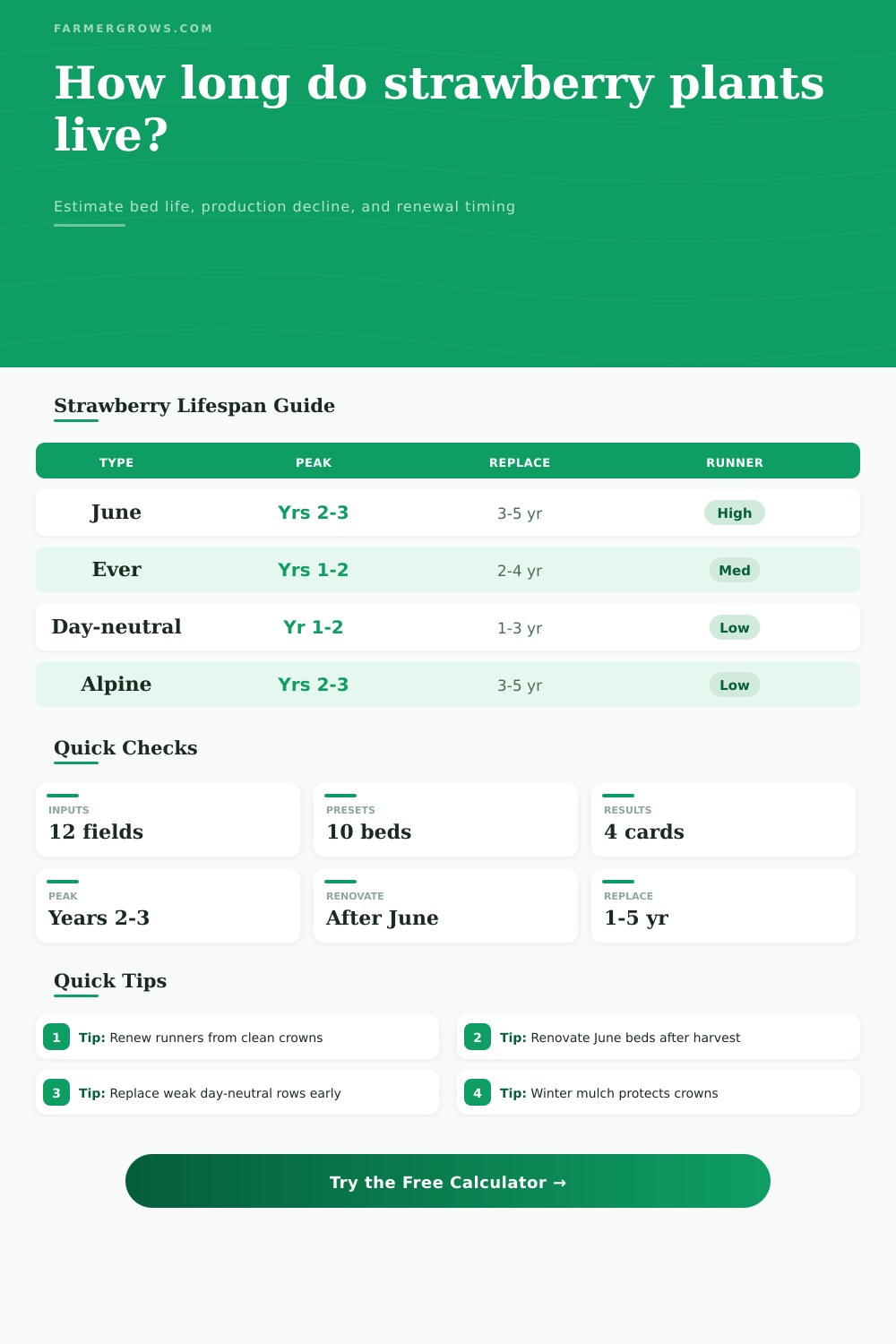
Strawberry Plant Lifespan Calculator
Estimate how long a strawberry planting will stay productive from plant type, bed age, runner renewal, disease pressure, winter zone, mulch protection, renovation timing, and production decline.
Load a realistic bed profile, then adjust plant type, current bed age, runner renewal, disease pressure, winter zone, renovation timing, and observed production decline.
Often kept 3 to 5 years when renovated after harvest and renewed with healthy daughter plants.
Usually stays useful 2 to 4 years, but crown crowding and summer stress shorten the strong years.
Best treated as a 1 to 3 year planting because repeated fruiting exhausts crowns quickly.
Can persist 3 to 5 years as edging or containers, with lower yield weight but steady picking.
Strawberry Lifespan Estimate
Your strawberry bed estimate will appear here.
| Strawberry type | Typical useful life | Peak production pattern | Renewal approach |
|---|---|---|---|
| June-bearing matted row | 3 to 5 years in clean beds | Light first year, strongest years 2 to 3, decline after crowding | Renovate after harvest and keep selected runner plants. |
| Everbearing | 2 to 4 years | Smaller flushes over the season, often best in years 1 to 2 | Thin old crowns and replace weak sections as vigor drops. |
| Day-neutral | 1 to 3 years | Repeated fruiting exhausts crowns, especially in heat or containers | Often replanted annually or every second season for high yield. |
| Alpine strawberry | 3 to 5 years | Small steady harvest, lower total weight, longer ornamental value | Divide or reseed patches when centers thin out. |
| Timing | Best fit | Life effect | Watch point |
|---|---|---|---|
| Right after June harvest | June-bearing matted rows | Extends useful life by renewing leaf canopy and spacing | Do not wait until late summer when new crowns need time. |
| Late renovation | Recoverable but stressed beds | May help weeds and crowding but gives less time for crown rebuilding | Use only if plants still have strong roots and clean crowns. |
| Skipped renovation | Low-input patch | Usually shortens productive life through crowding and disease | Expect smaller berries and more weak plants next season. |
| Annual reset | Day-neutral and intensive systems | Keeps production high by replacing exhausted crowns | Plan new plants before old rows collapse. |
| Pressure | Low risk sign | High risk sign | Lifespan response |
|---|---|---|---|
| Winter crown injury | Plants green up evenly in spring | Heaved crowns, dead centers, patchy stand | Mulch before deep cold and protect exposed raised beds. |
| Root and crown disease | Firm crowns and white roots | Wilting, reddish roots, brown crowns, stand loss | Rotate beds and replace rather than saving sick runners. |
| Leaf spot and fruit rot | Airy rows and clean mulch | Spotted leaves, moldy fruit, dense wet canopy | Thin rows, remove old foliage, and improve spacing. |
| Runner crowding | Selected daughter plants spaced well | Solid mat with tiny crowns and weeds | Renovate hard or start a clean replacement bed. |
| Bed condition | Keep one more year | Renovate and overlap | Replace now |
|---|---|---|---|
| Healthy June-bearing bed | Age under 3 years, strong runners, clean crowns | Age 3 to 4 years with moderate crowding | Age 5 plus, disease, or shrinking fruit size |
| Everbearing patch | Good crowns and steady flushes in year 1 or 2 | Year 2 to 3 with light decline | Weak crowns, heavy disease, or poor second flush |
| Day-neutral row | First-year plants still setting well | Second-year row with clean crowns | Heat-exhausted or low-yield older row |
| Container strawberries | Roots still vigorous and mix drains well | Refresh mix and root runners into new pots | Rootbound, crown rot, or winter-killed pots |
Use runners as renewal, not clutter. Select healthy daughter plants and remove weak runners so the row does not become a disease-holding mat.
Renovation timing matters. June-bearing beds need leaf and crown rebuilding time after the crop. Late renovation gives the bed less time to recover.
Day-neutral rows age quickly. Continuous flowering is useful, but it makes replacement planning more important than in a traditional matted row.
Do not save diseased runners. If crown or root disease is active, start clean plants in a new bed rather than extending a weak planting.
This calculator estimates useful productive bed life, not the maximum age of an individual strawberry crown. Local cultivar, soil drainage, rotation, pests, irrigation, fertility, and winter protection can move the result.
We grow strawberries because they is delicious. But lack of care can reduces the crop over time.
Year after year, maybe it’s grown on same bed. Maybe you count on nature to take care of it. Nature doesn’t. Little by little, the plants gives in to their own nature. They do not fade all at once but they fade away gradualy. Their berries shrink. Then they rot from within. Crowns begin to soften and decay. Your yield dwindles before you even realize there is anything wrong. It’s just the way strawberry plant are: seasonal workers with a rigid retirement policy, and you’d best be on that schedule.
How to Care for Strawberry Beds
To run the numbers yourself, use this calculator. Enter conditions that matter most to you, then let it do the math. It takes all the guessing out of it. It factors in known rate of decline. It also considers two toughest-to-overlook variables: the age of the bed itself and the type of plant.
In the world of strawberries, June-bearing varieties is workhorses. They push it all into one large haul, then go rest awhile. Properly renovated, they continues to produce for three to five years. Ebearings (everbearing) tend to be more erratic. Smaller waves of berries sap their energy reserves. The day-neutral ones are basicly sprinters. They fruit perpetually but burn out in a season or two. A day-neutral row that’s treated as though it were permanently installed is doomed, since they won’t last.
Renovating June-bearing beds makes the world go round. That’s when we mow down old foliage, tighten up rows, and force new growth once picking ceases. Sounds brutal. But if we don’t do this, runners thicken into a tangled mass that holds moisture and causes disease. Timing affects longevity. See the reference table on the page. If you renovate too late in summer, new crowns won’t have time to harden off before winter. Renovate less than once every three years? You’ll be farming a weed bed dressed up like strawberries.
Another silent killer are disease pressure. Canopy density promotes rapid spread of things like leaf spots and fruit rots, particulary in humid climates. Thin-out rows or lose ’em outright: Thick rows is disease highways.
Protecting roots in winter is more important than many realize, particularly in colder zones where the ground freezes, heaving up and exposing crowns to chilly air. A good layer of straw provide insulation and holds the crown firm. But if a bed is already exhausted. Whether by age or root rot, no mulch can saves it. Time for replacement, and you would of known when to do it with the help of calculator, which estimates the date when its remaining production falls below a useful level. This happens when reward doesn’t equal the effort.
Most gardeners hang on too long; they’re pulling tiny sour berries and dreaming of last year’s abundant haul. Starting over isn’t shameful. Rotate your beds every few years. It helps prevent soil-borne pathogens, and also ensures new plants has a nice clean slate to grow in. Choose your healthiest-looking daughters of the moment and root them well. Then, set them out where they can stretch their legs.
See how they take off, full of life? That’s the cycle. Savor the peak. Deal with the decline. Don’t get sentimental about keeping yourself in a spot that offers nothing but itself anymore. It’s waiting for someone new.