Pepper Plant Lifespan Calculator
Estimate how many productive seasons a pepper plant may have left from pepper type, climate, frost exposure, age, root space, disease pressure, pruning, and winter protection.
📋Pepper lifespan presets
Start with common pepper growing situations, from first-year field bells to tropical Thai chiles and overwintered superhots.
🌶Plant type and age
Peppers are tender perennials, but cold, root restriction, pests, and falling yield usually decide whether a plant is worth keeping.
🌡Climate and cold exposure
🪴Root space and maintenance
Pepper lifespan estimate
Enter your pepper plant details to estimate productive lifespan and replacement timing.
Calculation breakdown
📊Lifespan comparison grid
Best for frost-prone beds where starting new transplants is simple.
Most practical for favorite plants if pests are controlled before moving indoors.
Long-lived plants need pruning as woody stems and old roots reduce yield.
Extended culture works when disease pressure stays low and plants are renewed.
📘Pepper lifespan reference tables
| Type | Typical peak | Potential life | Notes |
|---|---|---|---|
| Bell pepper | Year 1 | 1-3 years | High yield first year, often replaced in cold zones |
| Jalapeno | Year 1-2 | 2-4 years | Good overwinter candidate in pots |
| Cayenne | Year 1-2 | 2-4 years | Handles pruning and repeat flushes well |
| Thai chile | Year 2-3 | 3-6 years | Often becomes a woody shrub in warm climates |
| Habanero | Year 2 | 3-5 years | Longer-lived with warmth and root room |
| Rocoto | Year 2-3 | 3-6 years | Performs best in cooler, frost-free conditions |
| Protection | Minimum | Survival | Use for |
|---|---|---|---|
| None | Frost exposed | Very low | Annual field peppers |
| Frost cloth | Light frost | Low to fair | Short cold snaps only |
| Garage dormancy | 45-55 F | Fair | Pruned container plants |
| Sunny window | 55-70 F | Fair to good | Small pots, low fruit load |
| Grow lights | 60-75 F | Good | Favorite plants and superhots |
| Heated greenhouse | 60+ F | Very good | Production or breeding plants |
| Age | Plant state | Yield outlook | Action |
|---|---|---|---|
| 0-8 months | First season | Rising | Train strong stems |
| 9-18 months | Second flush | Peak for many types | Prune lightly |
| 19-36 months | Woody base | Stable to declining | Refresh roots |
| 37-60 months | Older perennial | Variable | Keep only vigorous plants |
| 60+ months | Legacy plant | Often lower | Propagate or replace |
| Climate | Main limit | Best strategy | Expected life |
|---|---|---|---|
| Cold winter | Hard frost | Grow as annual or move pots | 1 season |
| Mild winter | Cold snaps | Cover and prune | 1-3 years |
| Frost-free | Age and pests | Renew old wood | 3-5 years |
| Tropical | Disease buildup | Rotate and replace weak plants | 3-7 years |
| Indoor | Light and pests | Quarantine and use grow lights | 2-4 years |
Prune back weak shoots, inspect under leaves, and isolate peppers for a week before placing them near houseplants or seedlings.
If a mature plant has chronic pests, suspected virus symptoms, or less than half its former yield, starting a clean replacement is usually better.
Lifespan estimates assume Capsicum plants with adequate fertility, drainage, and pest management. Actual survival changes quickly after freeze damage, root rot, virus symptoms, or severe mite outbreaks.
PEPPERS are ANNUALS; most people don’t grow them year-round (though they could), but simply let the frost kill their plants. Nature didn’t intend a pepper plant to live just one year, either, though that’s how we treat it. Look at a sturdy, loaded jalapeno plant in late October. It seems strong and ready to go, but then it freezes in the first frost regardless. Your weather say no more; its genetics say yes.
When a plant’s potential is greater than what your weather allows, it makes long-term gardening plans difficult. If you desire multiple crops from each set of roots, you has some extra hurdles. With this, you select the protection method and variety, and then the calculator on the page performs the math for you. You don’t have to guess; you get a clear timeline. And you understand why the various inputs affect the output, which makes the result more believable.
When to Keep or Throw Away Peppers
Lots of folks believe all peppers are eternal indoors, and while that may be true for some (who knows?), for most the issue is root space. Even with a lot of warmth and light, after a couple of years in a five-gallon pot, those bell-pepper roots will stop growing out, meaning they’ll stop growing up. Root volume factors into the tool’s calculations because a plant need a little fresh soil and at least a little room to grow as it goes, or it won’t continue producing. It doesn’t stop fruiting because it gets old; it stops because there’s nowhere for it to go down and make new roots. Age get the blame. The real cause is usually tired soil and physical constraints.
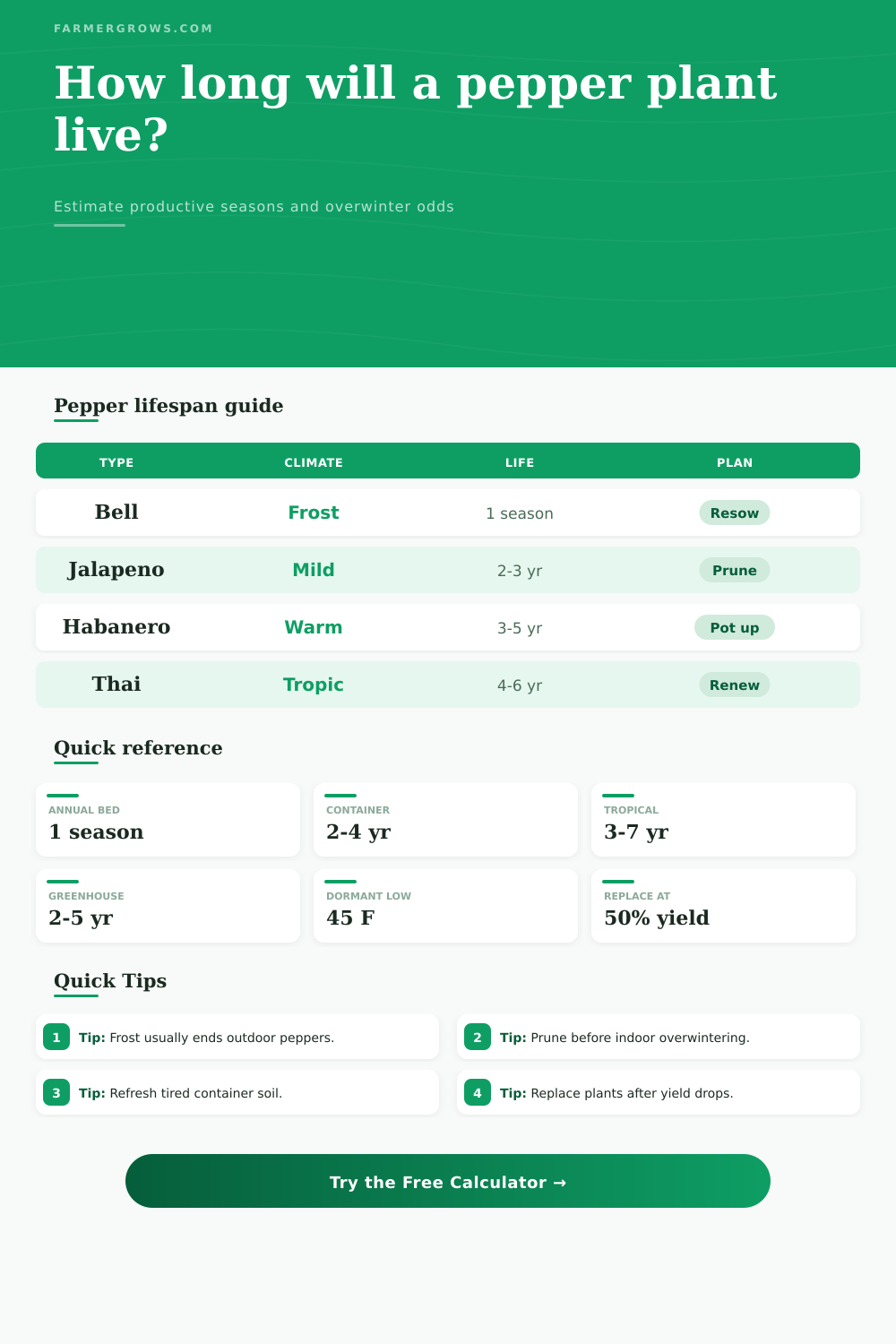
Even before considering lighting or pruning, what you can expect depends on your climate zone. Unless you have access to a dedicated greenhouse, it’s typically best to plan on growing peppers as a one-shot deal in hard-freeze zones. It’s rarely worth the hassle of lugging heavy pots inside the warmest part of the garage, hacking away at the plant, then nursing it along during the off season (unless perhaps you’re growing a prized superhot or very rare habanero). With the usual garden varieties such as regular sweet peppers, you just won’t get enough return on the investment. But with the later-maturing plants, especially the slower-growing ones, you may be able to coax multiple years’ production from one plant, provided you nurse it well, particularly since they are not long-lived by nature. This is shown clearly in the reference table (above).
The table also explains why blocky bells go out fast after an initial peak. Tropical types, on the other hand, tend to hang around longer in nature.
At least initially, pruning goes against our instincts. We want to preserve as many leaves as possible, hoping that by providing more surface area for making food, we can nurse the plant through its dormancy. But too many leaves left indoors will only invite problems with fungi and pests in low light. Heavy pruning before moving pepper plants indoors will minimize any unnecessary stress on their roots, which is already struggling to survive even though they’re not actively growing. It makes a huge difference to their survival rate, and if you don’t do this step, you may find yourself battling with mold and/or spider mites rather than waiting out the winter months.
The other big factor in knowing when to let go is disease pressure. Peppers do get infected by pathogens, especially if they grow outdoors in beds where such things can linger in the soil over time. Even though a pepper may appear perfectly healthy, it could be harboring some virus that would diminish its output come next year. The math behind the calculator, where it predicts poor yields or survival, is likely accounting for such hidden biological costs. Even if the existing plant appears vigorous, sometimes it makes more sense to start from scratch with sterile potting mix and clean seed.
There are no magic bullets that defy nature (though there are ways to keep growing your peppers longer: see tips below). But in return, will you get enough extra to make it all worthwhile? That depends on the variety, so again, know what each one can do, and be willing to let go or start again, as appropriate. Knowing your limits means you’re gardening intentionally, not expecting a miracle each springtime.