Tomato Plant Lifespan Calculator
Estimate how many weeks a tomato plant may live and produce from transplant date, plant habit, frost timing, greenhouse protection, disease pressure, pruning, heat stress, and harvest behavior.
📋Tomato lifespan presets
Choose a realistic season pattern, then adjust dates, variety habit, greenhouse cover, disease risk, pruning, and heat stress for your garden.
🍅Plant type and season dates
Tomato lifespan is usually bounded by plant habit, frost, disease decline, and whether the crop is outdoors or protected.
⚕Stress, pruning, and crop management
Disease pressure, hot nights, root restriction, and pruning style can shorten or extend the useful harvest window.
Estimated tomato lifespan
Calculated tomato lifespan and productive weeks will appear here.
Calculation breakdown
📊Season planning metrics
📘Reference tables
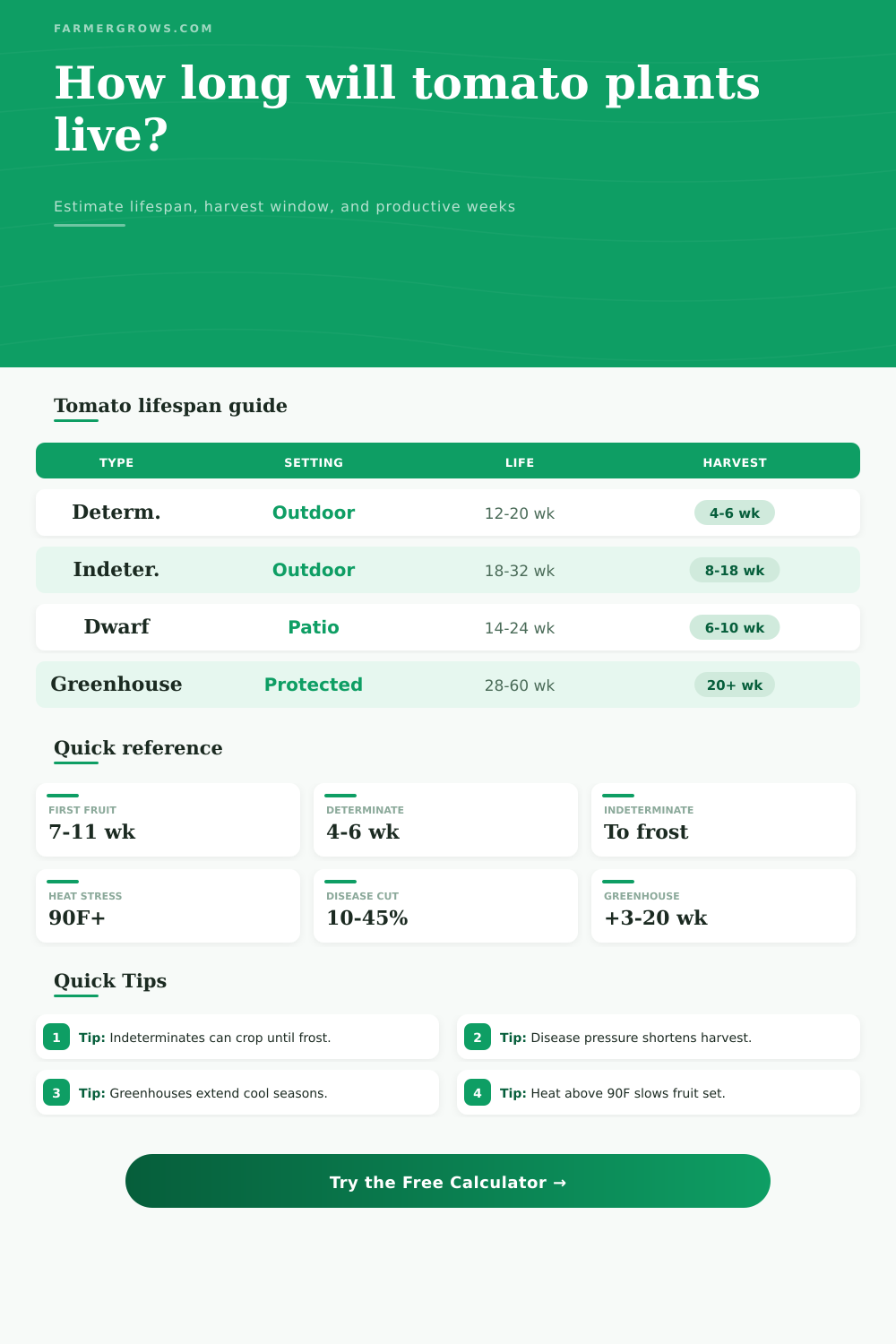
| Type | Growth habit | Usual life | Productive window |
|---|---|---|---|
| Determinate | Sets crop in flush | 12 to 20 weeks | 4 to 6 strong weeks |
| Semi-determinate | Stops after several clusters | 16 to 28 weeks | 7 to 12 weeks |
| Indeterminate | Continues new growth | 18 to 32+ weeks outdoors | Until frost or decline |
| Dwarf or patio | Compact plant frame | 14 to 24 weeks | 6 to 10 weeks |
| Setting | Frost effect | Best use | Watch point |
|---|---|---|---|
| Outdoor | No extension | Main season gardens | First frost ends crop |
| Row cover | About 1 week | Light frost protection | Remove in warm days |
| High tunnel | 2 to 4 weeks | Late fall harvest | Vent for humidity |
| Greenhouse | 3 to 20+ weeks | Protected production | Disease and pollination |
| Factor | Low | Moderate | High |
|---|---|---|---|
| Disease pressure | Little change | 10 to 25% shorter | 35 to 55% shorter |
| Heat stress | Fruit set steady | Short bloom gaps | Long fruit-set gaps |
| Root restriction | Stable moisture | More dry swings | Early decline likely |
| Pruning style | Airflow varies | Can extend health | May reduce shade |
| Tomato class | Early | Midseason | Late |
|---|---|---|---|
| Cherry | 50 to 60 days | 60 to 70 days | 70+ days |
| Slicer | 55 to 65 days | 65 to 80 days | 80+ days |
| Paste | 60 to 70 days | 70 to 80 days | 80+ days |
| Large heirloom | 70 to 80 days | 80 to 90 days | 90+ days |
Outdoor tomato plants often stay alive until a killing frost, but useful harvest normally ends earlier if nights cool and ripening slows.
When days stay above the heat threshold and nights remain warm, flower drop can pause productive weeks even while the plant stays alive.
Foliar disease reduces the leaf area that feeds fruit. In humid regions, this can matter more than the calendar frost date.
Protected tomatoes can live much longer, but the estimate still reduces lifespan when pruning, roots, heat, or disease become limiting.
This calculator estimates useful garden lifespan, not genetic maximum age. Local variety, soil, weather, pests, nutrition, and sanitation can move the result.
May: You put a little baby tomato plant in the ground, all hopeful and full of compost. In July, true to promise, some first red fruit appear. And then… August! Nights get hot. Some leaves goes spotty. Fruit production slows to a trickle as you await a frost that never seem to arrive. Ahh, the tomato trap.
We gardeners thinks we’re successful if our plants live through the year, but living doesn’t equal productive. If a tomato plant isn’t ripening what’s on it or setting additional fruit, then it’s just a space-hogging thing sucking up resource. Knowing where your useful harvest time stops shifts your thinking about the season. When? The calculator at top will do the math for you and tell you exactly.
When to Stop Growing Tomatoes
There’s a bigger factor: Plant habit (the ceiling of your crop window). Determinate varieties is built on a schedule. They’ll reach a certain size, bloom all at once in clusters, then fade out of existence following one large flush of fruit. Their productive window? Four to six weeks, perhaps; maybe longer in terms of plant longevity, but not in terms of output.
Indeterminate ones differs. Until stopped, typically by disease or cold weather, they continue producing flowers and stems indefinitely. That means you have different expectation of late crops…and prune accordingly. And then there’s timing. You can’t time picking tomatoes perfectly because some ripen quickly while others stay on the vine, and some turn yellow or stays hard while waiting their turn. The tool accounts for everything, including your frost date.
However, many gardeners forget that as nights get cooler, the ripening process slows down a lot. That means it takes weeks longer then it should for a tomato to turn red; it just hangs from the vine, turning yellow, creating a delay between when it is ripe on the calendar and when it is actualy ready to eat.
And then there’s heat stress. When daytime temperatures stays above ninety degrees Fahrenheit and nights remain warm, the pollen becomes sterile. No fruit ever forms and no flowers set. There is a silent pause in production that makes it look like the plant has stop altogether, but it is actually still very much alive.
Disease also kills your late-season crops. Blights (like leaf spot) can rob the plants of their canopyes so completely that they’re not producing sufficient sugars to ripen any crop already present by this point. This is the silent killer, especially in humid climates where it’s common. See the reference table below; it shows how moderate disease pressure cut your productive weeks significantly.
Green tomato plants in October? Sure, but what good are green plant without leaves? Less moisture around the stem surfaces reduces fungal spread and pruning also opens up the canopy and creates better air flow, further slowing diseases like these. A little bit of maintenance pays off big in extended harvest times.
There is other limitations for container growers. Because the root system is limited by its volume, it has less access to nutrients and water, and therefore decline sooner than it would in a deep bed. Even if you have an ideal variety, a five-gallon pot will dry up fast in summertime sun, triggering stress cycles that shorten the productive life. To adjust for the root restriction, the calculator provide you with a more realistic time frame for your patio or balcony garden.
And it takes into account greenhouse protection, where conditions may be heated and the season lengthened by weeks; or even months. So here’s what I really mean: How long do tomatoes live? You must plan for their life spans, meaning how much longer they has left. This means setting realistic expectations for any individual crop.
It helps you make decisions like when to move things under cover, or when to yank them out and plant something else in fall. It’s turning guesswork into strategy. You won’t have to guess why the crop stalled or wonder exactly when to tidy up.
Keeping the plant alive isn’t enough. We want to get the most weeks of actual feeding from each one. You should of planned better.