Basil Seed Viability Calculator
Estimate usable basil seed from age, storage temperature and humidity, a germination test, warm-soil readiness, seed type, variety, and your sowing target.
📋Basil sowing presets
Start from common basil seed situations: fresh packets, saved seed, cold spring soil, humidity-damaged lots, greenhouse cells, direct rows, microgreen trays, and specialty varieties.
🌿Seed lot, variety, and test
Basil usually keeps longer than carrot or onion seed, but heat and humidity can reduce vigor quickly. A warm germination test gives the best sowing-rate estimate.
🌡Storage and warm-soil conditions
Cool, dry storage protects basil seed. Warm sowing media improves speed and stand uniformity, especially with older or home-saved seed lots.
🌱Sowing target and seed supply
Choose the way you sow basil: transplant cells, direct rows, patio pots, or dense microgreen trays. The calculator adjusts seeds needed from your usable field viability.
Basil seed plan
Calculated plan appears here.
Calculation breakdown
📊Basil seed type comparison
Use this grid to compare seed forms before changing the seeds-per-gram value for a specific lot.
Raw seed
Coated seed
Pelleted seed
Saved seed
📘Basil reference tables
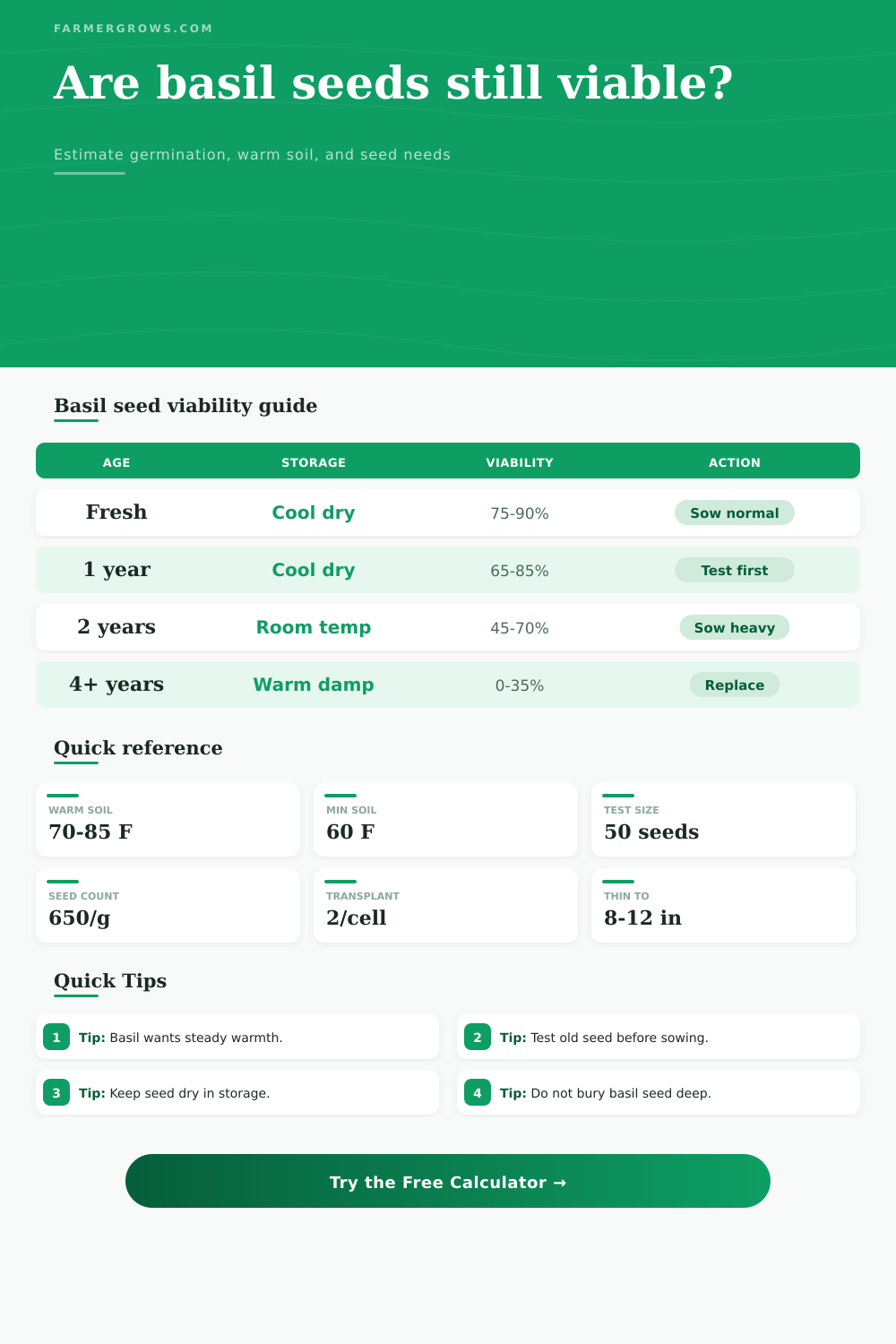
| Seed age | Cool dry | Room dry | Warm humid |
|---|---|---|---|
| Fresh | 80-95% | 75-90% | 60-80% |
| 1 year | 75-90% | 65-85% | 45-70% |
| 2 years | 65-85% | 50-75% | 25-55% |
| 3 years | 50-75% | 35-60% | 10-35% |
| 4+ years | 30-60% | 15-45% | 0-25% |
| Soil temp | Speed | Stand risk | Action |
|---|---|---|---|
| Below 60°F | Very slow | High | Wait |
| 60-64°F | Slow | Medium | Sow extra |
| 65-69°F | Fair | Medium | Cover warm |
| 70-85°F | Fast | Low | Ideal |
| 86-90°F | Fast | Medium | Watch drying |
| Basil type | Seeds/g | Thin to | Use |
|---|---|---|---|
| Genovese | 650 | 8-12 in | Leaves |
| Thai | 620 | 8-10 in | Stems |
| Lemon | 700 | 6-10 in | Herb beds |
| Holy basil | 590 | 10-14 in | Tea |
| Dwarf basil | 720 | 4-8 in | Pots |
| Target | Plants | Seed rate | Note |
|---|---|---|---|
| 72-cell tray | 72 | 1-2/cell | Transplant |
| 20 ft row | 24 | 2-4/in | Thin later |
| 12 patio pots | 12-24 | 3-5/pot | Keep best |
| 10x20 tray | Dense | 8-12 g | Microgreens |
| Old packet | Any | Test first | Sow heavy |
For basil transplants, start seeds on a warm mat or in a consistently warm room, then move seedlings to strong light after germination.
If basil seed was kept in a hot shed or humid greenhouse, trust a germination test more than the packet date before sowing a full tray.
🧪Current lot metrics
Basil seeds is not simply one thing or another; it is not a simple matter of being either dead or alive. There’s a continuum of vitality (or “vigor,” as seed-savers say), which varies depending on soil temperature now and where you store them. Plug in your test results and storage history into the calculator up top, and let it do the math for you. Saving you from having to guess how aggressively or cautiously to sow.
Seeds do die with age… but they also dies faster when kept too wet. A few-year-old pack that’s been stored in a cool, dry location is likely to do better than a freshly purchased pack that’s sat in a damp basement or shed for half a year. The enemy of seed are heat, which hastens metabolic breakdown within the embryo, but also moisture, which promotes both physical rot and mold. So don’t trust the date on the envelope; if yours have been hanging out in a damp basement or a hot car, they may be toast. Run a germination test first (see below).
How to Grow Basil Seeds Successfully
Wrap a sample of 50 seeds in a moist paper towel and keep at warm conditions for a week. See what percentage come up properaly. THAT number will be your true best guess…and much more accurate then any blanket advice.
There’s also a certain temperature threshold that serves as a kind of gatekeeper for basil: Below 60 degrees Fahrenheit, it pretty much hits the pause button. In fact, the seeds may stay alive but dormant for weeks or even longer. They may slowly rot where they fell without ever emerging. You are then left wondering what went wrong.
The sweet spot begin at about seventy degrees; the peak would of been around eighty-five degrees. Why time matter, and why the timing can be such a critical factor in an early spring garden. You won’t have much luck sowing directly into cool soil if you try. But that’s where the tool comes in: When you input your soil temperature, it figures in the likely emergence rate accordingly. This reminds you that warmth is only useful if you keep the seed consistently moist, without letting it dry out until emerging root system is established to prevent the hard outer coat from cracking open too soon.
Basil, for example, isn’t quite one-size-fits-all, either. Genovese is pretty typical stuff, but Holy and Thai basil varies quite a bit. Dwarf types might also have their own preferred spacings, which affects how much seed you’ll want to buy. You can choose your exact variety from the calculator, which will then reflect the recommended thinning interval (as well as the seed-to-gram ratio). That is not a big deal unless you are planting pots for your own patio instead of a dense tray of microgreen.
Still, we tend to panic about sowing tiny seeds and end up over-sowing them anyway. This create weak seedlings and requires a lot of later thinning.
How long does it last? Surprisingly, quite a bit depend on storage containers. An open paper envelope shoved in a drawer just isn’t as good as a sealed jar containing a desiccant packet. It all comes down to atmosphere: How fast will moisture reach equilibrium with the air around it? In a humid climate (and even indoors) things stored uncapped can be iffy. A frank look at where your stash has been stashed will provide more insight into what to expect. Maybe your two-year-old seeds are still sprouting strong because you’d stashed them cool and dry, sparing you some cash on fresh packets.
So to plan on being successful with basil, or really any seed, it boils down to taking control of the situation. Of your environment, and keeping realistic expectations. There’s no way to alter the seed itself (except its age) so you want to work with what you have.
Try a tiny amount first. There’s no guessing, and there’s also no wasting all those seeds if nothing sprouts. Better to learn early rather than spend weeks looking at empty cells. Get a few seeds going in warm medium, give ’em time and see what happens…and then go big or go home.
That’s how to honor the biology of the plants we are helping into growth, as well as the unknown nature of old seed stock. Be patient. Both your pantry and your garden will be happier for it. And soon enough, the fresh leaves that result will appear.