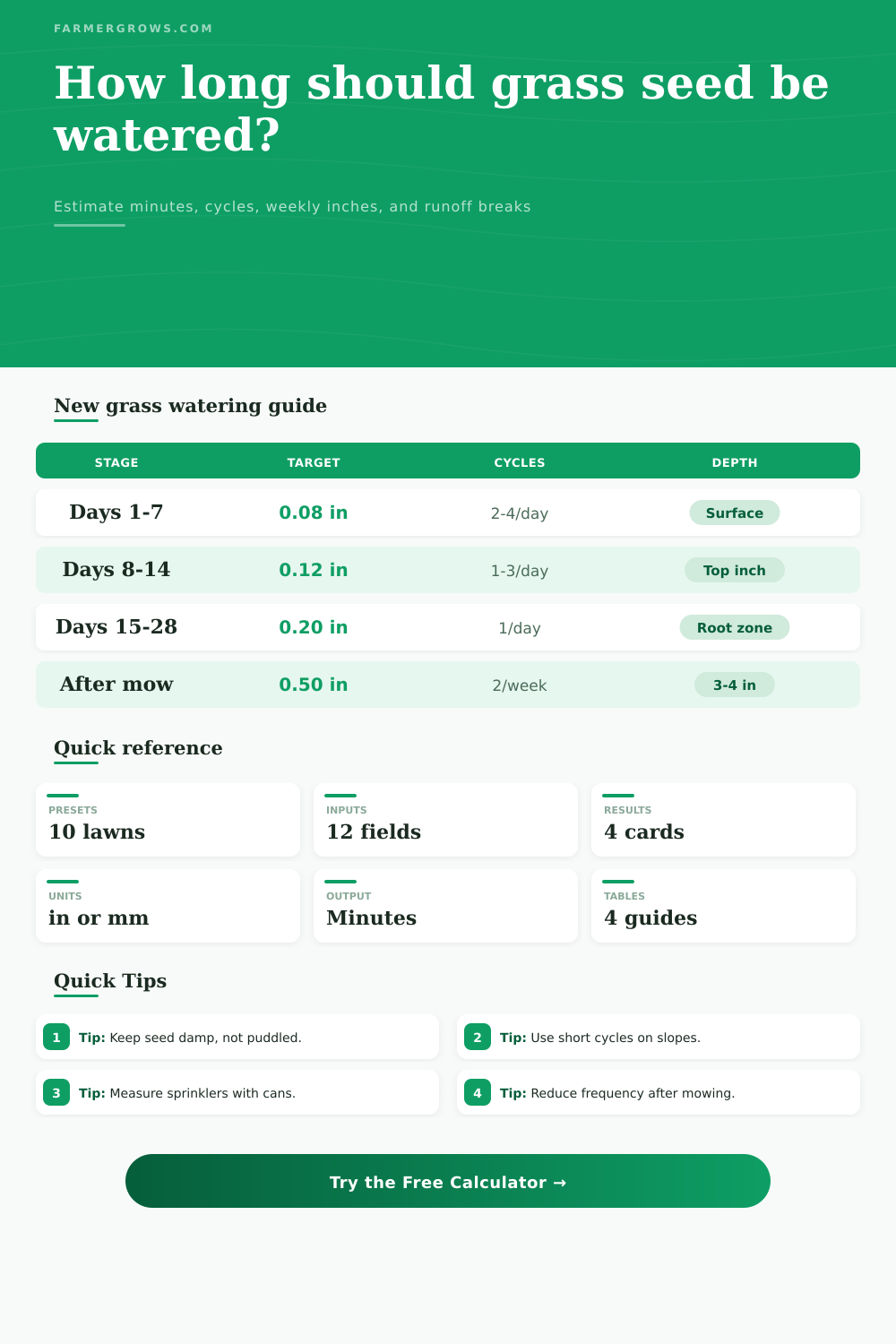
Grass Seed Watering Duration Calculator
Estimate watering minutes for newly seeded grass using lawn area, sprinkler rate, seed stage, soil texture, weather pressure, slope runoff risk, and weekly water targets.
📋New grass watering presets
Choose a realistic starting point, then adjust the sprinkler rate, seed stage, soil, slope, and weather pressure to match your yard.
🌱Lawn area and sprinkler inputs
Measure sprinkler output with straight-sided cans for 15 minutes, then convert that catch to inches per hour or millimeters per hour.
💧Seed stage, soil, weather, and runoff
New seed usually needs short, repeated watering until germination. As seedlings root, the calculator shifts toward deeper and less frequent watering.
Watering duration plan
Calculated from sprinkler output, soil intake, seed stage, weather pressure, and runoff risk.
Calculation breakdown
📊Watering performance snapshot
These values translate the schedule into practical field checks: area covered, depth per cycle, runoff risk, and weekly depth.
| Stage | Daily depth | Cycles | Goal |
|---|---|---|---|
| Days 1-7 | 0.06-0.12 in | 2-4 per day | Keep surface damp |
| Days 8-14 | 0.10-0.18 in | 1-3 per day | Moisten top inch |
| Days 15-28 | 0.15-0.30 in | 1 per day | Train shallow roots |
| After first mow | 0.35-0.60 in | 1-2 per week | Deepen root zone |
| Soil | Intake | Cycle cap | Watch for |
|---|---|---|---|
| Sand | Fast | 10-15 min | Drying between cycles |
| Loam | Moderate | 8-12 min | Even darkening |
| Silt | Moderate slow | 6-10 min | Surface sealing |
| Clay | Slow | 4-8 min | Puddles and sheen |
| Compacted | Very slow | 3-6 min | Runoff trails |
| Rate | 0.10 in | 0.25 in | 0.50 in |
|---|---|---|---|
| 0.25 in/hr | 24 min | 60 min | 120 min |
| 0.40 in/hr | 15 min | 38 min | 75 min |
| 0.60 in/hr | 10 min | 25 min | 50 min |
| 0.90 in/hr | 7 min | 17 min | 33 min |
| Weather | Weekly add | Frequency | Field cue |
|---|---|---|---|
| Cool or cloudy | -15% | Lower | Soil stays dark |
| Mild | Base | Normal | Surface lightens slowly |
| Warm sunny | +20% | Higher | Edges dry first |
| Hot or windy | +40% | Highest | Surface crusts fast |
Place several straight-sided cans in the seeded zone, run the sprinkler for 15 minutes, average the water depth, then var the calculator convert it into hourly rate.
If water shines on the surface or moves downhill, split the same total runtime into shorter cycles with 20 to 45 minute soak breaks.
This tool estimates irrigation duration for newly seeded lawns. Local restrictions, rainfall, soil amendments, seed mix, and sprinkler overlap can change the final timer setting.
So what happens? You sow the seed, give it one thorough watering (with the best of intentions), and assume that nature will do its thing from there on in. What actualy occurs is that your lawn become a dusty, sorry excuse for a lawn.
While new grass seed doesn’t want to be soaked, it does need moist conditions at surface level, but not soggy. Timing, not amount… Is everything: Getting the timing right is what makes the difference between a blank canvas and a luscious green carpet. It’s amazing how many people overwater or drown their lawns. Most of us thinks all grass is the same, regardless of its growth stage or type of soil.
How to Water New Grass Seeds
Plug in your sprinkler rate and area, and the calculator (above) does the math for you… No more guesswork about converting or coefficients. It’s not enough to simply pour that stuff onto the dirt; you have to know how fast that particular soil can absorbs water. If it’s sandy, it’ll drink up eagerly but won’t hold much, so maybe you should do short bursts several times daily, not one long one that all runs off down street. With clay, it’s the reverse: That stuff seals up fast, creating puddles that smother seeds. By suggesting breaks in the cycles, the tool considers such factors so you can give it time to soak in between.
Catch-can testing is the most under-rated part of lawn care. Why? Everyone believes what’s printed on the label of his or her sprinkler head. But that label is based off flat ground and perfect pressure. You’ve got a few tree in there. You also have some hoses and nozzle that are not quite lined up. Put some straight-sided cans around the area where you’re seeding, turn it on for 15 minutes and average the results from your catch-cans. That real world number will beat any theoretical spec sheet. Without this test, all your runtime calculations will be educated guesses (and more often than not), wrong.
The delicate first week or two: Once a seed begins to germinate, its first impulse is to get a little extra moisture on the surface. It must then start to swell, crack open, and release. This requires just enough moisture to “get going,” rather than enough to grow a root yet. Keep it moist, but don’t drench (though if you have sandy soil or a heatwave, adjust your timing and frequency).
This changes once sprouting begins and there are some actual roots formed, and they’re shallow. Now you want to coax them downward, so your watering routine become slightly more generous but less frequent to help support their hold in the ground. That’s when things shift, which usually coincides with initial mowing cut.
Weather makes all the difference. You might have a mellow spring day that requires baseline watering; then a hot, windy afternoon can evaporate moisture before it penetrates an inch into the soil. The calculator factors in all that with its adjustment to the target each week, according to what kind of weather you choose. What happens if you don’t change the settings from the default during a heat wave? Well, you’re taking a gamble with your new lawn.
First check around the edges of the lawn to see how fast it dries. Pay close attention to areas that are exposed or have runoff. Is it getting lighter-colored then the rest of the lawn? Then your water isn’t spreading evenly, or the sprinklers aren’t running long enough around the edges. Slopes exacerbate all these issues, since they also increase runoff risk. The paradox is that you want more water, yet you have less time between each cycle or you will lose it running down the slope before it soaks in.
Enter the cycle and soak tactic: Divide an hour’s worth of runtime over ten-minute increments with rest periods in between. Your timer will click off again and again. Seems inefficient; but it’s how you trick the compacted ground to take up water while minimizing runoff from washouts, preventing you from wasting your seed investment.
This is further complicated by slopes, where gravity is not on our side. A gentle slope may only require a little tweaking, but a steeper grade calls for some patience. We want to deliver moisture when they needs it without causing the surface to seal (a short cycle). So it seems like we’re pulling twice as much weight for half of the effect. In truth, it’s staying down in the root zone and not running out into your gutter.
It’s more read-your-soil than read-a-chapter kind of lawn care: Light soil? Thirsty. Dark soil? Saturated. A crust? Poor infiltration; break it up, or shorten cycle times. Your eyeballs are the adjusting tool; the chart is a good place to start from. Make sure the seeds stay moist, but not puddle-wet. And let the roots do the work. That would of been the simple rhythm for going from scattered grain to green grass.