Roundup to Grass Seed Wait Calculator
Estimate the first grass seed date after a completed Roundup or glyphosate treatment using the exact product label interval, application date, rainfall or irrigation notes, soil disturbance, reseeding type, and your chosen safety buffer.
1Choose a waiting scenario
Presets only fill timing assumptions. Always replace the label interval with the number printed on the exact container, booklet, or PDF for the product used.
2Enter the label interval and dates
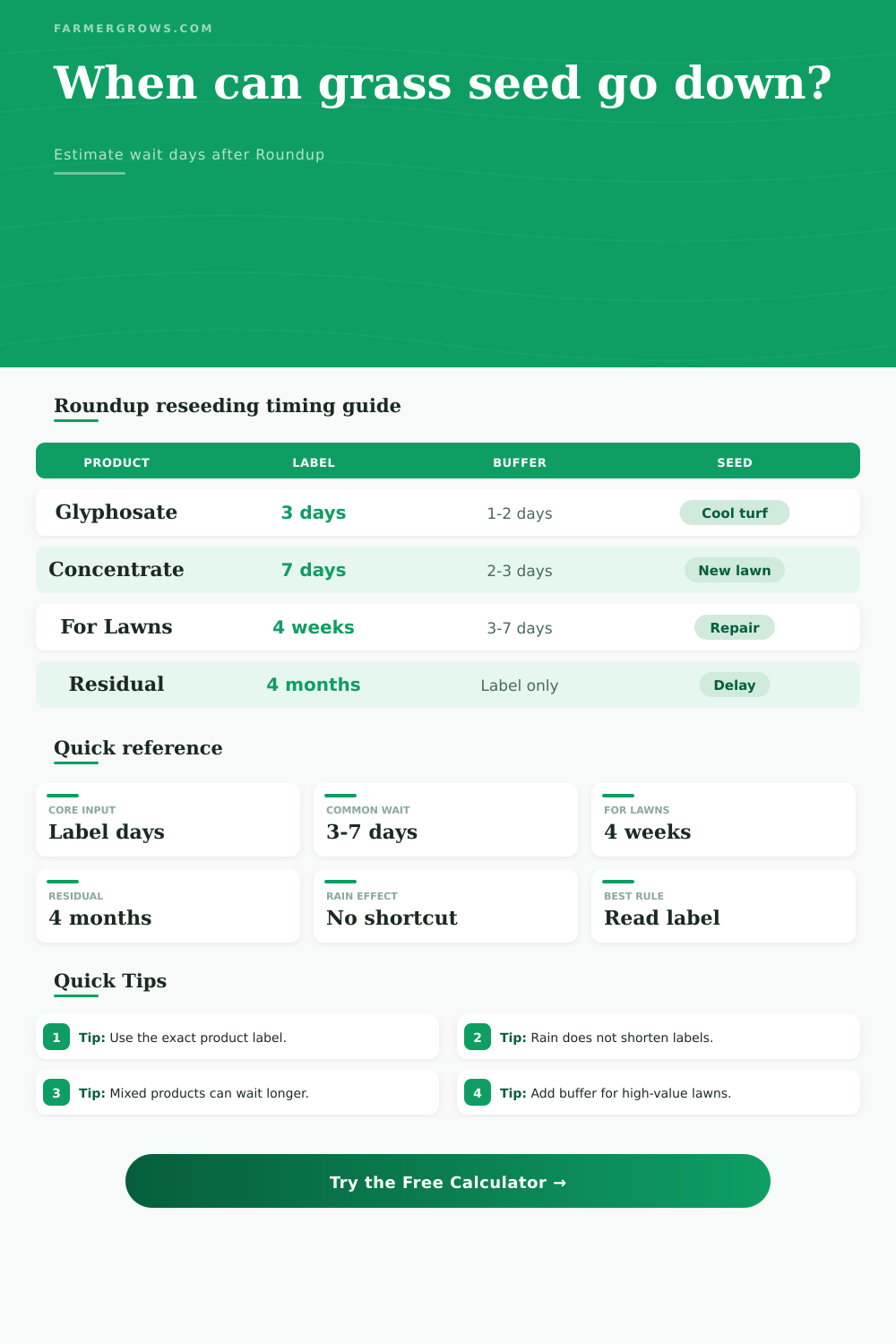
This tool starts from the product label interval. Rainfall, irrigation, and soil work can add planning margin, but they do not make the label wait shorter.
3Add site timing factors
Roundup to grass seed timing result
Your label-based seeding date will appear after calculation.
Timing breakdown
4Timing signals to review
5Label interval reference tables
| Product wording | Grass seed wait | Calculator use | Important caution |
|---|---|---|---|
| Glyphosate-only weed and grass killer | Often 3 days for lawn grasses | Enter 3 if your exact label says 3 | Do not use this if the product has residual actives |
| Some glyphosate concentrate or brush labels | Often 7 days for grasses | Enter the printed number | Concentrates and use sites can differ |
| Roundup For Lawns type products | May say 4 weeks before seeding | Enter 28 days | These are not glyphosate-only products |
| Extended control or vegetation preventer | May require months | Enter label month equivalent | Residual herbicides can injure new grass |
| Factor | Can shorten label? | Possible extra days | Reason |
|---|---|---|---|
| Rain or irrigation | No | 0 to 3 | Only affects seedbed readiness |
| Soil disturbance | No | 0 to 2 | Allows time for grading or firming |
| Reseeding type | No | 0 to 3 | Full renovations need more cushion |
| Label uncertainty | No | 0 to 14+ | Exact label prevents product mixups |
| Label wording | Days to enter | Use when | Notes |
|---|---|---|---|
| 24 hours | 1 | Label explicitly says one day | Add your own buffer if desired |
| 3 days | 3 | Common lawn grass reseeding line | Do not round down |
| 7 days | 7 | Some labels or conservative use | Good for uncertain concentrates |
| 4 weeks | 28 | Some non-glyphosate lawn products | Week counts are calendar days |
| 4 months | 120 | Residual or extended control labels | Use exact label if it defines months |
| Status | Meaning | Suggested action | Risk note |
|---|---|---|---|
| Too early | Target is before calculated date | Move seed date later | Label or buffer is not met |
| Exact date | Target equals calculated date | Review label one last time | No spare calendar margin |
| Ready | Target is after calculated date | Seed schedule fits timing | Weather can still matter |
| Late window | Target is safe but seasonal risk rises | Prioritize grass timing separately | Heat or frost can affect stand |
6Timing reminders
The label interval is the minimum legal and safety anchor for this calculator. If the package, booklet, or current label says a different number, use that number.
Some Roundup-branded products are not glyphosate-only. Lawn weed killers and extended-control products can require weeks or months before seeding.
Rain, sprinklers, or a damp seedbed do not erase the printed reseeding interval. The calculator only adds time when wet soil may delay seedbed work.
A target date after the calculated date satisfies the timing plan, but grass establishment still depends on seed quality, soil temperature, moisture, and season.
I am hoping to sow seed on Tuesday after I’ve sprayed weeds one Saturday morning. Oh, except that label says I need to wait four weeks, not three days. Now it’s a long-waiting game, more then a fast weekend chore. Reading the directions first can makes all the difference between success or failure.
Enter your own product interval into the calculator and it does the date math for you. You no longer has to count the days yourself. You’ll see exactly where your target seeding date fall within the safety margins.
Why You Should Read the Label Before Seeding
The confusion begin, as it so often does, at name on label. Many consumers think that since bottle says Roundup, it is just glyphosate. They believe it is safe to seed immediately after use because it breaks down fast enough. They fail to see active ingredients (those are the ones below the trade name). Usually, glyphosate formulas means waiting three or seven days to seed (depending on how concentrated formula is).
But those products labeled specifically for lawn care will has other herbicides added. These is residual herbicides meant to prevent future weeds from sprouting for several weeks. And they’ll also kill your seed if you sow too early. That’s why the tool have options for selecting what type of product it is. That way you’re getting the right baseline wait time, based off real chemistry instead of general guesswork.
Rain is another reason for early action or unnecessary panic. Many assume that if it’s really raining hard, herbicides will be washed down into soil in no time, so they’re safe to go ahead and sow early. But rain doesn’t accelerate the interval listed on labels. It may carry the active ingredients deeper into roots, but it doesn’t make the safety clock start over because there was a soaking rain. And sometimes muddy conditions can makes it harder to get things ready properley. Do not rake or till over mud!
The calculator has a place to account for both soil disturbance and rainfall, which allows for reasonable buffers to reschedule if it rains too much. Add an extra day or two if there’s lots of rain and then you till; otherwise you could of end up trying to seed on the day when soil is still too sloppy.
Labeling is absolute minimum. That’s the earliest you can safely get it planted. Otherwise, it violates rules of the game (the app) or risks harming young grass through chemical damage. In other words, labeling is the minimum requirement, not a recommendation. If you have an extra two to three days, give soil more time to firm up from being disturbed. Let any leftover surface material blend in completely so it doesn’t stop good seed-to-soil contact. This isn’t a bad thing; its an inexpensive form of insurance against uneven germination.
If this is an expensive renovation project, or if the turf have value, adding even more to this safety margin may mean avoiding a pricey overseed operation come fall. But there’s another added problem, one that’s not related at all to herbicide chemistry: Seasonal timing. Are you racing the calendar on this one? For instance, is your target date approaching late summer heat or early fall frost? Then you’re really up against both chemical limits and biological ones.
The calculator can helps you see whether your back-of-the-envelope wait period will put you beyond the best seeding window. And if so, that means that you’ll be in a true trade-off situation. You must either stick to the safety window for the herbicide, or risk poor establishment by planting despite its advice.
To be fair, all this is explained clearly in the reference tables on page layout, which avoid drowning you in legalese. It show you at a glance where products fall into their families. It explains why knowing whether it’s in weeks or days make a difference. It also points out that certain product families does one thing different than another. Knowing precisely what is in the bottle is first step toward making your plan to repair your lawn.
Read the labels, know the active ingredients. Know the range of when it is good for seeding. Specifically, find the reseeding interval for your kind of grass, not just anything growing. Trust the math to tell you when to go next. Don’t rush things because you are eager to see results, or you will hurt your new lawn.
The reward for waiting patiently will be a thicker, even stand of grass…one that will endure the coming winter.