Cilantro Seed Sprouting Time Calculator
Estimate when cilantro seeds should crack, push their first shoots, and build a usable stand based on soil temperature, seed age, depth, moisture, and pre-sowing treatment.
📋Cilantro sowing presets
Choose a realistic cilantro sowing setup, then adjust the seedbed details. Presets are built around coriander seed behavior in cool, warm, and stressful conditions.
🌱Seedbed inputs
Use the temperature at seeding depth when possible. Cilantro sprouts fastest in cool to mild soil and slows sharply when too cold, too hot, dry, old, or buried too deep.
Cilantro sprouting estimate
Calculated from your cilantro seedbed conditions.
Full sprouting breakdown
📊Current seedbed indicators
🔍Comparison grid
Compare the current setup with nearby changes. Cilantro often responds more to temperature and seed preparation than to extra fertilizer at germination.
📚Cilantro sprouting reference tables
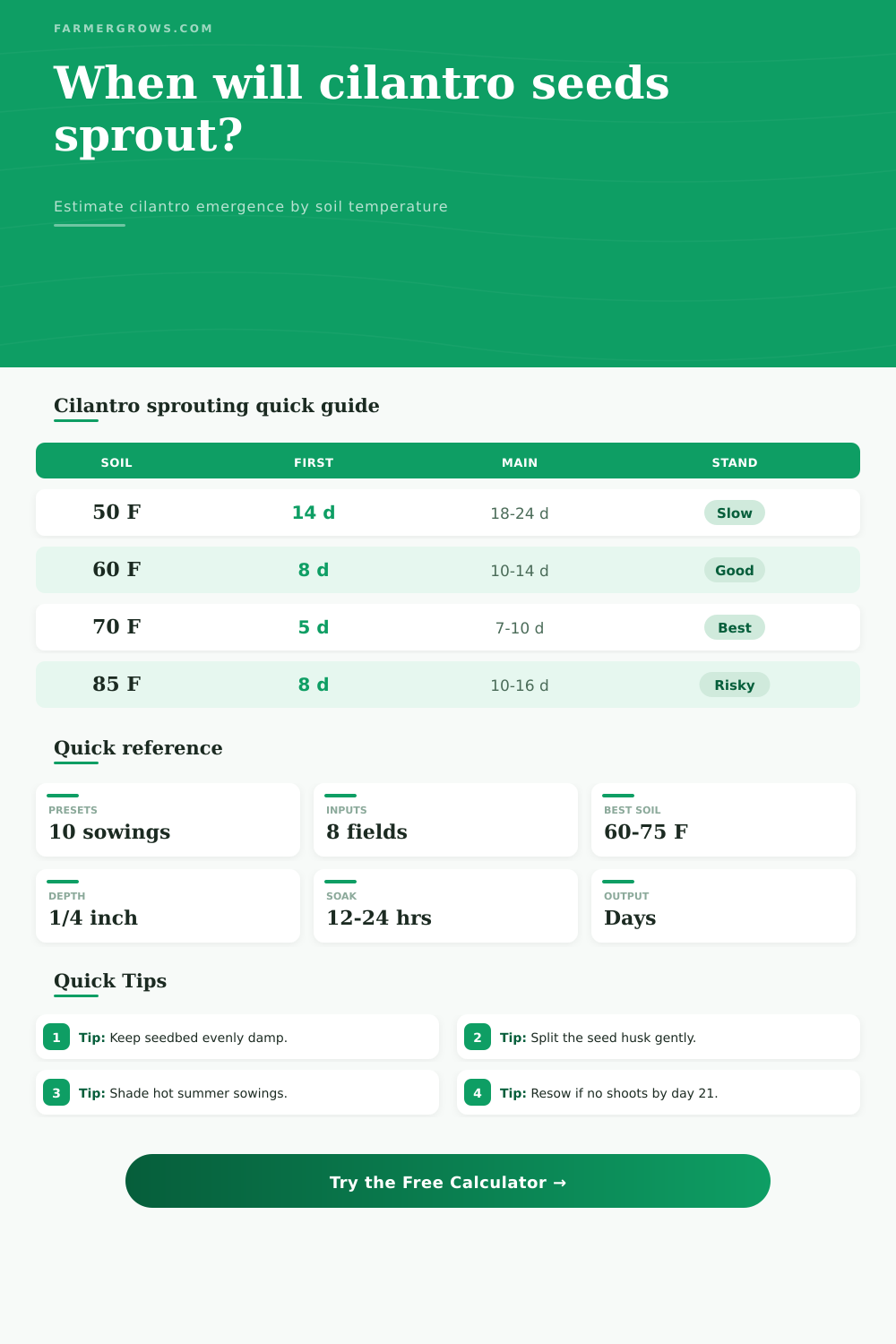
| Soil temp | First shoots | Main window | Notes |
|---|---|---|---|
| 45–50°F | 14–20 days | 18–28 days | Slow and uneven; protect from cold crusting. |
| 55–60°F | 8–12 days | 10–16 days | Good for spring and fall direct sowing. |
| 65–75°F | 4–7 days | 6–10 days | Fastest practical cilantro emergence range. |
| 80–85°F | 7–11 days | 10–18 days | Use shade; seed may stall if surface dries. |
| 90°F+ | 10+ days | Patchy | Heat stress reduces germination and favors bolting later. |
| Seed condition | Timing effect | Stand effect | Best use |
|---|---|---|---|
| Fresh current-season packet | Baseline | Strong | Garden rows, trays, succession sowing. |
| 1 year cool dry storage | Add 1 day | Slight dip | Reliable if sealed and dry. |
| 2 years sealed storage | Add 2–3 days | Moderate dip | Sow thicker or test a sample. |
| 3+ years or unknown | Add 4+ days | Weak | Pre-sprout or sow heavily. |
| Pantry coriander seed | Variable | Uncertain | Use only if whole, unroasted, and fragrant. |
| Setting | Target | Risk if off | Correction |
|---|---|---|---|
| Depth | 1/4 in | Deep seed emerges slowly. | Cover lightly and firm. |
| Surface | Fine seedbed | Crust traps shoots. | Use compost or vermiculite. |
| Moisture | Evenly damp | Dry swings delay germination. | Water gently and often. |
| Airflow | Fresh but not windy | Soggy trays rot; wind dries beds. | Vent domes and shade beds. |
| Heat | Mild soil | Hot soil gives patchy stands. | Use shade cloth or sow evening. |
| Method | Usual first shoots | Main use | Watch point |
|---|---|---|---|
| Indoor cell tray | 5–8 days | Transplants for cool weather | Avoid root disturbance. |
| Direct garden row | 7–14 days | Leaf cilantro and coriander seed | Keep row evenly damp. |
| Raised bed broadcast | 6–12 days | Dense cutting patch | Thin if stand is crowded. |
| Microgreens tray | 4–7 days | Cilantro shoots | Pre-soak for uniform trays. |
| Hydro mat or plug | 4–8 days | Controlled indoor starts | Do not var mats dry out. |
Whole cilantro seed is a small dry fruit. Lightly rubbing or cracking the husk can expose both seed halves and improve uniformity, but crushing the embryos can reduce stands.
If a prepared, moist sowing shows no cilantro shoots by the calculator's check date, scratch a small section open before resowing to see whether seed rotted, dried, or stayed firm.
This calculator estimates cilantro emergence timing, not final harvest date. Weather, seed lot, salt levels, and soil crusting can move real stands earlier or later.
The problem is that cilantro seeds come wrapped in a tough outer husk. Nothing happens for a week or so; you think your soil is hiding it from you, waiting for it to sprout. In fact, the husk is just protecting the seed’s embryo inside while blocking its water uptake until conditions are just right.
If you don’t take into account moisture and temperature, germination will seem random. Know those factors, and you can predict it. After entering your soil conditions, the calculator up top does the math for you, no guesswork about temperature fluctuations affecting growth.
How to Grow Cilantro Seeds Easily
First: Check the heat of your soil, since cilantro prefers growing in cool soils (sixty to seventy-five degrees Fahrenheit). If it’s cooler than that, your seed will wait. If it is warmer than eighty-five degrees, the plant will be stressed and may go dormant, emerge occasionally, or not at all.
And then there is fact of age of your seed: Fresh packets are generaly more viable then older ones from the pantry. Take the cilantro example. Of all the herbs, cilantro’s seed (technically a dried fruit containing two seeds within a hard covering) benefits most from seed prep. If you break open the shell first, it no longer has that barrier to water uptake. And when does it matter? At emergence time; when it realy matters. Breaking open the shell before planting really hastens emergence…as does soaking for a dozen or two hours beforehand.
That’s why some of you got your shoots in five days and others took two weeks at the same soil temperature: Because if you used primed seed, the calculator timed its estimate accordingly. Luck had little to do with it. It mostly depended on who prepared their seeds most.
This is what the Cilantro Calculator looks like: And here’s what the Cilantro Calculator says: Many plants are picky about when they emerge (see also the topic: Seedling Emergence). Cilantro especially dislikes inconsistent moisture levels. While it is emerging, the top layer of soil must be moist but never soaked. When it dries up to the quarter-inch level, the seed will shrink and die even if there’s water below that depth. Rot occurs with standing water before air reaches the root. Patchy stands occur when moisture is uneven (see the reference tables on this page). Patches appear as failure, not just something that needs reseeding.
Depth plays a supporting role. Too-deep planting requires more energy for the small shoot to find daylight. That robs reserves until the plant can start photosynthesizing. In raised beds and garden rows, shallow quarter-inch coverage are best.
Instead of a day, it will give you a range for when things may emerge. No two beds of soil is exactly the same because one part is denser and another is warmer. It could be that some of your seed will emerge on day five, with the majority following on day 10. Plan for the latter end of that range so you don’t panic too soon.
When the check date rolls around (in the results above), if there’s still nothing there, check the seeds (don’t water again! To do this), scratch open a little area and have a look. Are the seeds white and swollen? They are just slow. Are they mushy? Rot took them down. Are they hard as a rock and still dry? Never did get hydrated well enough.
Knowing such timing factors allows you to succession plant with greater ease; staggering sowings not just by calendar date but by the likely days to emerge. That way you’ll have a steady supply (rather than everything bolting simultanously as it would of if you’d had only one big crop in warmer weather). The calculator takes into account how temperatures change throughout the season and helps you plot out those intervals. You will have less guesswork and less worrying while you wait. Either way, knowing your timetable give you more peace of mind.
It’s not “just wait” any more; now it’s “wait smart.” Instead of sitting there gaping at an empty patch of earth, you’re intervening when environment is aligned for growth. Warmth. Water. A cracked shell. Water. A broken surface. If you get these three things right, the seed doesn’t give a hoot about what time it is…but it will act predictably if its shell is crackable, when temperatures is warm enough, and when moisture is present. Once you have these three under control, an annoying chore becomes a controllable system. Before long, out pops those shoots of green on the day you knew they’d be coming.
Nature, apparently, is predictable…if only you’ll stop acting as though it’s a riddle.