Kale Germination Time Calculator
Estimate kale sprout timing, full stand timing, expected emergence, and transplant calendar from soil temperature, seed age, sowing depth, moisture, and seedbed conditions.
📋Kale germination presets
Start with a realistic kale sowing setup, then tune the temperature, seed lot, depth, and seedbed details to match your tray or garden bed.
🥬Germination inputs
Kale usually germinates quickly in cool-to-mild conditions. The estimate below adjusts for the actual seed zone temperature, seed age, depth, moisture, seed contact, and row cover.
Kale germination estimate
Calculated from seed temperature, depth, moisture, seed age, and seedbed contact.
Full breakdown
📊Current condition comparison
This grid compares your current setup with cooler, warmer, and ideal kale germination conditions using the same seed age, depth, moisture, and seedbed assumptions.
🌱Kale germination condition grid
Kale seed germinates best when the top layer stays evenly moist. Mist trays or use a light cover so shallow seed does not dry before the radicle emerges.
For uniform starts, measure the seed zone. A cool room with a warm mat can germinate much faster than the air temperature suggests.
📚Kale reference tables
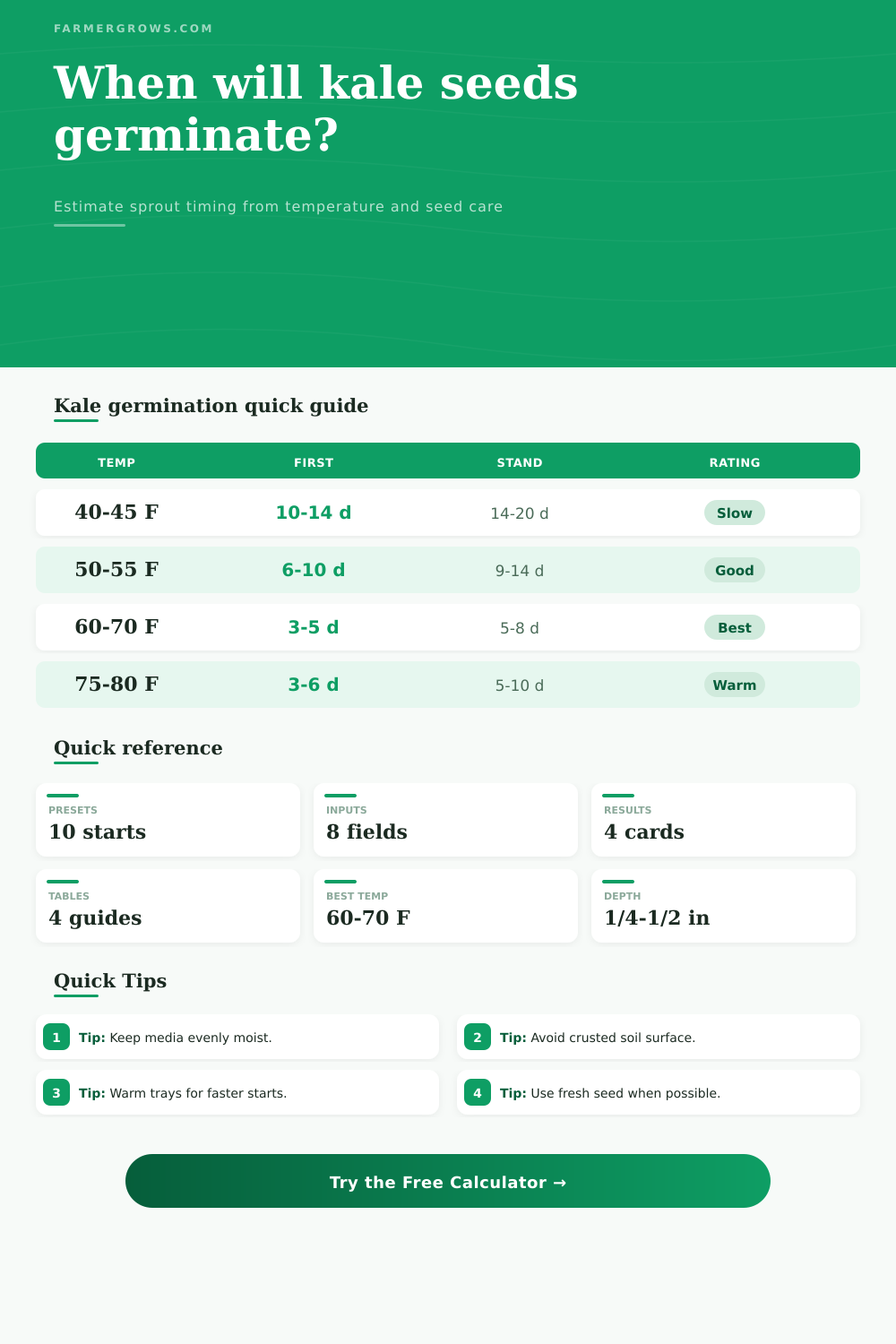
| Seed zone | First sprouts | Full stand | Notes |
|---|---|---|---|
| 40-45°F / 4-7°C | 10-14 days | 14-20 days | Viable but slow; protect from crusting. |
| 50-55°F / 10-13°C | 6-10 days | 9-14 days | Good for early direct sowing. |
| 60-70°F / 16-21°C | 3-5 days | 5-8 days | Fast, uniform kale germination range. |
| 75-80°F / 24-27°C | 3-6 days | 5-10 days | Still workable; avoid drying and heat stress. |
| 85°F+ / 29°C+ | 5-9 days | 8-14 days | Warm enough to reduce uniformity. |
| Seed age | Typical vigor | Time effect | Stand effect |
|---|---|---|---|
| Fresh | High | Baseline | 90-95% |
| 1 year | High | No change | 88-93% |
| 2 years | Good | +5% | 82-90% |
| 3 years | Fair | +15% | 70-82% |
| 4+ years | Variable | +30% | 45-70% |
| Depth | Metric | Rating | Use case |
|---|---|---|---|
| Surface | 0 cm | Risky | Only with blackout or humidity cover. |
| 1/8 in | 0.3 cm | Shallow | Fast trays, but dries quickly. |
| 1/4 in | 0.6 cm | Best | Most kale trays and fine beds. |
| 1/2 in | 1.3 cm | Good | Outdoor rows with steady moisture. |
| 1 in | 2.5 cm | Slow | Too deep for many small-seeded brassicas. |
| Scenario | Temp | First sprouts | Move or thin |
|---|---|---|---|
| Indoor cell tray | 65-70°F | 3-5 days | Bright light at emergence. |
| Direct spring bed | 50-60°F | 5-9 days | Thin after true leaves show. |
| Low tunnel winter | 42-50°F | 9-15 days | Vent sunny afternoons. |
| Microgreens tray | 68-74°F | 2-4 days | Uncover at lift stage. |
| Fall baby leaf flat | 60-68°F | 3-5 days | Keep evenly moist. |
Calendar outputs are estimates for planning. Soil crusting, seed storage, pathogens, droughty media, and temperature swings can move kale emergence outside the calculated range.
How successful is your seed germination? Most gardeners judge themselves against the percentage of germination indicated on the seed packet: ninety-five percent guaranteed, so get it home and watch it happen in the soil. Not actualy. In fact, comparing what happened in the lab to what sprouted for you here are a test of your own temperament.
This is especially true for cool-season crops such as kale. Its greens is easy to forgive once they are up and running, but they are not always easy to start unless conditions are near-optimal. Here’s how to understand what makes one seed leap fast and another stay asleep, even in seemingly similar circumstances, where soil matters more than the overall weather picture.
How to Make Kale Seeds Grow Well
Germination rate depend on temperature (but most people only monitor air temperature without accounting for ground temperature). The above calculator use actual ground-zone temperature, rather than using a room thermostat. Because brassicas are relatively hardy to cooler weather, they will germinate in cool soils, but don’t assume that cool also means slow, if conditions stay moist, low temps aren’t always problematic. Use a soil-probe thermometer to get a read. Even if it’s warm in your house where the seed tray sits, those seeds might take twice as long to pop if they’re on a chilly concrete floor. Waiting longer gives soil-born pathogens more opportunity to attack weak seeds before they pop open. Better to go a little slower than risk shocking tender young root system with heat spiking.
When it comes to small seeds, how deep you plant makes a difference. Because kale seeds have little fat stored in their cotyledons, they lacks the energy to penetrate thick soil before those reserves run out. Planting too deeply, though there will be no visible symptoms, will diminish vigor. Half-inch-deep sowing is difficult; the weight of the dirt plus the surface tension of the water present substantial obstacles compared than a quarter inch. Soil that’s fine-textured can span the distance better because it promotes good contact between seed coat and moist particles… Quickly and evenly promoting imbibition.
Another variable: Are the seeds old? Cool, dry storage extends brassicas’ life considerably (years), though it is not a simple matter of them being alive or dead; their strength fades more quickly than those measures suggest. You might get plants from even a 4-year-old packet, but they won’t all come up at once or evenly. They will grow in a messy way, as if they were planted far apart, rather than the packet being bad. That’s reflected in the tool, which reduces the number you expect to see emerge based off how long the seeds have been around, and thus gives you a realistic estimate of the count, not a hopeful one.
The last detail is moisture management. Uneven stands result when the soil crusts up. When it does, moisture evaporating on the surface draws clay and silt particles together into a tight seal, appearing harmless but behaving more like concrete to an embryonic shoot. Preventing such a crust requires keeping the soil surface always moist (but not sodden; be careful in the root zone!). To help maintain that happy medium, use a row cover (or even just a humidity dome) to slow evaporation, yet allow gas exchange. This is a very simple way to protect against weather changes inside your house (humid one day, bone dry the next) or outdoors (windy days versus calm).
See the reference table to see what happens when these variables are combined in each temperature band. So, it’s not just when but how you time your sowing, in tune with the warming trend where you live, not pushing yourself into cold soil, which doesn’t work as well. Kale asks for a soft touch, not force.
Once you know that the trick is keeping conditions steady enough till the seedling pops out from the soil, less anxiety sets in. No more staring at the ground; now you’re regulating temperatures and moisture deliberately. And your hard work pays off with a strong, thick population that repays thoughtful preparation. When you make good starts, it feels effortless, because this is basic physics working on livig things. You should of known that when you make good starts, it feels effortless, because this is basic physics working on living things.