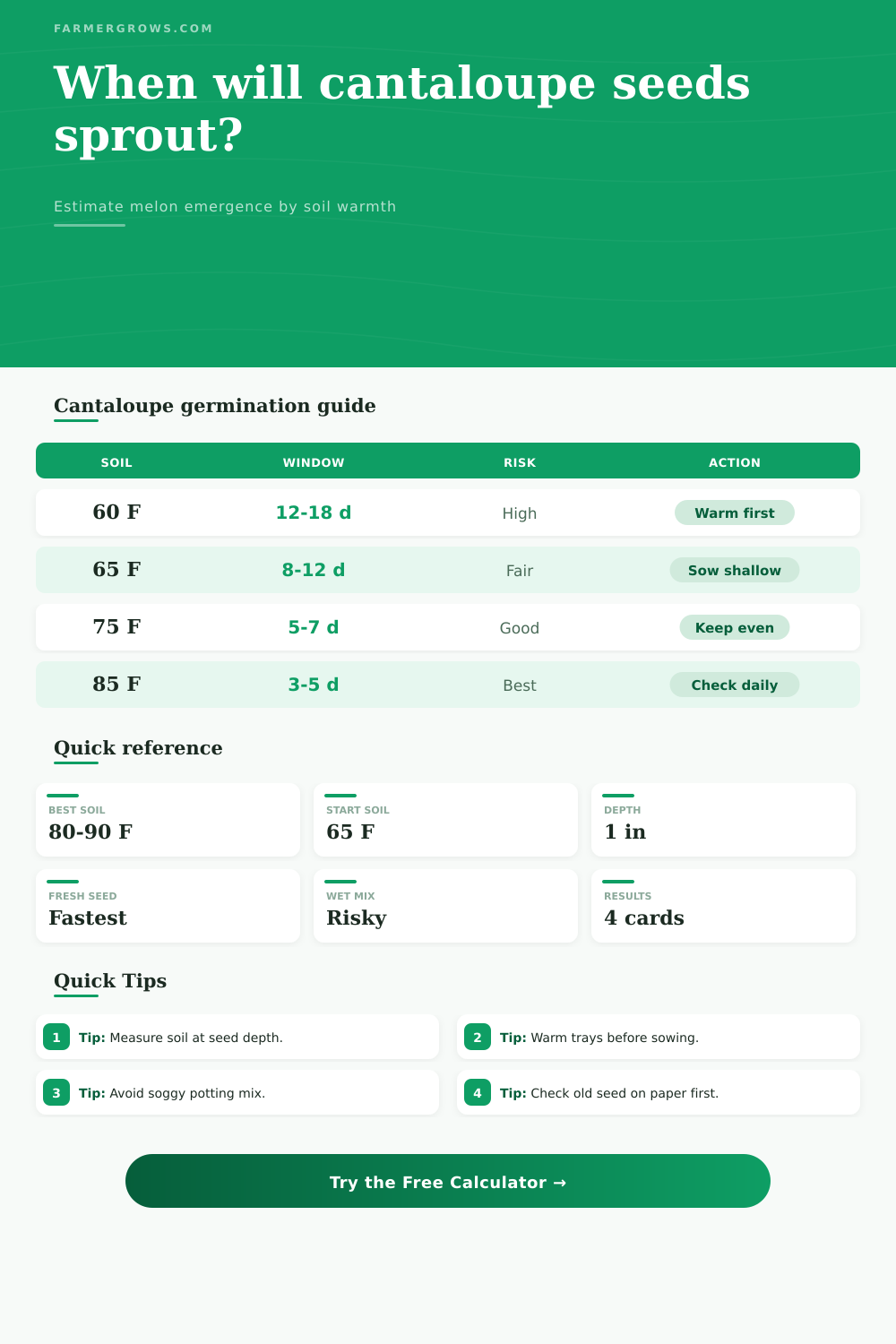
Cantaloupe Seed Germination Time Calculator
Estimate when muskmelon and cantaloupe seeds should emerge from soil temperature, night warmth, seed age, sowing depth, moisture, and indoor or direct seeding method.
📋Named cantaloupe germination presets
Start with a real sowing situation, then tune the temperature, depth, seed age, and moisture to match your tray or garden bed.
🌱Cantaloupe seed inputs
Use the temperature at seed depth, not the afternoon air temperature. For outdoor sowing, check the top inch of soil in the morning and afternoon.
Cantaloupe emergence estimate
Calculated from the current soil warmth and seed conditions.
Full germination breakdown
📊Scenario comparison grid
Compare the current setting with cooler soil, the best warm-soil target, and a hot-stress case using the same seed age, depth, and moisture choices.
🧪Germination factor cards
| Soil temp | Estimate | Outlook | Use |
|---|---|---|---|
| 55-59°F | 18-24 days | Very slow | Delay or warm soil |
| 60-64°F | 12-18 days | High risk | Marginal direct sowing |
| 65-69°F | 8-12 days | Fair | Minimum warm-soil start |
| 70-74°F | 6-9 days | Good | Safe indoor or covered bed |
| 75-79°F | 5-7 days | Good | Strong tray emergence |
| 80-90°F | 3-5 days | Best | Ideal warm start |
| 91-95°F | 4-6 days | Watch heat | Vent trays and tunnels |
| Seed age | Time add | Rate | Action |
|---|---|---|---|
| Fresh to 1 year | 0 days | 85-95% | Sow normally |
| 2 years | 0-1 day | 75-90% | Use normal spacing |
| 3-4 years | 1-3 days | 55-75% | Sow extra seeds |
| 5+ years | 3-6 days | 30-55% | Test before trays |
| Factor | Good range | Delay | Risk |
|---|---|---|---|
| Depth | 0.75-1.25 in | 0 days | Best contact |
| Shallow | Under 0.5 in | 1-2 days | Dries quickly |
| Deep | Over 1.5 in | 2-4 days | Weak emergence |
| Moisture | Even, not wet | 0 days | Best oxygen |
| Soggy mix | Waterlogged | 2-5 days | Rot or damping off |
| Method | Warmth | Speed | Best use |
|---|---|---|---|
| Heat mat cells | Steady | Fastest | Early transplants |
| Room-temp cells | Moderate | Medium | Warm house starts |
| Greenhouse tray | Variable | Medium-fast | Vent on hot days |
| Black plastic mound | Warm days | Fast outdoors | Short seasons |
| Bare soil mound | Variable | Slowest | After warm weather |
Use a soil thermometer at the actual seed depth. Cantaloupe planted into cold soil may sit long enough for rot, insects, or uneven emergence to become the real problem.
Start cantaloupe transplants close to planting time. Young melon seedlings transplant better than overgrown plants with crowded roots or long, pale stems.
This calculator estimates seed emergence timing for cantaloupe and muskmelon. It is not a guarantee; seed lot quality, soil pathogens, crusting, salinity, and actual temperature swings can change results.
Springtime cantaloupe seeds make you nervous; it’s almost as if you just know things are not going to work out well. You put those seeds into the warm soil and water, then wait…and wait…wait. Nothing doing. Days go by. The ground hasn’t changed, so maybe you used wrong seed, or maybe you didn’t plant deep enough? It’s all quiet over there… It sounds like something’s wrong.
But the truth is: things is happening below, a biological process where moisture, warmth and time combine. You don’t need to feel guilty or worry that you didn’t love or care proper, you just don’t really get what the seed wants to awaken.
Why Cantaloupe Seeds Do Not Grow
The moisture should feel like a squeezed wet sponge, not a swamp, along with steady heat at exactly the right level right where the seed sits. With this tool, you can figure if your germination tray are warm enough, you don’t have to guess.
The single greatest factor is soil temperature, which regulates the embryo’s metabolism: Tropical cantaloupe seeds will fails in cool ground. The seed might attempt to germinate if the temperature of the soil is about sixty degrees F, but then things goes very slowly. Often rot wins because the seed takes up water, softens, and fungi eats its food reserves.
To find out what’s happening in your own soil, you have to examine the dirt right where the seed will be located. Remember, that is the environment that counts. Air temperature (see “The Weather App Doesn’t Help Much,” above), measured by your weather app, doesn’t matter much, since air heats up fast, but soil cools off overnight. Sprouting can range from three days in perfect warm temperatures to almost three weeks in borderline cool ones, the chart indicates.
Depth is another key factor here. Too-deep planting, where the tiniest cantaloupe sprout has to expend all its energy trying to push up through heavy dirt until it finally gets some sun, is less important then other factors, yet still critical. An inch-deep hole typically suits most condition best. This keeps the distance from underground to aboveground minimal and secures the seed so it is not washed around by moving water. Too much over-covering and too-tight packing down will also make a physical barrier for the sprouting seedling to work against.
This is a common mechanical problem. Many gardeners mistake it for some kind of biological problem with the seed. They end up blaming bad seed when in fact they planted their crop based off two inches of compacted soil.
Overly careful watering is where many people fail early on, because they’re trying hard not to make a mistake: they want to nurture, and overwatering is an instinct. But remember: Seeds requires both water and oxygen. Overwatering makes the seedling mix sopping wet. This replaces the soil’s air pockets with water and suffocates the developing root before it has time to take hold. Remember: You want even moisture, not saturated, all along. If you let the surface go somewhat dry before watering again, your seedlings will grow deeper roots (and there’s no chance of fungal problems such as damping off).
You report how you are watering, and the tool adjusts the risk score accordingly so that you see a realistic sense of potential delay.
Another surprise is that people think old packets are still fresh, but seed age also matters. Older seed won’t be as viable as newer seed, which means they’ll take longer to get going, and not all at once as some do. You may get a few pops on day four but then would of had to wait until day ten for more. This is not an ideal beginning when you’re trying to care for your seedlings, since early starters will outcompete or shade their late-risers. A test on paper towel ahead of time saves heartbreak down the road; it’s just a little extra step for peace of mind.
You can’t see them yet. That’s why we have to learn how to grow cantaloupe. We must first deal with what is unseen, making sure things are right underground where moisture and temperature meets in a delicate balance. Knowing the ground is your friend, both home and heater for the earliest stages, makes it easier not to fret over all that bare earth, but instead trust the process.
Knowing just what’s going on underneath helps make the waiting time go faster.