Spinach Seed Germination Time Calculator
Estimate first sprouts, main emergence, full stand timing, and germination risk from spinach soil temperature, seed freshness, sowing depth, moisture, and planting method.
📋Spinach sowing presets
Choose a real spinach sowing situation, then adjust temperature, depth, seed age, and moisture for your seedbed or tray.
🌱Spinach germination inputs
Soil temperature drives the base estimate. Depth, moisture, seed age, seed treatment, and sowing method adjust the final emergence window.
Estimated spinach emergence window
Calculated from seed-zone soil temperature, sowing method, seed freshness, and seedbed conditions.
Full germination breakdown
📊Condition score grid
These cards translate your inputs into practical spinach seedbed signals: temperature quality, depth fit, moisture reliability, and seed vigor.
🧪Comparison grid
Compare your current estimate with cooler, warmer, and controlled-moisture spinach germination scenarios.
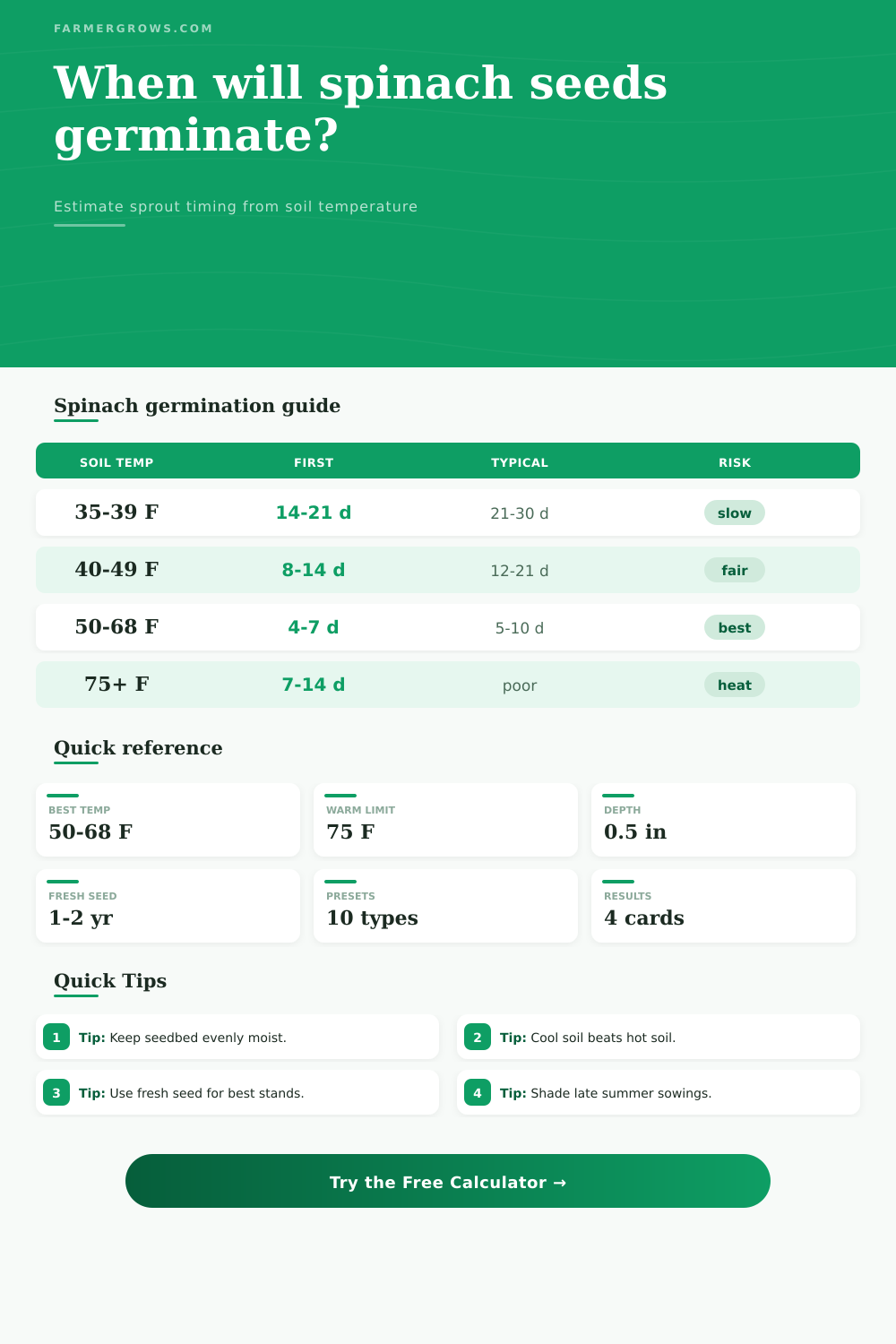
| Seed-zone temp | First sprouts | Main emergence | Stand risk |
|---|---|---|---|
| 35-39°F / 2-4°C | 14-21 days | 21-30 days | Very slow; seed may sit |
| 40-49°F / 4-9°C | 8-14 days | 12-21 days | Usable but uneven |
| 50-59°F / 10-15°C | 5-8 days | 7-11 days | Good spring range |
| 60-68°F / 16-20°C | 4-6 days | 5-9 days | Fast and reliable |
| 69-74°F / 21-23°C | 5-9 days | 8-14 days | Heat stress begins |
| 75°F+ / 24°C+ | 7-14 days | Often poor | High inhibition risk |
| Depth | Use case | Effect | Adjustment |
|---|---|---|---|
| Surface to 0.125 in | Paper test, trays | Fast but dries quickly | Watch moisture |
| 0.25 in | Cool beds or trays | Quick emergence | Best with fine cover |
| 0.5 in | Most garden rows | Balanced timing | Common target |
| 0.75 in | Dryer spring rows | Slightly slower | Use loose soil |
| 1 in or more | Coarse dry soils | Delayed and weaker | Avoid if possible |
| Seed age | Likely vigor | Timing effect | Stand note |
|---|---|---|---|
| Current season | High | Baseline | Best for direct sowing |
| 1 year | Good | Little change | Store cool and dry |
| 2 years | Moderate | 1-2 days slower | Sow a little heavier |
| 3+ years | Low to mixed | 2-5 days slower | Test before planting |
| Unknown | Variable | Add buffer days | Run a 20-seed test |
| Scenario | Typical temp | Expected window | Best action |
|---|---|---|---|
| Early spring bed | 45-55°F | 8-16 days | Keep row moist |
| Ideal fall bed | 55-65°F | 5-10 days | Water lightly |
| Warm late summer | 70-80°F | 8-18 days | Shade and cool soil |
| Cell tray indoors | 60-68°F | 4-8 days | Move to bright light |
| Winter low tunnel | 35-45°F | 14-30 days | Expect slow starts |
Spinach seed needs steady moisture after it absorbs water. If the top half inch dries, the calculator adds delay and lowers the stand estimate.
When soil runs above 75°F, shade cloth, evening watering, or pre-sprouting can improve the odds more than simply sowing extra seed.
Use this as a planning estimate. Soil crusting, poor seed-to-soil contact, disease pressure, and extreme temperature swings can still change spinach emergence.
Why fail at spinach? Because you don’t understand how cold helps wake up a seed. You plant those tough guy in early spring, wait a couple of weeks and ask: What’s the deal? The spinach embryo might still think it is winter, even though ground looks lively to you. Knowing soil physics is more useful than back-of-the-packet reading. Once you enter your conditions, this page do the math. You won’t have to guess if a delay is normal or if you have a problem.
The page translates raw temperature numbers into real-world timeframes for when to check for first sprouts, main emergence, and full stand. The primary variable are soil temperature. A cool-season crop like spinach prefers to germinate when the soil remains chilly, but not downright frigid. Its sweet spot is between fifty and sixty-eight degrees F. Below forty, it starts slowing way down. Germination still happens; it just takes a heck of a lot longer. What should of happened in five days can take up to twenty days. You’re asking a lot of yourself with all that wet bed and no reward.
Why Spinach Seeds Fail To Grow
Once the soil reaches seventy-five degrees or more, you start bringing on heat inhibition. Seed turns off its enzymes for germinating to protect itself from overheating. This is why summer spinach often fails. Even if you water every day, it can fail miserably. The calculator use that potential as part of your estimated stand percentage. This is your reality check before digging in.
But it is not the same for depth, which most people overthink. Small spinach seeds don’t have a lot of energy stores for trying to fight their way up out of thick ground, or even just being buried deeply. In garden beds half-an-inch is typically enough. That’s ample protection from drying out up top, yet enough space that once it breaks the surface the shoot can find its way upward fast. Go deeper. Particularly in soils with high clay content, and you’ll get a poorer than normal stand, because the sprouts wear themselves out before they make it aboveground. With each additional millimeter of material overhead, there’s more effort required and time lost to overcome. Your set-in-your-mind emergence window gets adjusted depending on how far you intend to plant down, because every added millimeter require more effort and time to overcome.
Another big thing to consider is how consistent the moisture was. Once spinach takes up its first amount of water, it must has steady moisture from there on in. In fact, if the seed doesn’t emerge until after the top half-inch of soil dries out entirely, the seed is dead. That’s what happens on those windblown spring days, and also if we forget to water one time and then next, and then again. The calculator factors in your specific moisture situation, such as whether you are using covers to hold in humidity, and estimates how long things may be delayed. It helps you picture how many of your seeds you can reasonably expect to see surface-side up.
Vigor also takes seed age into account. The fresher the seed, the better. Seeds of this year’s batch will outperform older ones kept in a warm garage for the past three years. Don’t assume that old seeds won’t sprout; they eventually might. But more slowly and not necessarily all at once. If your seedlings don’t come up evenly sized and at roughly the same time, it’s hard to know which ones to thin, leaving you with a garden full of lopsided plants. The calculator include seed freshness in its calculations. It will tell you when you’ll want to use heavier seeding, or perhaps a paper towel test before starting.
Growing spinach is all about working within the limits of our environment and setting reasonable expectations. It’s all about working with the cards we’re dealt once we understand these variables. Compare your situation using the reference tables, then amend the seedbed or wait for a cooler period if the math isn’t looking good. Getting things up isn’t the point; the trick is to get them up uniformly so that they’ll come along together. Match your planting date to the right combination of moisture and temperature patterns, and sure enough: Those first green hooks poke through on time. That’s the beauty of planning. Not hoping.