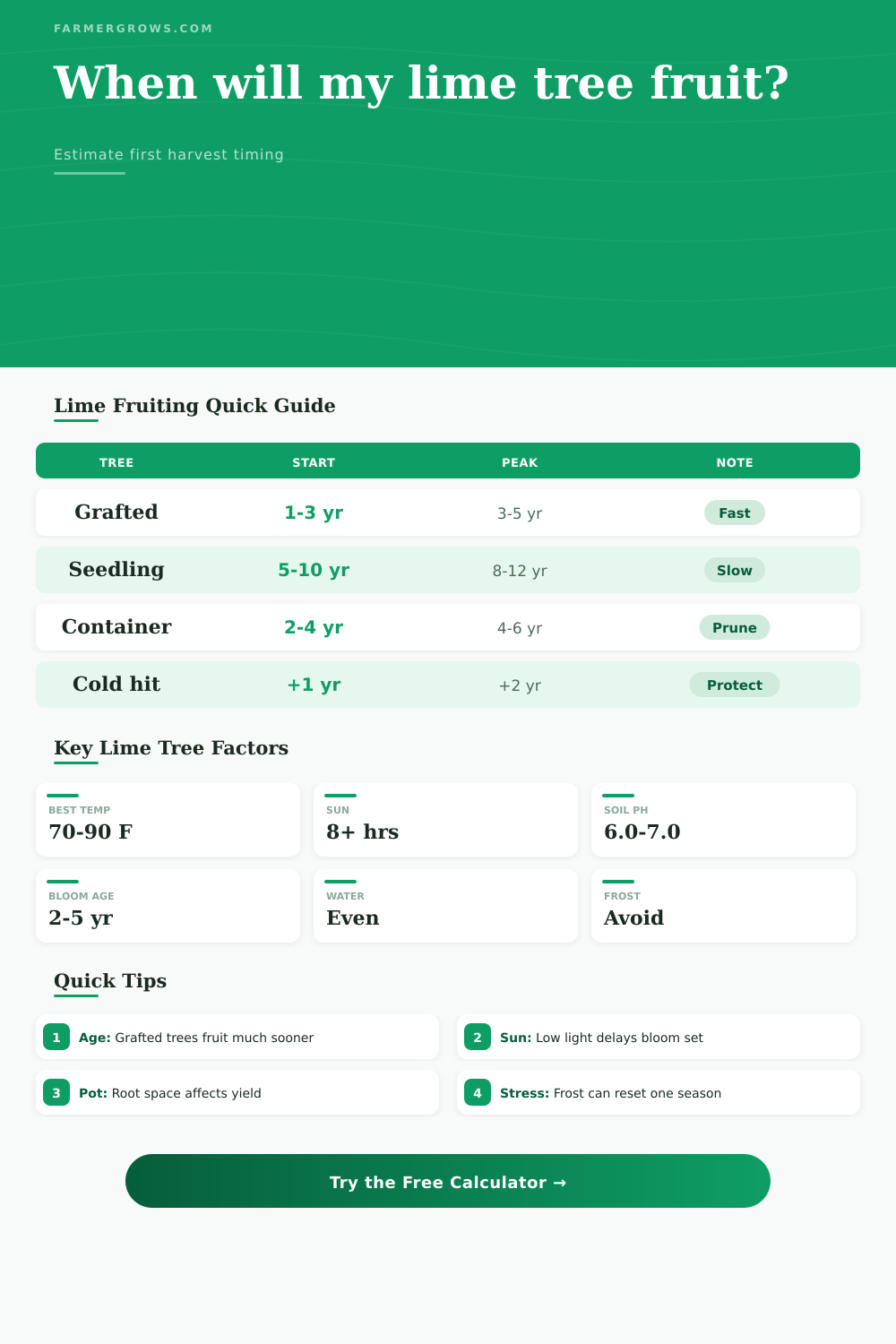
Lime Tree Time to Bear Fruit Calculator
Estimate how long a lime tree may take to flower and set its first usable harvest based on variety, propagation, tree age, climate, container size, and care.
Your Lime Fruiting Estimate
| Propagation type | Typical first fruit | Why it differs | Best use |
|---|---|---|---|
| Grafted nursery lime | 1 to 3 years | Mature fruiting wood is joined to vigorous rootstock. | Fast home harvests and reliable variety identity. |
| Rooted cutting | 2 to 4 years | Genetically mature wood roots, but roots must catch up. | Patio limes from known productive trees. |
| Air-layered tree | 2 to 4 years | Starts with mature top growth and a smaller root system. | Special varieties where grafted plants are rare. |
| Seed-grown lime | 5 to 10 years | Juvenile citrus seedlings must mature before flowering. | Experiments, rootstock, or long-term growing. |
| Lime variety | Fruiting speed | Container habit | Harvest note |
|---|---|---|---|
| Key / Mexican lime | Fast once mature | Compact and productive with heat. | Small fruit, often heavy seasonal flushes. |
| Persian / Tahiti lime | Moderate | Needs room for canopy and root growth. | Larger seedless fruit, strong backyard choice. |
| Bearss lime | Moderate to fast | Well suited to large containers. | Often sold grafted and already near bearing age. |
| Makrut lime | Moderate | Leaves are often harvested before fruit matters. | Fruit can be slower if tree is leaf-pruned hard. |
| Rangpur lime | Fast | Vigorous, can outgrow small pots. | Orange-skinned acidic fruit on hardy trees. |
| Growing condition | Effect on timing | Warning sign | Correction |
|---|---|---|---|
| Under 6 sun hours | Adds 6 to 18 months | Long soft shoots, few buds. | Move to brighter exposure gradually. |
| Small container | Adds 4 to 12 months | Frequent wilting and pale leaves. | Shift to a wider citrus mix container. |
| Cold injury | Adds 8 to 24 months | Leaf drop, dead twig tips. | Protect from frost and rebuild canopy. |
| High nitrogen only | Adds 3 to 9 months | Leafy growth with no bloom. | Use balanced citrus fertilizer with micros. |
| Uneven watering | Adds 3 to 12 months | Bloom drop or pea-sized fruit drop. | Keep moisture steady, not soggy. |
| Tree situation | First flower estimate | First crop estimate | Early yield range |
|---|---|---|---|
| 2-year grafted patio lime | 0 to 10 months | 8 to 18 months | 5 to 30 limes |
| 3-year Persian lime in ground | 0 to 8 months | 7 to 16 months | 15 to 60 limes |
| 1-year rooted cutting | 12 to 24 months | 20 to 34 months | 3 to 20 limes |
| 4-year seedling lime | 12 to 48 months | 20 to 58 months | 1 to 25 limes |
| Cold-damaged mature lime | 8 to 20 months | 16 to 30 months | 0 to 40 limes |
When you plant A lime tree with the hope of fresh fruit in your yard, it might seem like an awfully long wait. Some people pick in the second year, but others don’t even get leaves until their fifth year; they is just sticks with leaves. Typically, it’s not luck. It’s about root space and how the tree was propagated.
If you buy a grafted tree at nursery, that has mature wood on good roots, it will be ready to bloom faster than seedling that needs to grow from scratch. That’s the primary biological-clock variable in your timeline. How big is window for your particular tree? This page is a tool that combines growing conditions and tree’s propagation status to help you measure it. You choose if the tree is a grafted variety, a seedling, or a cutting, as well as its height and age.
Why Your Lime Tree Is Not Fruiting Yet
But remember: One that was grafted in a tiny pot won’t behave like one set into ground. Limited root space mean less ability to take up water and nutrients. Survival becomes more important then reproduction when there isn’t room to stretch out. No fruits for you until they can.
Another factor that many people overlook is sunlight. Direct sunlight are necessary for forcing a lime to undergo the hormonal changes needed to flower. No more than four hours? Forget about it; that poor thing will only produce foliage. Because shade halts fruit production, the calculator factors this into its guess. That’s why it asks you about your sun exposure. And no, the tree isn’t sick. It is just in vegetative mode because it doesn’t have enough light to justify using the energy necessary to bear fruit.
Genetics aren’t everything; so are climate and stress history. Even a full-grown lime may not give in to a brief hard freeze. But it could set back its fruiting clock an entire season. Leaves drop, the canopy regrows…and only then will tree think about setting buds. Similarly, transplant shock (moving a potted tree outside after growing it in) or even just repotting the thing also cause such a delay. Let the roots recover first and don’t expect a crop until they do.
Force-feeding a tree fertilizer while it is recovering make things worse. It forces more leaf growth, which weakens the tree by pulling away resources that do not produce enough food through photosynthesis to make up for the loss. When I know what goes into that number, waiting makes more sense. Rather than feeling stumped when nothing happens, it gives me something to examine: Are you watering so much the roots are drowning? Is your pH level creeping upward? What other things are you doing to care for this plant? The breakdowns on the side of calculator, in the reference tables, explain those details.
They explain that certain types (Persian vs. Certain types like Persian and Key limes react differently depending on whether they are planted in ground or in containers. A large pot might not have enough space and could stunt a Tahiti lime, but it would be fine for a Bearss. Get to know the details of your variety’s nature, and create reasonable expectations instead of measuring yours against another person’s.
A concrete goal includes the readiness score and the first crop estimate. It might take weeks, months, or years. If it looks like a long wait, reassess size of your container (it must be big enough) and also how sunny the location is (that’s the other thing you can change). Bump up to a bigger one, ideally made off materials that let water drain through quickly, and place the pot in a brighter location.
Don’t feed too much (high-nitrogen stuff promotes vegetative growth… Lush foliage but no flowers). Find balance. When the tree is feeling secure, fed up on good stuff, energized by plenty of sunlight, it’ll turn its attention more toward making fruit than leaves.
Citrus gardening rewards patience. Informed patience is even better then blind hope. Citrus growing is a living system… Something that takes time and steady inputs to develop. Knowing the biology (and making environmental tweaks) transforms a long waiting period into an achievable project. Each month, chasing the sun and watering diligenty gets you closer to your first sweet-tasting lime hanging from a branch all by itself. It’s worth it, the first harvest alone.