Orange Tree Time to Bear Fruit Calculator
Estimate when a navel, Valencia, blood orange, Cara Cara, satsuma-type orange, or seedling orange tree may bloom, set its first useful crop, reach stronger production, and enter its expected harvest window.
Choose a realistic starting point for your orange tree, then refine the age, propagation method, climate, winter low, chill exposure, sun, and stress level for your garden.
Mature budwood usually blooms quickly, but fruiting still depends on canopy strength and root establishment.
Seed-grown citrus can stay thorny and vegetative for years before it flowers reliably enough to crop.
Restricted roots can bloom early but delay full crops because leaf area and water reserve stay limited.
Orange fruit forms on healthy wood after bloom, so freeze-damaged trees may lose a whole crop cycle.
Orange Fruiting Estimate
Your orange timing estimate will appear after calculation.
| Orange variety | Typical first crop | Harvest window | Timing note |
|---|---|---|---|
| Washington navel | 2 to 4 years from grafted nursery tree | Winter to early spring | Often fruits young, but heavy crops wait for canopy size. |
| Cara Cara navel | 2 to 4 years from grafted nursery tree | Winter to early spring | Similar to navels; fruit color develops best with cool nights. |
| Valencia | 3 to 5 years from grafted nursery tree | Spring to summer | May hang fruit while new bloom appears, so young trees need vigor. |
| Moro blood orange | 2 to 5 years from grafted nursery tree | Winter | Cold nights improve color, but freeze injury delays bearing. |
| Hamlin | 2 to 4 years from grafted nursery tree | Fall to winter | Early-season orange that performs well in warm, humid citrus regions. |
| Tree source | Bloom effect | Fruit timing effect | Calculator adjustment |
|---|---|---|---|
| Grafted named orange | Mature budwood can bloom early | First useful fruit often 2 to 4 years after planting | Uses the fastest standard orange baseline. |
| Seed-grown orange | Long juvenile growth before bloom | Can need 7 to 12 years or more before reliable crops | Adds a major juvenile delay and quality warning. |
| Own-root or air-layered tree | No rootstock vigor advantage | Usually slower than grafted but faster than seedling | Adds a moderate establishment delay. |
| Top-worked mature citrus | Existing roots push mature scion growth | Can bloom quickly once new scaffold wood forms | Reduces wait time but flags pruning recovery. |
| Dwarfing rootstock | Earlier compact flowering possible | Heavy crops take longer due to smaller leaf area | Shortens bloom slightly and delays mature yield. |
| Climate setting | Orange fit | Timing effect | Frost planning cue |
|---|---|---|---|
| Mild citrus zone 9b to 10b | Best general home-orange setting | Reliable bloom and fruit sizing after establishment | Protect young trunks during rare hard cold. |
| Hot inland citrus zone | Fast growth if irrigation is steady | Can size fruit well, but heat stress can shed flowers | Mulch, water deeply, and avoid severe summer pruning. |
| Humid subtropical citrus zone | Good warmth with disease pressure | Fast canopy growth where drainage and leaf health hold | Keep airflow open and avoid waterlogged roots. |
| Cool coastal or 9a edge | Possible with protection | Slower sugar development and more winter delay | Use wind shelter and frost cloth on young trees. |
| Cold fringe with protection | Experimental for many oranges | Fruiting depends on winter survival of canopy wood | Containers or covers may be required each winter. |
| Stage | What it means | Typical timing | Grower cue |
|---|---|---|---|
| First bloom | Tree is mature enough to flower | Often spring after the estimated date | Do not expect every flower to hold fruit on young trees. |
| First useful crop | Enough fruit holds to harvest a small crop | Usually one season after stable bloom | Thin overloaded branches and support young scaffolds. |
| Mature production | Tree has enough canopy for repeat crops | Often 5 to 8 years for grafted in-ground trees | Keep irrigation steady during bloom and fruit swell. |
| Harvest window | Fruit develops sweetness on the tree | Variety dependent from fall through summer | Oranges do not ripen much after picking, so taste-test first. |
| Recovery year | Freeze or heavy pruning reduced fruiting wood | Can delay bearing by a full crop cycle | Regrow leaves before pushing the tree for fruit. |
Protect the fruiting wood: Orange trees crop from healthy canopy after bloom. A freeze, hard pruning, or leaf loss can delay fruit more than tree age alone suggests.
Judge containers by leaves, not flowers: A potted orange may bloom early, but it needs enough root volume, water reserve, and foliage to hold fruit to harvest.
This calculator gives planning windows for orange fruiting. Local rootstock, soil drainage, irrigation, pest pressure, salinity, pruning, and unusual weather can move real timing earlier or later.
Why plant an orange tree? For the sweet stuff: juice. But much of the time you’ll be waiting, and it’s not just your patience that will be tested; it’s your irrigation schedule, too. Homeowners buying a grafted nursery tree expect fruit their first year, which is not what any kind of citrus can offers meaningfully. The calculator above handles the math once you plug in your specific variety and planting conditions, which saves you from guessing whether your tree is just growing or actualy preparing to crop.
Once you enter your planting conditions and variety into the calculator above, it takes guesswork out of whether your tree is just growing or getting ready to crop. You won’t have to hope anymore. Instead, you get a time frame that accounts for the tree establishing its roots, developing its canopy, and dodging the dangers of your specific local climate.
How Long to Wait for Oranges
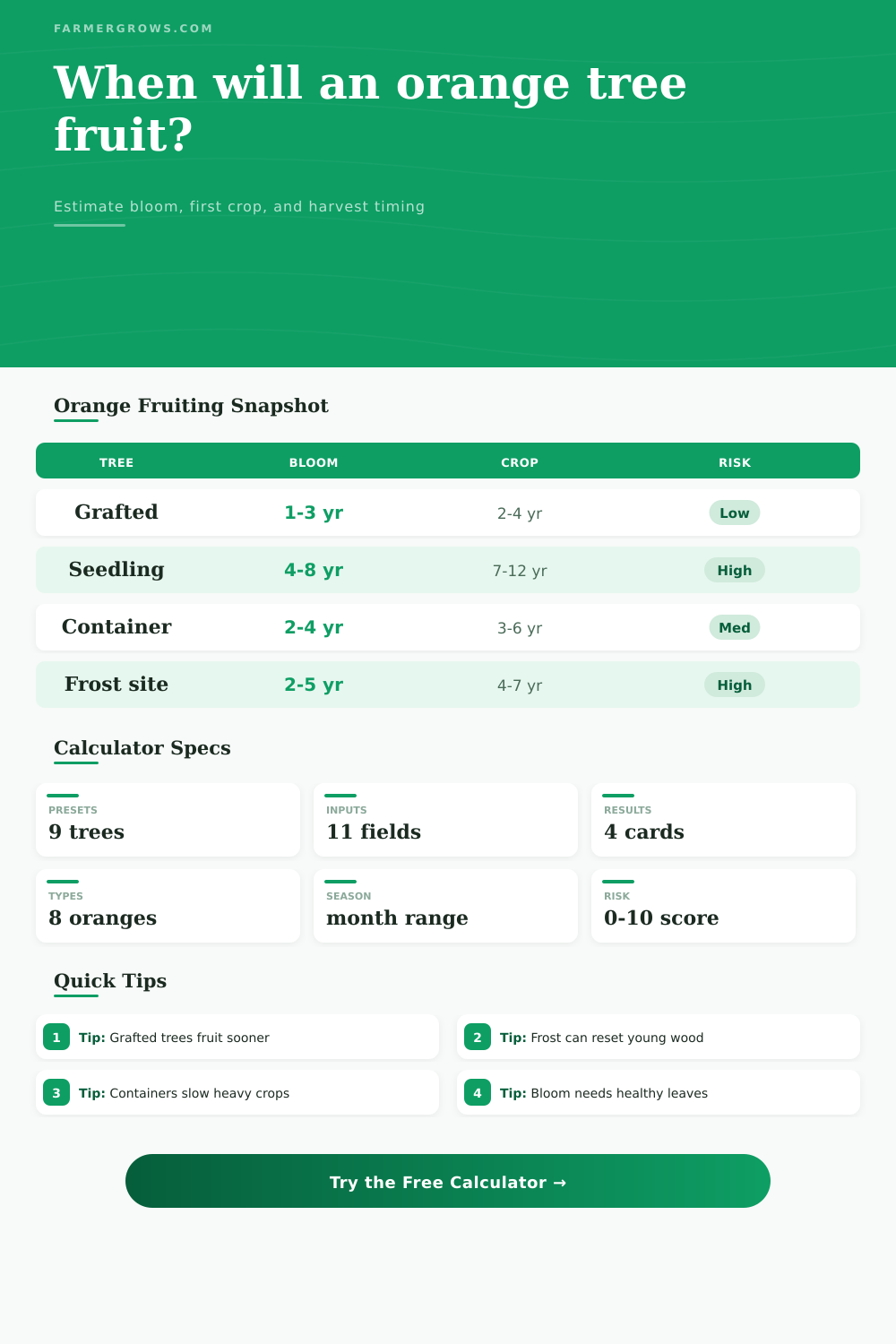
But there’s one other thing people overlook: How did the tree get propagated? If it’s grafted, then it has adult genetics on board that is eager to produce fruits right away, and also require several more years of gathering sufficient leaf surface to sustain the blooms’ demands. By contrast, seed-grown oranges (those grown from a actual seed like an orange pit out of your breakfast cereal) initially spend many years in what biologists call a “juvenile” state. In this state, they has no interest in sex, they just make lots of thorn and shoot up as fast as possible. Chances are you’ll be waiting seven to twelve years before a seedling sets fruit, and even then inconsistently. That’s why so many people who stick an orange pit in the ground never see any result (they missed this detail). When you show seed-grown status, the tool will adjust dramatic downward, reflecting all that biological lag time.
There’s another level of complication that few ground-planted fanatics appreciate: container gardening. Sometimes the stress of being potted up makes a tree flower early, almost as a matter of survival instinct. But then you need truckloads of nutrients (and therefore water) to carry a crop of fruit all the way to maturity, which is impossible in a fifteen-gallon pot. So the tree drops its load and saves itself, and you’re left with flowers, but no oranges. It is a minor point, but one to keep in mind when setting expectations.
Since there is only so much soil in a pot, no matter how many blooms a plant produces in springtime, I schedule the expected first crop later in the year to account for amount of roots compared to size of the pot. The size of the pot. If those flowers do lead to fruit (as opposed to dropping on the lawn), however, climate also decides. Those flowers typically open in late winter or early spring. If you live far enough north, this happens during a sensitive period when a bad cold snap can kills the orange trees while they are blooming. Any hope of a crop for the year is gone before it even starts, lost in a single freeze. To judge that risk, the tool wants to know about your winter low temperature and how much stress you expect. Are you near the frost line? Estimates will stretch to match, since recovering from cold damage is time-consuming. It starts all over again, since you’ve got to grow back the wood that bears the fruit.
And then there is what you have growing: Your crop calendar is determined by variety selection. You might grow winter-harvest navel oranges or summer-harvest Valencias, which may have both new blooms coming and old fruit ready to go. This is a double whammy on a young tree. Blood oranges require cooler nights to get that deep color. Well, so does frost, if you’re not careful. To avoid it all, the chart on the page breaks down what’s required of various varieties, and thus where their harvest window aligns. Does your location match theirs…or are you at war with Mother Nature?
And finally: Patience is the ultimate input. Pruning or fertilizing won’t make a tree bear a crop any faster then it’s prepared to do so. In fact, such pushing tends to cause more harm than good. It is like burning leaves or damaging roots, which sets you even farther behind than if you’d simply waited. We’re aiming to sustainably produce for decades, not set ourselves back by producing one huge crop on young branches that gets killed by carrying so much weight too soon. You should of planned for the wait (not worry while you wait) when you know what your limits are. Plant for the long haul; every leaf you add this year becomes part of the foundation for the sweet reward waiting for you down the road. That’s something to savor now, even as it quietly grows.