Peach Tree Time to Bear Fruit Calculator
Estimate first blossoms, first harvest, and mature peach production from planting age, rootstock vigor, chill fit, variety season, and care conditions.
Timing is an estimate for healthy peach trees. Local frost, disease pressure, cultivar genetics, and pruning choices can shift actual harvests by a season or more.
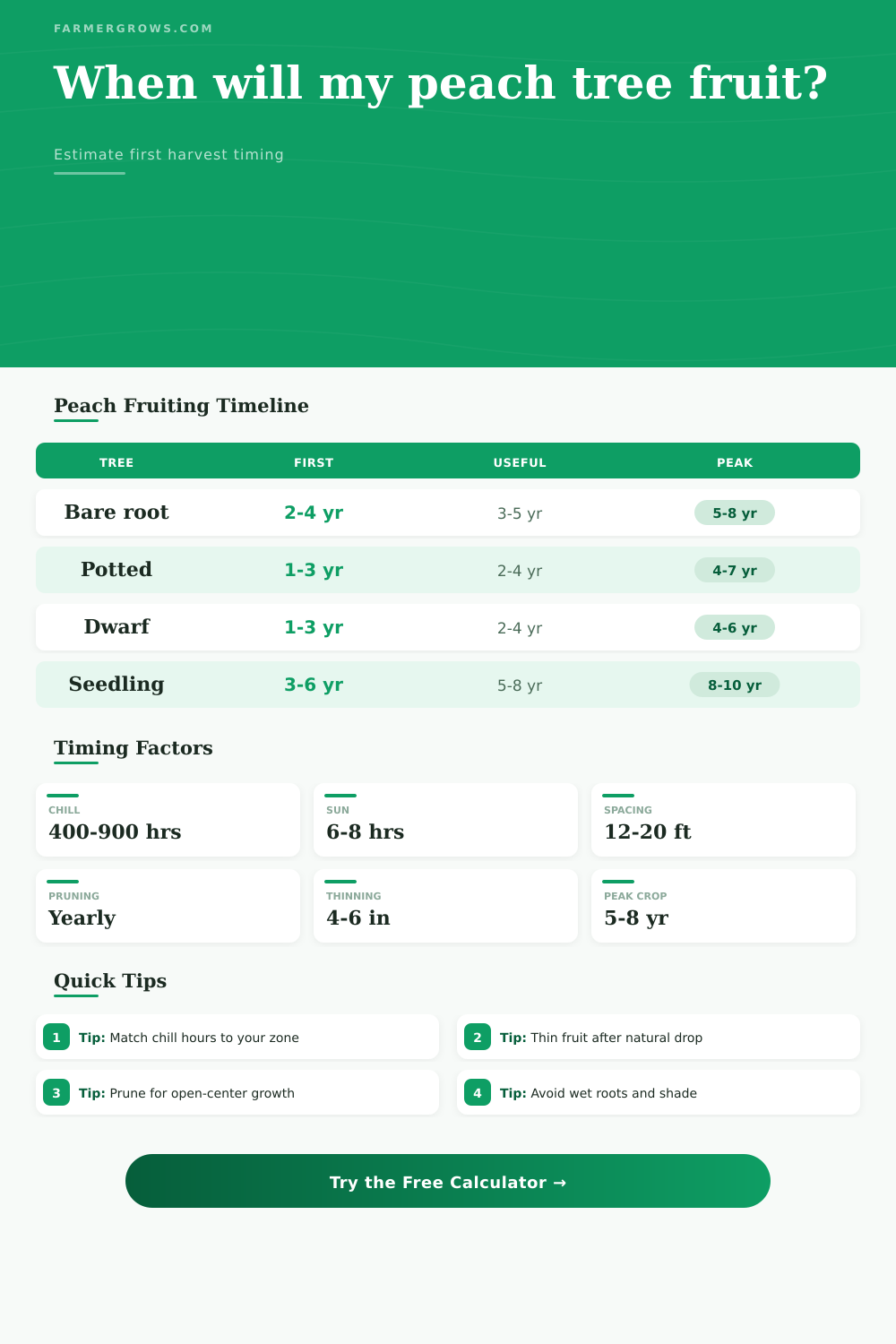
Peach Fruiting Estimate
| Tree Type | First Blossoms | First Edible Fruit | Full Bearing |
|---|---|---|---|
| Bare-root grafted whip | Year 2 to 3 | Year 3 to 4 | Year 5 to 7 |
| Potted grafted nursery tree | Year 1 to 2 | Year 2 to 3 | Year 4 to 6 |
| Dwarf grafted peach | Year 1 to 2 | Year 2 to 3 | Year 4 to 6 |
| Standard vigorous peach | Year 2 to 4 | Year 3 to 5 | Year 6 to 8 |
| Seed-grown peach | Year 3 to 5 | Year 4 to 6 | Year 7 to 10 |
| Chill Match | Bloom Reliability | Fruit Set Effect | Timing Adjustment |
|---|---|---|---|
| Local chill exceeds need by 100+ hours | Strong | Consistent set if frost is low | No delay |
| Local chill within 50 hours of need | Fair to good | Some uneven bloom possible | Add 0 to 1 year |
| Local chill 50 to 150 hours short | Weak | Poor bud break likely | Add 1 to 2 years |
| Local chill far below requirement | Unreliable | May bloom sparsely or fail | Change cultivar |
| Care Factor | Good Practice | Delay Risk | Why It Matters |
|---|---|---|---|
| Sunlight | 6 to 8+ direct hours | Shade can add 1 year | Peaches set fruit on vigorous new wood |
| Drainage | Moist but never waterlogged | Wet roots may stall growth | Root stress reduces bloom buds |
| Pruning | Open-center annual pruning | No pruning lowers fruiting wood | Light reaches new shoots and spurs |
| Thinning | Fruit spaced 4 to 6 inches | Overcropping weakens next year | Balanced crop supports repeat harvests |
| Ripening Season | Typical Harvest | Young Tree Note | Common Use |
|---|---|---|---|
| Early peach | Late spring to early summer | May bloom early and face frost | Fresh eating, first market fruit |
| Midseason peach | Mid to late summer | Often most predictable timing | Fresh eating and preserves |
| Late peach | Late summer to early fall | Needs a long warm season | Canning, storage, extended harvest |
| Nectarine type | Similar to listed cultivar season | More disease-sensitive in humid sites | Fresh eating with smooth skin |
When you plant a fruit tree, there’s an anxiety to it, because it takes so long to see what happens. There’s all this digging around, settling in of the roots…and then waiting. You wait for years. And while you’re waiting, it feel as if nothing is happening at all. Sure, the tree puts out leaves, and everything looks fine, but still…no peaches! It’s enough to make anyone lose hope before ever tasting the fruits (or nuts or berries) of their work.
Why? Because peach trees is ruled by a biological clock that doesn’t have patience for yours. That clock accelerates or slows depending on whether you pruned the branches, what kind of tree you purchased, and how many cold hours your winter had. The calculator does all this math for you. All you have to do is input your location and the kind of tree you’re growing, and the calculator will spit out an answer (the one at the top of page). This spares you from having to guess at these wonky natural balances.
Why Peach Trees Take Time to Bear Fruit
First it considers age class and rootstock. If you have a seedling tree like a peach grown from a stone, it may be six years before it fruits because it has to build its own huge network of roots first. But if you buy a grafted nursery tree, it never go through that initial phase. Its scion wood already understands what to do with itself; it simply has to wait until the roots catch up. That’s why seedlings typically take so long (often five or more years), whereas bare-root whips start fruiting in two to four years. The calculator takes this into consideration, so no need to scold yourself over your watering routine; it may have nothing to do with that.
Then: Another key element that most of us miss at home as gardeners is chill hours. That’s the number of hours during winter when peach buds must recieve some hours of cold to properly wake up. Too-warm a winter means your tree never gets on the same page and may even bloom erratically or even leaf out prematurely. Poor fruit set follow. The calculator plots your local chill data against what the variety requires, and then determines whether it matches up or not. Big gap? Expect a wait for blooms, or none at all, to adjust the timeline upward. It is not due to laziness on the part of the tree. It is just hormonal signaling that didn’t get triggered by enough cold nights.
That wait period can be shortened both through pruning, and sunlight. The peach grows its fruiting spurs on last year’s growth of wood. If you don’t prune, the canopy closes in and no inner branches ever recieve sunlight. They make leaves instead of flowers because they are not exposed to light. To keep the trunk open to air and sunshine, with an open center type of pruning, it forces tree to grow outward different than inward. So it creates more wood than just the trunk, more wood that can bears fruit each season. If you don’t prune properly, sometimes you’ll have a big crop one year and none the next couple because you wore the tree down.
Peach roots also don’t like wet feet; they hate waterlogging of soil. A tree in waterlogged ground will get stunted (delayed maturity) and succumb to root rot. Energy that should of go into forming fruiting structures goes instead to battling disease if your soil isn’t well-draining. The tool takes that into account, too; prolonging the wait for mature trees when sited on low spots or in heavy clay. That’s penalty time for bad site selection, but fair enough.
As with most things that take patience, peach trees are no different, the wait eventually does pay off (even if the initial crop isn’t huge). Thinning those early crops, too, means the tree stores up energy for next year’s harvest, which is a good thing. And knowing how those factors play out, you no longer see a leafy green stick… You see an orchard-in-the-making.
It’s one thing to have a tree produce fruit; it’s another to maintain its health so that it can continue doing so for many years. When you know what the tree needs, then the wait isn’t quite as much; it’s making something.