Fig Tree Time to Bear Fruit Calculator
Estimate when a fig tree will make its first figs, when the main crop becomes reliable, and whether breba fruit is likely after cold, pruning, container, and variety effects.
1Fig fruiting presets
Pick a realistic starting point, then adjust the details below. Presets change every input and rerun the fruiting estimate.
2Fruiting type comparison
Most backyard figs fruit without pollination and usually bear fastest from cuttings or layers.
Breba crop can be good, but main crop may need pollination depending on cultivar.
Fruit set depends on caprification and fig wasp access, so timing can look delayed.
Seedlings need juvenile time and may never make useful fruit in some climates.
3Tree and climate inputs
Your fig fruiting estimate
Adjust the inputs and calculate to estimate first figs and reliable harvest timing.
4Timing factor cards
5Fig timing reference tables
| Tree source | First figs | Reliable crop | Why it changes |
|---|---|---|---|
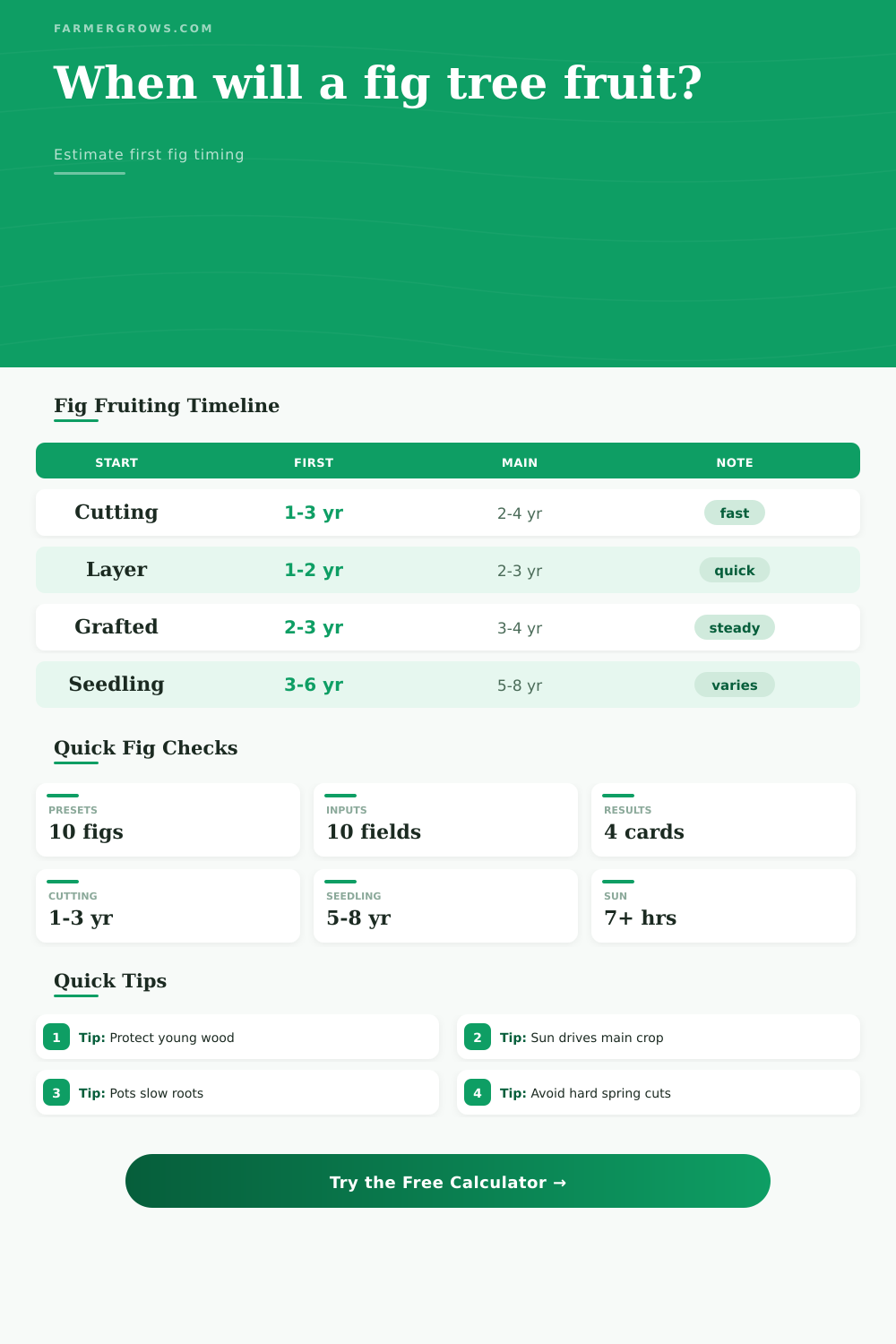
| Rooted cutting | 1 to 3 years | 2 to 4 years | Cuttings come from mature wood, but roots and canopy still need size. |
| Air layer or sucker | 1 to 2 years | 2 to 3 years | A larger layered plant can carry fruit sooner if transplant shock is mild. |
| Grafted nursery tree | 2 to 3 years | 3 to 4 years | Nursery trees are often pruned for structure before heavy cropping. |
| Moved mature transplant | 1 to 4 years | 2 to 5 years | Root loss can pause fruiting even when the topwood is mature. |
| Seedling fig | 3 to 6 years | 5 to 8 years | Seedling juvenility and unknown fruit quality add delay and uncertainty. |
| Crop habit | Breba behavior | Main crop behavior | Timing note |
|---|---|---|---|
| Common fig | Low to moderate | Usually reliable | Most home figs do not need wasp pollination for the main crop. |
| Breba common fig | Moderate to strong | Reliable if season is warm | Old wood protection is the key to early summer breba fruit. |
| San Pedro type | Often useful | May need pollination | Can appear productive early, then fail main crop without caprification. |
| Smyrna type | Usually limited | Needs caprification | Without caprifig pollen and fig wasp access, fruit may drop before ripening. |
| Unknown type | Uncertain | Uncertain | Track fruit drop, eye shape, and whether small figs hold through summer. |
| Site factor | Speeds fruiting | Delays fruiting | Action |
|---|---|---|---|
| Sun exposure | 7 to 10 hours of direct sun | Less than 5 hours | Open the canopy and avoid shaded walls where possible. |
| Heat and season | Long warm autumn | Cool nights and short summers | Use a warm wall, mulch, or tunnel protection in marginal areas. |
| Root room | Deep soil or large pot | Root-bound dry pot | Refresh container roots before the tree stalls. |
| Winter damage | Canes survive winter | Top dies to the ground | Mulch crowns and protect young stems in cold zones. |
| Pruning | Light thinning after structure | Repeated hard spring cuts | Keep enough one-year wood for early fruiting. |
| Symptom | Likely reason | Timing effect | Next check |
|---|---|---|---|
| Small figs drop early | Pollination need, stress, or weak roots | Main crop may not count yet | Confirm cultivar type and water consistency. |
| Lots of leaves, no figs | Too much nitrogen or juvenile growth | First crop can slip one year | Reduce fertilizer and improve sun. |
| Breba never appears | Old wood removed or frozen | Early crop unlikely | Protect canes and prune after breba. |
| Figs form but stay green | Season too short or cultivar too late | Reliable crop delayed | Choose earlier cultivars or add heat. |
| Pot dries fast | Root-bound container | Crop size and timing stall | Root prune or move to a larger pot. |
6Practical fig fruiting tips
This calculator is a planning estimate. Local cultivar performance, winter lows, soil moisture, and nursery age can shift real harvest timing by a season or more.
When you planted that fig cutting, all the websites said it would bear fruit the next summer. You kept up with the watering, and the thing grew leafy in no time, but come fall there were no figs. It was like a broken promise.
But that’s not necessarily how it works; in fact, most often it’s due to confusion about what these trees can do, and more importantly, what they cannot. How long it takes for something to produce fruit is as much about biology as it is about your patience. It is also about whether you started with a seed or mature wood, since each option start a different clock.
Why Your Fig Tree Has No Fruit
A rooted cutting is a clone of an older tree, therefore the genetics are there from day one and the plant grows up fast. In fact, a cutting might set fruit in its first or even second year. Why? It is biologially ready to reproduce. It is not so with a seedling. This creature has a juvenile period to endure before it begins devoting energy to reproduction… Not for several years.
If you started your fig from a pit you bought at the grocery store, brace yourself for a longer wait, and perhaps the resulting fruit won’t be the same than the parent tree’s. This calculator will help untangle these time frames, so you don’t think you’ve done something wrong when it’s just nature’s way.
So the starting point is propagation method (but then there’s the end game: climate). It is not merely about growing heat, but also having enough heat to ripen the fruit. If days get shorter before fall; plus cool air, you’ll see a tree set some tiny figs in early summer that drop again later on. It’s why season length, plus sun exposure, matters. Though I’d think seven hours of direct sun would be plenty, that heat doesn’t always build up enough in a cool maritime climate to mature late-ripening cultivars. Ideal genetics are no guarantee; all that’s needed is time (degree days), and you won’t get them when you don’t have enough. Those figs will go green and fall off… Not because you didn’t care for them, but because your expectations was wrong.
But again, there’s a difference between new growth and old wood, too. Many home growers don’t know that figs has two distinct crops. The first is the so-called breba crop, which develops on last year’s wood. Later comes the main crop, which develops on this year’s new growth. In your zone, where the upper branches are killed back by winter cold, you’ll lose the entire breba crop. And if the tree is busy growing back those lost branch instead of setting flower buds one spring, you may postpone the main crop as well. That’s why protecting that old wood, whether with mulch or something else that covers it when wind whips up and gets really cold, can help get you some fruit earlier. Otherwise, you basically prune the fruit right off before it even begins to develop.
Some add an extra twist: fig pollination. While many popular cultivars such as Brown Turkey or Celeste are self-fruitful (meaning they don’t rely on a wasp to pollinate them), others called Smyrna figs do, requiring close proximity to both a caprifig tree and a particular type of fig wasp to set fruit. A Smyrna fig will bloom nicely, but no edible fruit will ever be had without its pollinators. That’s why it’s important when purchasing rare varieties, particularly for beginners, to be sure they’re suited to local pollination conditions. If your tree sheds little green figs every year, perhaps it lacks what’s necessary to get fruit up and growing in the first place.
This biological equation is limited by the physical limits of container growing. The plant must be able to get consistent water and expand its roots accordingly. If the pot is too small and limits space for the roots, then the roots won’t be able to support a large canopy or store enough carbohydrates. Fewer carbs stored in the roots = fewer resources available for next season’s fruiting. When you upgrade from a small pot to a large one or plant in the ground, the tree suddenly has the setup to support reproduction, and unlock its potential.
The last bit is patience. Fig trees don’t come into their own overnight, even under ideal circumstances, because they have to fill out, and store up reserves. You can guess those timings and other available resources based off your particular set-up. But really, it is all about reading the tree. How does it set fruit? What rate of fall occurs? Modify care appropriately, because the reward, a fresh-from-the-vine crop of homegrown figs, is well worth the wait…if that’s what you’re waiting for.
And remember, the tree has a purpose; all you do is look closely and you’ll be able to see it.