Apple Tree Time to Bear Fruit Calculator
Estimate when an apple tree may set its first sample apples, when it should reach a reliable harvest, and how rootstock, cultivar habit, chill fit, pollination, pruning, sunlight, stress, and crop management change that fruiting timeline.
Load a realistic orchard scenario, then adjust the exact rootstock, cultivar class, tree age, chill match, pollen access, pruning level, and site stress for your tree.
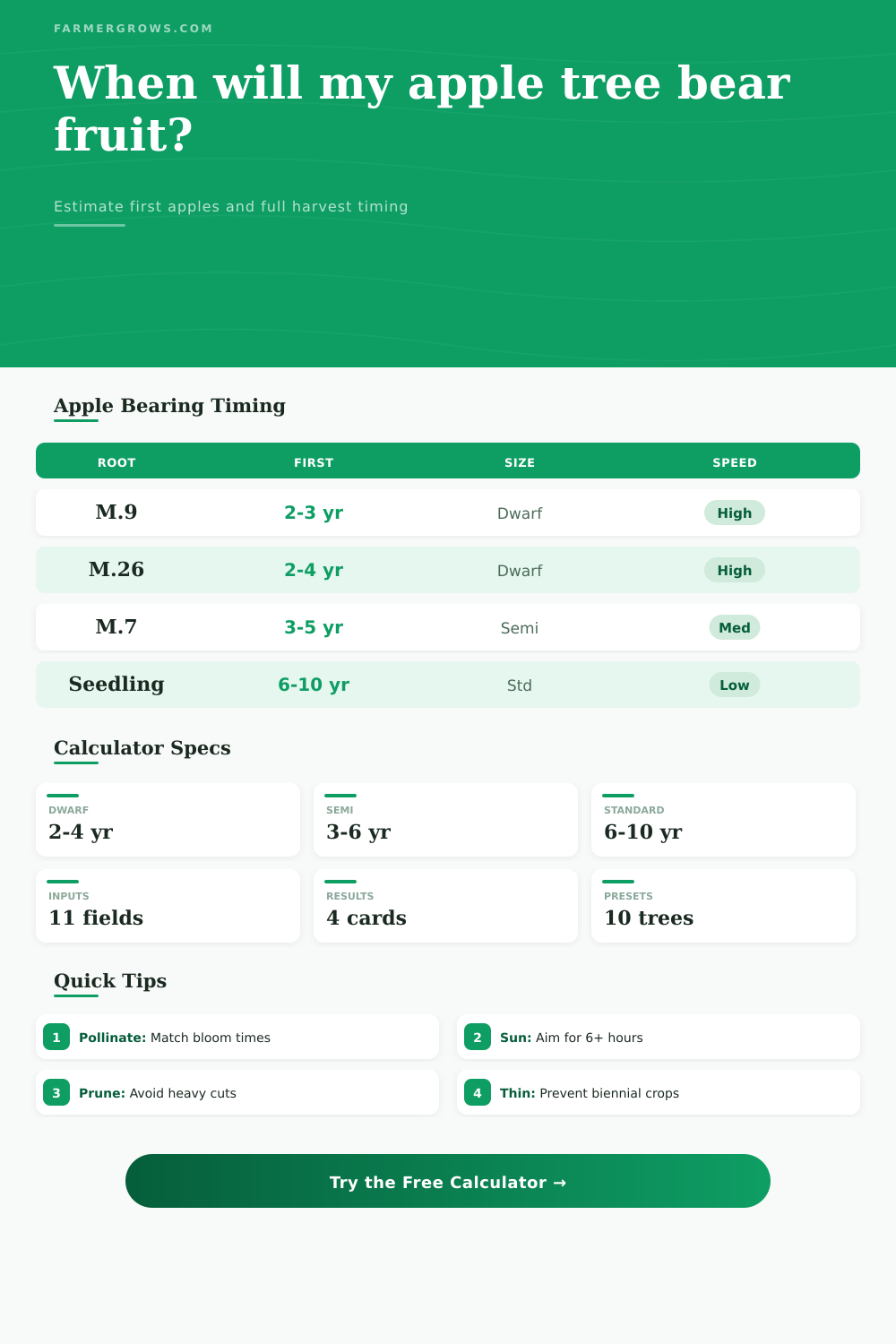
Dwarf and modern Geneva roots push trees into flower earlier than vigorous MM.111, standard, or seedling roots.
Gala, Liberty, and Golden types are usually earlier; Northern Spy, some heirlooms, and cider apples often ask for more patience.
Apples normally need overlapping bloom from a compatible partner, crabapple, or nearby orchard to turn flowers into fruit.
Drought, wet roots, deer browsing, fire blight damage, and hard renovation pruning can add seasons before steady cropping.
Apple Bearing Estimate
Your apple tree timeline will appear here after calculation.
| Rootstock or form | Typical first apples | Reliable harvest | Usual mature yield |
|---|---|---|---|
| M.27 miniature dwarf | 2 to 3 years after planting | 3 to 5 years | 15 to 35 lb in a small trained tree |
| M.9 or G.41 dwarf | 2 to 4 years after planting | 4 to 6 years | 35 to 90 lb with support and good thinning |
| M.26 dwarf | 2 to 4 years after planting | 4 to 6 years | 50 to 110 lb in a managed home orchard |
| M.7 or MM.106 semi-dwarf | 3 to 6 years after planting | 5 to 8 years | 90 to 220 lb depending on spacing |
| MM.111 vigorous semi-dwarf | 4 to 7 years after planting | 6 to 9 years | 140 to 280 lb on a strong frame |
| Standard or seedling apple | 6 to 10+ years after planting | 8 to 14 years | 200 to 500+ lb on a mature tree |
| Cultivar class | Examples | Timing effect | Management note |
|---|---|---|---|
| Early regular bearer | Gala, Liberty, Akane | Usually trims several months from first fruit timing | Thin early clusters to avoid stunting a young tree |
| Regular bearer | Golden Delicious, Enterprise | Near rootstock baseline | Good pollination and steady pruning keep annual crops regular |
| Moderate bearer | Honeycrisp, Fuji | May need a little more time before reliable crops | Watch biennial tendency and remove excess young fruit |
| Shy or late heirloom | Northern Spy, Esopus Spitzenburg | Often adds a season or more | Favor limb angles, sunlight, and calm annual pruning |
| Cider or processing apple | Dabinett, Kingston Black | Can be moderate to slow depending on rootstock | Allow framework development before chasing a heavy first crop |
| Condition | Best signal | Timing impact | Calculator response |
|---|---|---|---|
| Well matched chill | Even budbreak and compact bloom | Supports normal fruiting age | No delay and higher confidence |
| Marginal winter chill | Extended bloom or weak leaf-out | May delay fruit set even on mature wood | Adds delay and lowers confidence |
| Strong pollen source | Compatible apple within bee flight range | Turns flowers into fruit sooner | Small timing credit and better readiness |
| No known pollen source | Flowers open but drop without fruitlets | Can prevent cropping despite tree age | Large delay and major confidence penalty |
| Scenario | Rootstock | First useful fruit | Watch point |
|---|---|---|---|
| High-density backyard apple | M.9 or G.41 | Often year 2 to 3 | Needs staking, water, thinning, and compatible pollen |
| Classic home orchard tree | M.26 or M.7 | Often year 3 to 5 | Balanced pruning matters more than forcing height |
| Large rural shade-and-fruit tree | Standard or seedling | Often year 6 to 10+ | Large frame growth delays the bearing shift |
| Espalier or trained fence apple | Dwarf rootstock | Often year 3 to 5 | Training cuts and spur placement can slow the first crop |
| Patio columnar apple | Columnar form | Often year 2 to 4 | Container water swings quickly reduce fruit set |
Protect the first crop: A few apples on a young dwarf tree are fine, but a heavy set can steal growth. Thin clusters early so the tree builds fruiting wood for future seasons.
Do not judge by flowers alone: Apple blossoms need compatible pollen, bee activity, and frost-free bloom weather. If flowers drop cleanly each spring, pollination may be the missing step.
This calculator estimates biological timing from common orchard ranges. Local chill hours, late frost, cultivar strain, rootstock authenticity, fire blight, deer browsing, and soil drainage can move actual harvest timing.
In early spring, you plant your bare-root tree and then sit back and wait for fall’s first nippy nip. Next year: You wait some more. Another year passes. The leaves begin to fill out, the branches thicken, but no: Still no fruit on offer. Betrayal! But realy, it’s all just biology, doing exactly as it was built to do. This isn’t a vending machine; this is coaxing life out of piece of wood.
Why the waiting? Knowing that answer makes the difference between giving up on your orchard in disgust, and reaping decades worth of apples off one tree. But what does that look like? The calculator above will do the math for you, but here’s what those numbers mean: Look no further than the roots. Literal.
Why Apples Take So Long to Grow
The engine under the tree’s hood are called rootstock. Plant on dwarfing M.27 or M.9 rootstock, and almost immediately the tree is genetically programmed to send energy toward reproduction instead of upward (vertically). By year two or three, you may have some fruit. Plant the same variety on a standard seedling root, and the tree devote the first decade to creating a thick enough trunk to support size canopy necessary to block sunlight from hitting your lawn. That switch from abundance to survival isn’t a glitch in the system; it’s the system working exactly as intended.
This gets complicated by cultivar habit: some are early bloomers (flowering eagerly early in their lives) while others is shy bearers (wanting to get the structure right first). Honeycrisp, for example, can be notoriously tricky in this way, sometimes taking an extra year before settling into a regular bearing pattern different than, say, Liberty or Gala. And so the tool takes those tendencies into account, setting its baseline accordingly depending which variety class you choose. Small thing; but when you’re thinking about your food-budget for the coming half-decade, it make a big difference.
And then there’s the issue of pollination, where most home gardeners go wrong. Most apples is self-sterile. This means they need another compatible apple with a similar bloom time nearby, within bee flight distance. Even if you have a three-year-old Honeycrisp grafted onto a dwarfing rootstock and it’s in perfect health, without its pollen, all those glorious blooms in springtime will drop to the earth. The calculator shows at-risk situations in which your set-up has no possible partner, alerting you to the reality that a solitary tree is realy not much more than a very nice-looking shrub.
There is also environmental stress from non-negotiable chill hours. What do I mean? Grow a 60-hour-required variety in a location where they gets only 30 chill hours of cold weather, and the buds won’t break evenly (or even). Looks like you didn’t took care of them. That is a climate-mismatch issue.
Sunlight exposure is important, too. Less than four hours direct sun per day means your tree can barely produce enough food energy to grow (and then fruit). Guess which one a tree without enough food are going to choose? Survival. Growth. Survival trumps reproduction. Usually.
The waiting time is not always necessary, though: Many people adds years to that wait by pruning too hard. Cutting back really hard will make the tree push out lots of vigorous vegetative growth, getting it off track from focusing on producing flowers (and eventually fruit). By doing some balanced formative pruning to encourage air flow and light penetration, you trigger the tree to develop its fruiting wood. Each year you get heavy-handed with the saw in spring, you’re teaching your tree to stay young. It is a small thing, but it matter when you want apples now, not later.
On the page, this is laid out in plain ranges: Dwarf trees may bear while the standards sits quiet for years. Think of these range numbers as a guideline, not a guarantee. No spreadsheet could of ever account for all of the variables that occasionally make life tricky, soil quality, pest pressure, even some hard winters.
But when you understand how your pruning affects pollination from other trees and what kind of tree-rootstock vigor you’re working with, you go from guesswork to management. It takes patience, yes, but it’s now a conscious choice, not a passive punishment. You put the tree into the ground. Now let it grow, and then wait for its fruit.