Lime Tree Lifespan Calculator
Estimate realistic lime tree life, remaining productive years, age stage, decline risk, and replacement timing using lime-specific stress factors: Key versus Persian type, rootstock vigor, container root room, salt or alkaline water stress, freeze wounds, HLB pressure, drainage, sun, pruning, and yield trend.
Choose a lime profile, then adjust tree age, lime type, rootstock vigor, growing setting, pot size, salt stress, HLB pressure, freeze injury, pruning, drainage, sun, and yield trend.
Useful life depends on pot volume, watering stability, and root refresh cycles.
Can stay productive longer when roots are pruned and soil is refreshed.
Best longevity comes from well-drained soil, full sun, and low disease pressure.
Repeated wood injury reduces canopy age and raises trunk disease risk.
Productive replacement usually comes earlier when symptoms and yield loss appear.
Lime lifespan estimate
Adjust inputs to estimate your tree's productive window.
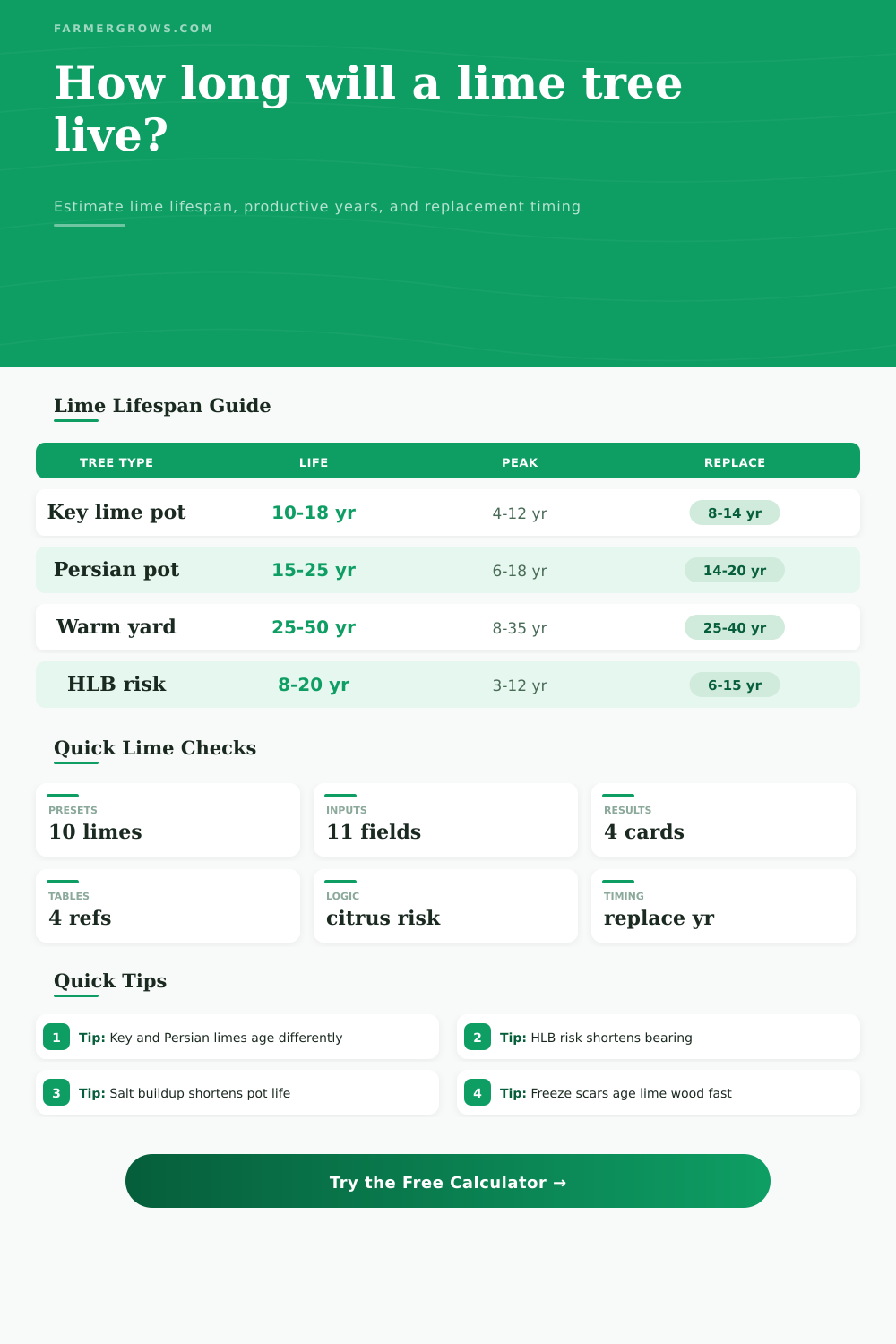
| Lime type | Typical life | Peak production | Main limit |
|---|---|---|---|
| Dwarf Key lime in pot | 10-18 years | 4-12 years | Root congestion, water swings, nutrient depletion |
| Large container lime | 15-25 years | 6-18 years | Root refresh schedule and winter protection |
| Semi-dwarf Persian lime | 22-40 years | 7-28 years | Drainage, freeze scars, citrus disease |
| Bearss, Persian, or Tahiti lime in ground | 30-55 years | 10-38 years | Trunk health, root disease, canopy renewal |
| HLB-affected lime | 8-20 years | 3-12 years | Canopy decline and poor fruit quality |
| Tree signal | Keep managing | Plan replacement | Replace soon |
|---|---|---|---|
| Healthy young tree | 0-8 years old with rising canopy | Only if wrong site or rootstock | Rare, unless diseased at planting |
| Mature stable tree | Steady flush, full leaves, normal fruit | Begin backup tree at 60-75% of life | When repair costs exceed harvest value |
| Container decline | If roots can be refreshed | When pot-bound and yield slows | If root ball is woody, dry, and sparse |
| Freeze-damaged tree | If trunk and graft are sound | After repeated scaffold loss | If trunk split or graft union failed |
| HLB or chronic decline | If symptoms are mild and yield useful | When canopy thins or fruit quality drops | With severe mottling, twig dieback, and low fruit |
| Factor | Low-risk effect | High-risk effect | Best correction |
|---|---|---|---|
| Drainage | Roots stay active for decades | Root rot can remove 20-50% of useful life | Raise crown, improve drainage, avoid wet mulch |
| Pot size | Large refreshed pot extends patio life | Small hot pots age limes early | Repot, root prune, and refresh mix every few years |
| Pruning | Light renewal keeps fruiting wood exposed | Hard topping and crowded interiors reduce vigor | Thin lightly after harvest and remove deadwood |
| Freeze history | Light leaf burn has small long-term cost | Trunk and scaffold wounds trigger decline | Protect graft union, paint exposed bark, prune after regrowth |
| HLB pressure | Low pressure allows normal lifespan planning | Confirmed decline can dominate replacement timing | Monitor symptoms, manage psyllids locally, replant strategically |
| Stage | Approximate age share | What to expect | Management focus |
|---|---|---|---|
| Establishment | 0-20% of expected life | Root growth, first flowers, light crops | Water consistency, shape scaffold, avoid overcropping |
| Build-up | 20-40% of expected life | Canopy fills and harvest rises | Feed citrus regularly, keep mulch off trunk |
| Prime bearing | 40-70% of expected life | Most reliable fruiting period | Maintain irrigation, sanitation, and light penetration |
| Late bearing | 70-90% of expected life | Yield depends more on renewal and root health | Start backup tree if decline signs appear |
| Replacement window | 90%+ of expected life | Survival may continue after harvest value falls | Compare renovation cost with new tree payoff |
For patio limes, replacement timing often follows root-ball quality. If water runs around a hard root mass and new flushes are weak after feeding, useful life is usually shorter than the calendar age suggests.
For yard limes, check the trunk, graft union, drainage line, leaf density, and fruit size. A structurally sound old tree can remain valuable, but chronic thinning often makes a young backup tree the practical choice.
The reason you planted the lime tree was this: You longed for juicy summer fruit, and perhaps even a hint of holiday fragrance in winter. As you envision it becoming a mature tree, it will provide abundant crops as you enjoy shade of its limbs at cocktail hour with a margarita in hand. More likely, things don’t play out like this. Most limes turns into short-lived, fussy citrus that won’t live nearly as long than any maples or oaks.
A lime trees life span is determined more by it’s environment then by its genetics. Under certain conditions, a potted Key lime may only live a decade. In other circumstances, an in-the-ground Persian lime can lives for half a century. Root space, water quality, and disease pressure usually makes all the difference. Understanding how these elements work help you decide when to keep caring for the tree and when to start planning for replacement.
How to Make Your Lime Tree Live Longer
This is where the calculator (above) comes in. It asks which stressors you’re dealing with: What’s the setting? What lime type are you growing? How strong is its rootstock? A lime grafted onto vigorous rootstock and set out in a rich backyard planting bed has nothing in common with dwarf Key in a five-gallon pot. Different stresses; different solutions.
The calculator accounts for how confined and restricted the roots are (and what size container). If the root system wraps around inside a smallish pot, the tree will survive but not realy grow well. So you’ve got a live tree but no more good fruit. That difference between surviving and producing matters. Why do most people replace their trees once the tree is dead? Smart gardeners replace them when the tree’s production isn’t worth maintenance cost anymore.
It isn’t just about variety; it also depends on your environment and specific type of lime you have. It’s also about rootstock. Certain rootstocks are vigorous (pushing for longevity and size). Others dwarf the trees (keeping them manageable, but shortening their overall life span). The calculator accounts for that, too, vs. It also considers how old your existing tree is. An older tree on weak roots speeds up the close of the productive window. Knowing that lets you time when to buy your next one properly. A new lime purchased in spring will mean waiting another couple of years for fruit. Miss that window, and you’re limes-less for quite awhile.
There’s another level: disease and climate. Citrus greening, or Huanglongbing, flips the equation. Even a seemingly healthy tree will drop like a rock in high-psyllid zones. Regional HLB threat is built into the tool. So are the effects of freezing weather. Because lime wood is tender; one hard frost kills scaffold limbs, cracks trunks. Repeated freeze damage is even worse because it hasten aging by forcing regeneration again and again. This weakens the structure and invites rot at each wound. The leaves are green but the strength below is hollow.
Salt stress is the silent killer of container growers. Over time, hard water accumulates in your soil. Leaves show burn at the tips. Growth rate gradually slows year after year. Root system may get compromised before you even see severe damage. Flushing the soil out can help…but usually doesn’t reset the clock entirely. The calculator considers salt pressure to arrive at a realistic estimate. This reminds us that both water quality and fertilizer choice are important. Poor drainage makes it worse. Wet soil also promotes root rot caused by phytophthora. Good airflow and keeping the crown dry saves more trees than all supplements combined ever will.
Growth also depends on pruning. Regular (light) pruning allows more light to enter the canopy. This leads to fewer fungal problems. It also encourages more fruiting wood. A hard topping is a shock to the tree, causing it to take longer to recover. That might look nice in the short term, but would of cost you years of strength down the road. If your citrus is getting shade, it’ll gradually weaken them over time. It will not kill them overnight. But stretch out their decline so that you end up with fewer flowers, smaller leaves, then production is negligible.
The tool includes how much sun they are getting as well as your pruning practices. And here’s what we’re looking at: all of this together. When you see it all laid out, it makes sense why some limes make it to age 10, while others reach 40 or beyond. It’s not so much luck. It’s managing the unseen stresses that add up over the life of any plant. The tree will tell you where it is in that process; know how to respond appropriately based off which stage it’s at.
Need a backup? Time to get started on growing one. Still in build-up mode? Protect those roots with a vengeance. Invest in a lime tree. It’s a long-haul commitment. Handle it accordingly. Plant it for shade. Plant it for juice. Keep it happy long enough to provide both.