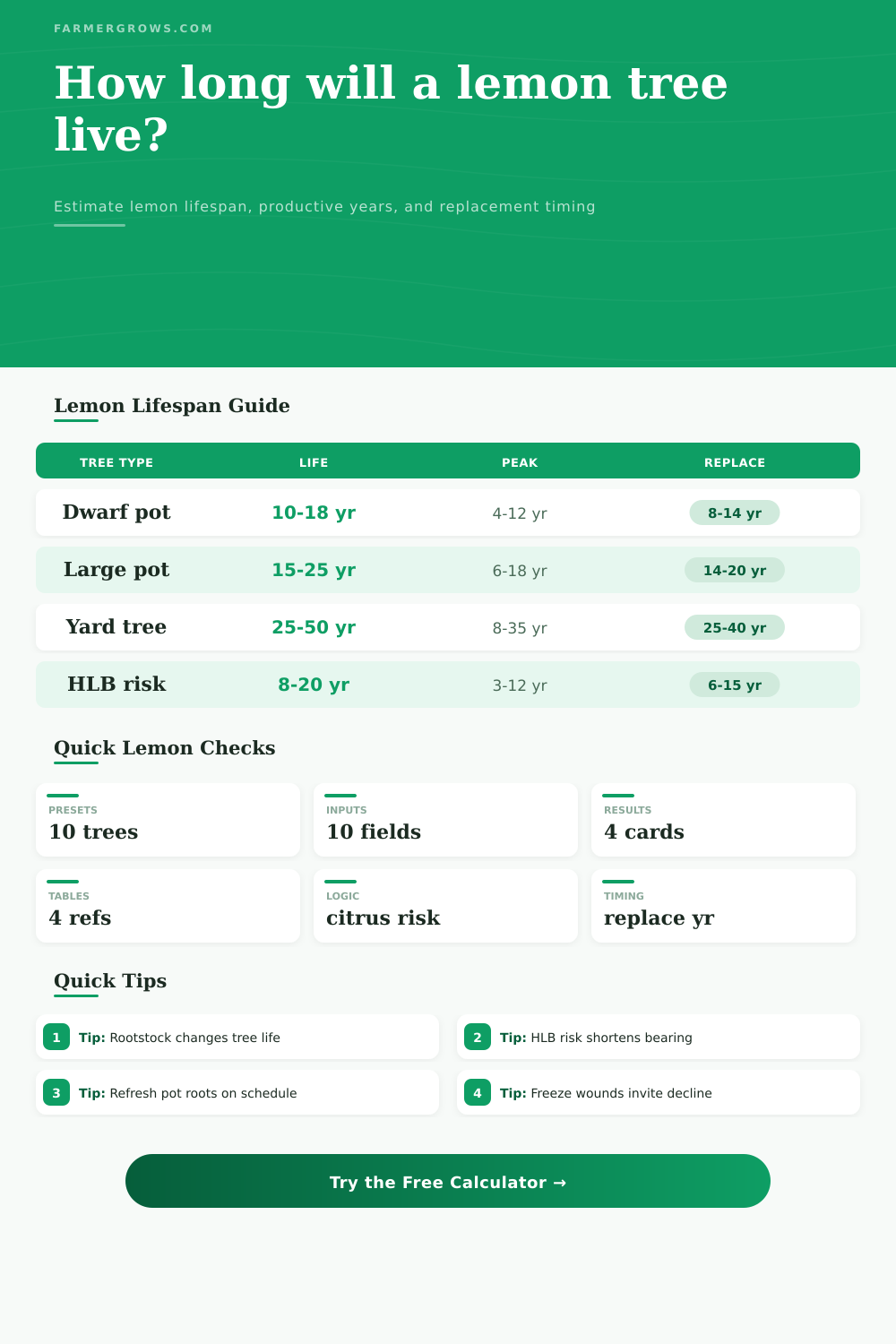
Lemon Tree Lifespan Calculator
Estimate realistic lemon tree life, remaining productive years, age stage, decline risk, and replacement timing using citrus-specific stress factors: rootstock, container root room, freeze wounds, HLB pressure, drainage, sun, pruning, and yield trend.
Choose a lemon profile, then adjust the tree age, rootstock or tree form, growing setting, pot size, HLB pressure, freeze injury, pruning, drainage, sun, and yield trend.
Useful life depends on pot volume, watering stability, and root refresh cycles.
Can stay productive longer when roots are pruned and soil is refreshed.
Best longevity comes from well-drained soil, full sun, and low disease pressure.
Repeated wood injury reduces canopy age and raises trunk disease risk.
Productive replacement usually comes earlier when symptoms and yield loss appear.
Lemon lifespan estimate
Adjust inputs to estimate your tree's productive window.
| Lemon type | Typical life | Peak production | Main limit |
|---|---|---|---|
| Dwarf Meyer in pot | 10-18 years | 4-12 years | Root congestion, water swings, nutrient depletion |
| Large container lemon | 15-25 years | 6-18 years | Root refresh schedule and winter protection |
| Semi-dwarf yard lemon | 22-40 years | 7-28 years | Drainage, freeze scars, citrus disease |
| Standard Eureka or Lisbon | 30-55 years | 10-38 years | Trunk health, root disease, canopy renewal |
| HLB-affected lemon | 8-20 years | 3-12 years | Canopy decline and poor fruit quality |
| Tree signal | Keep managing | Plan replacement | Replace soon |
|---|---|---|---|
| Healthy young tree | 0-8 years old with rising canopy | Only if wrong site or rootstock | Rare, unless diseased at planting |
| Mature stable tree | Steady flush, full leaves, normal fruit | Begin backup tree at 60-75% of life | When repair costs exceed harvest value |
| Container decline | If roots can be refreshed | When pot-bound and yield slows | If root ball is woody, dry, and sparse |
| Freeze-damaged tree | If trunk and graft are sound | After repeated scaffold loss | If trunk split or graft union failed |
| HLB or chronic decline | If symptoms are mild and yield useful | When canopy thins or fruit quality drops | With severe mottling, twig dieback, and low fruit |
| Factor | Low-risk effect | High-risk effect | Best correction |
|---|---|---|---|
| Drainage | Roots stay active for decades | Root rot can remove 20-50% of useful life | Raise crown, improve drainage, avoid wet mulch |
| Pot size | Large refreshed pot extends patio life | Small hot pots age lemons early | Repot, root prune, and refresh mix every few years |
| Pruning | Light renewal keeps fruiting wood exposed | Hard topping and crowded interiors reduce vigor | Thin lightly after harvest and remove deadwood |
| Freeze history | Light leaf burn has small long-term cost | Trunk and scaffold wounds trigger decline | Protect graft union, paint exposed bark, prune after regrowth |
| HLB pressure | Low pressure allows normal lifespan planning | Confirmed decline can dominate replacement timing | Monitor symptoms, manage psyllids locally, replant strategically |
| Stage | Approximate age share | What to expect | Management focus |
|---|---|---|---|
| Establishment | 0-20% of expected life | Root growth, first flowers, light crops | Water consistency, shape scaffold, avoid overcropping |
| Build-up | 20-40% of expected life | Canopy fills and harvest rises | Feed citrus regularly, keep mulch off trunk |
| Prime bearing | 40-70% of expected life | Most reliable fruiting period | Maintain irrigation, sanitation, and light penetration |
| Late bearing | 70-90% of expected life | Yield depends more on renewal and root health | Start backup tree if decline signs appear |
| Replacement window | 90%+ of expected life | Survival may continue after harvest value falls | Compare renovation cost with new tree payoff |
For patio lemons, replacement timing often follows root-ball quality. If water runs around a hard root mass and new flushes are weak after feeding, useful life is usually shorter than the calendar age suggests.
For yard lemons, check the trunk, graft union, drainage line, leaf density, and fruit size. A structurally sound old tree can remain valuable, but chronic thinning often makes a young backup tree the practical choice.
When you buy A lemon tree (or any other kind), most of us don’t purchase it with landscape design in mind; we expect it to bear fruit. After three years, however, maybe you notice some yellowing of its leaves. Where’s my crop? The plant starts to decline…no apparent reason…and eventually dies. Generally it wasn’t old age that killed it. Typically, a mix of factors including unseen disease, water issues, or root stress shortens the life span long before the tree look simply “old.” To know how to kill a lemon tree, or any tree, look beyond the leaves to the ground beneath: examine the soil and roots.
Once you’ve inputted your specific circumstances, the calculator (above) do the math for you. It considers the combination of container size, local disease threat, etc., and even takes into account the type of rootstock being used. Home gardeners tend to think “as long as I water it well, my standard Meyer lemon will last forever.” Wrong. Vigor from the rootstock sets the baseline; then the environmental conditions decide what percentage of that potential gets shown.
Why Lemon Trees Die Early
An extra-vigorous rough lemon rootstock may be happy growing in heavy soil, while a dwarf variety grafted onto a weak rootstock could barely get by in open. Know what kind you have, because the aging curves of the two types are completely separate. Trees in pots are different than trees in the ground, of course. Containers limit the roots: A root ball will eventually become a tight mass that can no longer absorbs nutrients and take on water well. It’s said to be pot-bound; the tool reflects that by prompting me on when I last refreshed my roots.
Maybe it was never potted on, or hadn’t been done in years (you want to think: decades). Then the tree has basically aged beyond what its calendar age would indicate. Its roots have filled out the container, circled the inside, and suffocated new development. Sometimes you notice foliage getting thinner long before the tree itself is actualy dead. And most gardeners give up then, unaware that simply cutting back the roots and replanting in fresh soil could keep the plant alive another decade, during which time we might get many more good years.
For those of you with in-ground trees, it’s even more complicated. The main threats are freeze damage and poor drainage, which leads to other problems. Lemons don’t like their roots wet. And when they’re sitting in sodden soil, they becomes vulnerable to Phytophthora root rot, which will kill the vascular system in just months. The calculator takes into account your soil conditions, so if yours tends toward clay, and it gets waterlogged after rain, the estimated life will go down sharply, as the roots will be under constant stress.
Freezes work the same way. One bad freeze may just burn the foliage, which recovers. Multiple freezes that injure scaffold branches or the trunk will provide entry points for follow-up diseases. Wounds age the tree prematurely. Or what about citrus greening (HLB or Huanglongbing)? This one is the top limiting factor for how long lemon trees last in many areas. The canopy declines and nutrients aren’t transported. This causes the fruit to be irregular.
Because this alters the whole approach, they’ve added a disease-pressure option as an input. For those of us who have confirmed psyllids in our area, planning for a fifty-year-old tree isn’t possible. Plan for getting a replacement far earlier then the tree appears to be struggling. That’s spelled out nicely in the reference table on the page. It explains that the HLB risk moves the timeline away from long-term investment toward short-term management.
Light is not primary, but it is an important supporting player. Too much shade (especially from a dense, dark interior) promotes fungal problems and limits air flow. Keep the canopy open by pruning regularly so that sun can penetrate into the fruit-set areas in the tree center. It sounds like a little thing, but makes a difference throughout the tree’s life. Also note the trend of your crop. If you’re doing everything right but haven’t had as many fruits over the last couple of or three years, it could signal the start of the tree’s late bearing period. Time to plan to replace.
Not only do I want the tree to survive; I want it to be fruitful. A productive plant is worth something. An unproductive one is not (unless you’re collecting bonsai). With the help of the calculator, you can determine whether it’s a temporary setback (a bump in the road) or terminal decline (death by 1,000 cuts). And if it’s the latter, the calculator tells you.
Within roughly what time frame? Should you repot, fix drainage issues, prune, or replace it with a young tree while there is still an old tree to share roots with? More effort is saved knowing to cut your losses than to nurse a sickly lemon along. Bottom line: How successful you are at keeping the hidden stresses underground will determine how long you get from your citrus.