Olive Tree Lifespan Calculator
Estimate olive tree age class, realistic remaining life, productive years, freeze-damage recovery, drainage risk, pruning response, and the best window for rejuvenation pruning or replacement.
Choose a named olive scenario, then adjust cultivar, age, irrigation, pruning, freeze damage, soil drainage, disease pressure, planting setting, and vigor.
Precocious and efficient, but commercial hedge blocks often renew earlier than the tree's biological life.
Strong oil cultivars can carry long productive windows when drought and canopy shade are controlled.
Traditional trees have long trunks and scaffold life, especially in dry, mild, well-drained sites.
Table-fruit quality depends on renewal pruning, irrigation timing, and avoiding hard freeze damage.
A resilient choice for marginal cool climates, but repeated freezes can reduce productive canopy life.
Your Olive Lifespan Estimate
Results update after calculation.
Use these tables as planning ranges. Actual olive tree lifespan depends on cultivar, root health, freeze severity, pruning history, and whether the goal is maximum crop or living heritage value.
| Cultivar group | Typical life | Peak productive window | Rejuvenation cue |
|---|---|---|---|
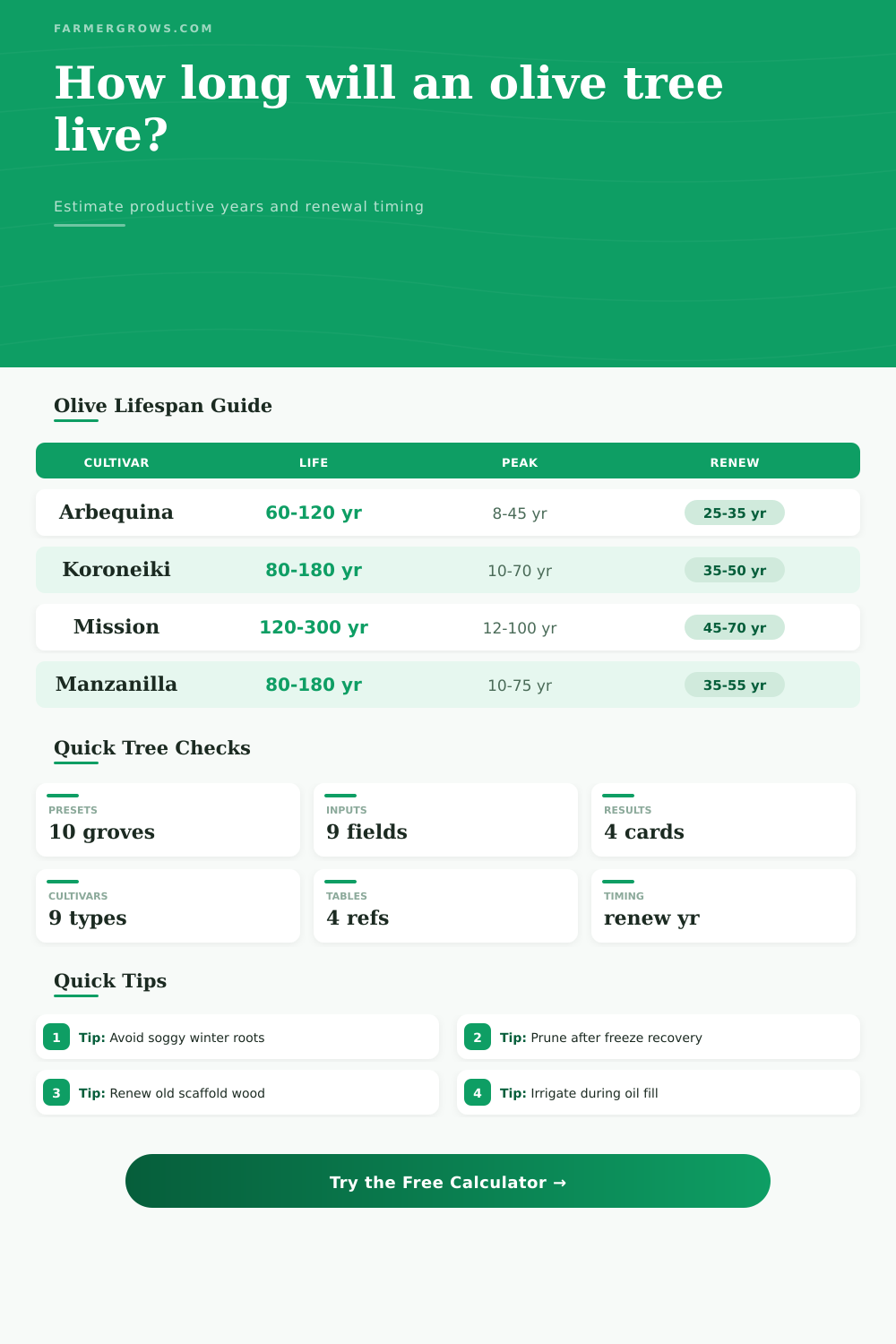
| Arbequina, Arbosana | 60 to 130 years biologically; hedge blocks often renewed sooner | Years 8 to 45, longer with open canopy and water | When row shading, weak fruiting wood, or harvest access limits yield |
| Koroneiki, Picual | 80 to 220 years in suitable dry climates | Years 10 to 80, especially with managed drought stress | When alternate bearing rises and inner canopy stops renewing |
| Mission, Frantoio | 120 to 300 years or more in mild, drained sites | Years 12 to 110, often extended by staged scaffold renewal | When scaffold limbs shade out fruiting zones or decay appears |
| Manzanilla, Kalamata | 80 to 190 years with good pruning and freeze protection | Years 10 to 75 for high-quality table fruit | When fruit size declines or freeze-damaged wood dominates |
| Leccino | 90 to 220 years where cold injury remains light | Years 10 to 85 with balanced canopy and healthy trunk | After hard freeze recovery or when canopy density lowers crop quality |
| Age class | Expected behavior | Best management | Replacement signal |
|---|---|---|---|
| Juvenile, 0 to 4 years | Rooting, trunk building, light or no crop | Train scaffold shape, avoid heavy fruit load, protect from freezes | Replacement only if trunk is girdled, roots fail, or freeze kills the base |
| Young bearing, 5 to 15 years | Increasing crop and canopy volume | Keep light in canopy, irrigate during flowering and sizing | Persistent weak growth despite water, drainage, and nutrition correction |
| Prime bearing, 16 to 60 years | Stable fruiting when renewal shoots are maintained | Annual light pruning, disease monitoring, harvest-access shaping | Production falls below goal for several seasons after good care |
| Veteran, 60 to 150 years | Long-lived trunk, aging scaffold wood, variable crop | Stage rejuvenation over several years and preserve healthy trunks | Major structural decay, severe freeze splits, or unreachable canopy |
| Ancient, 150+ years | Heritage value may exceed crop value | Conserve trunk, renew low shoots, avoid shock pruning | Only replace for safety, root collapse, or site redevelopment |
| Stress factor | Low risk | Moderate risk | High risk response |
|---|---|---|---|
| Irrigation | Steady water in bloom and oil fill | Short dry spells reduce crop but not tree survival | Erratic drought and overwatering reduce vigor and bearing life |
| Freeze damage | No injury or light tip burn | Canopy dieback delays crop for 1 to 3 years | Trunk injury can reset scaffold age and invite decay |
| Soil drainage | Rocky slope, raised berm, or sandy loam | Heavy soil that drains after storms | Standing winter water can cause root death and rapid decline |
| Pruning | Light annual thinning and renewal | Occasional pruning with some shaded wood | Topping or neglected dense canopy shortens productive years |
| Scenario | Main goal | Renewal timing | Planning note |
|---|---|---|---|
| Patio olive in container | Compact form and ornamental crop | Root and canopy renewal every 4 to 8 years | Container life is limited by root volume, heat, and watering swings |
| High-density hedge row | Efficient mechanical harvest | Assess at 25 to 40 years | Block replacement may come before biological tree death |
| Backyard fruiting tree | Reliable table or oil harvest | Begin scaffold renewal around 35 to 70 years | Keep canopy reachable and favor young fruiting shoots |
| Heritage landscape tree | Living trunk and cultural value | Renew slowly, often after 80+ years | Preserve sound wood and avoid removing too much canopy at once |
Stage rejuvenation. Remove old scaffold wood over several seasons so the tree keeps enough leaves to feed recovery shoots.
Fix drainage first. A mature olive can tolerate dry soil better than saturated winter roots, especially in clay or low spots.
Read freeze damage slowly. Wait for spring regrowth before major cuts; live cambium may push shoots after a delay.
Separate crop life from tree life. Old olives may live for centuries, while commercial yield goals may justify renewal much earlier.
This calculator gives planning estimates, not a diagnosis. Inspect trunk decay, root health, local freeze history, and cultivar performance before removing a mature olive tree.
It feels like planting an olive tree means forever. With shovels, a little sapling, standing there in it. A century-old tree in Tuscany or Crete, they tell you at the garden center that’s how long you’ll wait. It is romantic. Mostly false in your back yard.
Once you plug in the particulars of where you live, the calculator on this page do the math. That prevents you from treating a landscape icon like a museum piece. The big misconception is mixing up productive lifespan with biological lifespan. If I leave an olive tree alone and provide plenty of water, it may live to be three hundred years old. But that’s not what we’re talking about here.
How to Make Your Olive Tree Live Longer
We are talking about its productive life span (i.e., when does it stop yielding good table olives, or top-notch oil?). As the wood grows older, as the canopy shades out and blocks the sun from reaching fruit, fruit quality diminishes. The tool on this page breaks down two lifespans. When will the tree die? When will it cease being worth picking? Because that difference impacts how you maintain the tree completely.
First, consider the cultivar. Nine popular varieties is available here; each has a distinct genetic clock. Arbequina, for instance, is compacted for early productivity in high-density plantings. By age five, some of them may begin producing fruit. But they hit their commercial stride more rapidly… And will fade quickly thereafter.
Other heritage selections, such as Frantoio or Mission, take years to fill out. Their scaffolding are designed to last for decades. Not only does selecting variety depend on flavor preference; it depends on matching the tree’s growth habit to your own patience.
And then there’s the environment, which adds length and subtracts life from that lifespan. Olives hail from dry regions, so most of us fret about drought. Yes, they like heat; no, they don’t like wet feet. That’s their killer. It is not so much the heat as it is the soggy soil that suffocates roots over winter; heat will wither them during summer, but it won’t kill them. Saturated soil will kill them sooner then hot, dry soil. The calculator’s drainage input is set for a reason: it can be death to have soggy ground in winter.
Are you planting in heavy clay that you haven’t improved? You’re betting against longevity… And it’s a nasty gamble few rookie growers realize until next spring when some trees shows dieback. Another silent assassin in the longevity department: Freeze damage. A hard frost will send a whole year’s worth of shoots up from trunk, looking like the tree is recovering; but really, it’s resetting the clock for the number of productive years you’ve got left. That’s taken into account in the calculator, which knocks down expected bearing window if there was severe cold.
That’s also why the pruning strategy shifts with age. You should shape young trees and renew old ones. Too many years of letting an ancient canopy go all dense starves the interior wood, leading to decay that no amount of fertilizer can fix. Fertilizer won’t help either. The tool also assists in planning ahead for that renewal phase: it tells you when’s the right year to do heavy rejuvenation pruning, or even replace things when the crop quality has fallen beneath your threshold. Don’t wait until they are dead; you should of been waiting for decline rather than death.
This is laid out on the page in age class reference tables, which tell you just what sort of maintenance is required at every step from juvenile training through veteran conservation. The takeaway: An olive tree isn’t some set-it-and-forget-it monument, no. It’s a workhorse of a plant requiring care about light, water, and soil. Tend to it (pruning before the wood dies back), fix drainage now, and stretch out its useful lifespan many times over. Your hands will help create the reality. The calculator gives you the baseline. Begin with good roots. Keep an eye on the canopy. And who knows? Maybe you’ll pull off those centuries, too.