Apple Tree Lifespan Calculator
Estimate realistic apple tree life, remaining productive years, current age stage, disease pressure, rootstock lifespan, pruning response, crop-load stress, and replacement timing.
Choose a realistic tree profile, then adjust rootstock, current age, disease pressure, pruning quality, soil drainage, crop load, vigor, sun, and winter injury risk.
Fast to fruit, short-lived, best with careful watering and light crop loads.
Productive early, but replacement planning starts sooner than larger trees.
Useful middle ground with good care, renewal pruning, and drained soil.
Can be long-lived, but MM.106 suffers quickly on wet or root-rot sites.
Later bearing, deeper roots, and the longest practical productive life.
Apple Tree Lifespan Estimate
Results update after calculation.
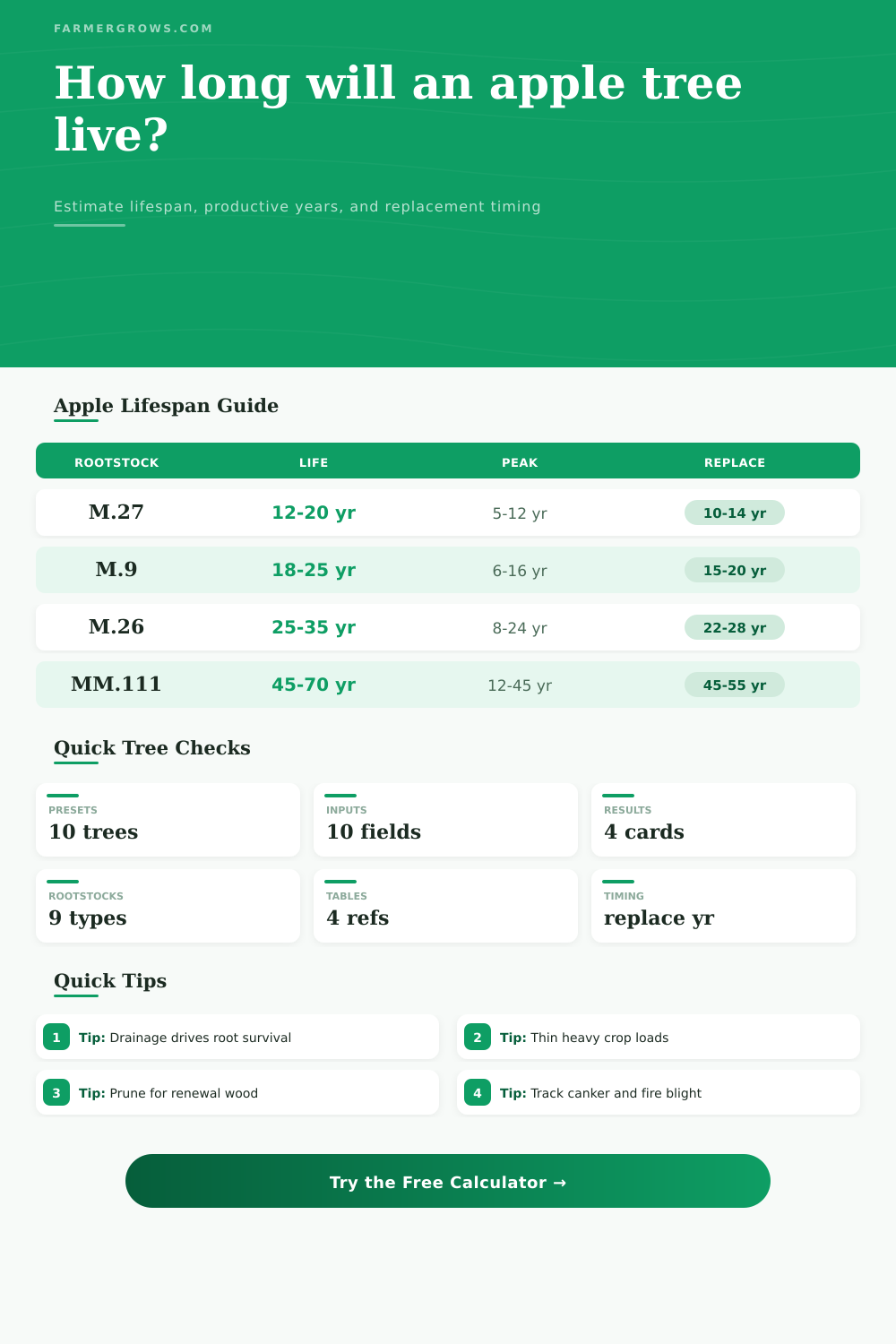
| Rootstock | Typical useful life | Peak productive period | Main lifespan limit |
|---|---|---|---|
| M.27 mini dwarf | 12 to 20 years | 5 to 12 years | Small root system, drought stress, crop overload |
| Bud.9 dwarf | 18 to 28 years | 6 to 18 years | Support, young-tree crop load, weak sites |
| M.9 dwarf | 18 to 25 years | 6 to 16 years | Permanent support and water balance |
| G.41 dwarf | 22 to 32 years | 6 to 20 years | Graft union, crop load, and support |
| M.26 dwarf | 25 to 35 years | 8 to 24 years | Burr knots, canker, and wet soil |
| M.7 semi-dwarf | 35 to 50 years | 10 to 35 years | Suckering, limb structure, and disease |
| MM.106 semi-dwarf | 32 to 45 years | 10 to 32 years | Root rot and poor drainage |
| MM.111 semi-standard | 45 to 70 years | 12 to 45 years | Canopy renewal and large-tree pruning |
| Seedling standard | 60 to 100 years | 15 to 65 years | Storm damage, hollow trunks, and neglect |
| Factor | Low pressure | Moderate pressure | High pressure |
|---|---|---|---|
| Disease pressure | Clean bark, minor scab, active sanitation | Recurring scab, mildew, small cankers | Fire blight, borer injury, scaffold canker |
| Soil drainage | Roots dry down after rain | Occasional wet feet or compacted layer | Standing water, root rot, heavy clay pocket |
| Pruning | Annual renewal cuts and open canopy | Irregular pruning with some crowding | Large wounds, shaded interior, neglected limbs |
| Crop load | Fruit thinned and limb load managed | Heavy years corrected after bloom | Repeated overload, biennial bearing, broken limbs |
| Vigor | Healthy shoots and leaf color | Short shoots or inconsistent growth | Dieback, sparse leaves, shrinking canopy |
| Stage | Approximate share of lifespan | Production behavior | Replacement action |
|---|---|---|---|
| Establishment | 0% to 15% | Framework growth, few apples | Protect trunk, train scaffold, avoid overcropping |
| Young bearing | 15% to 35% | Yield climbs quickly if vigor is balanced | Thin fruit and keep leader or trellis structure strong |
| Prime production | 35% to 70% | Best balance of fruit size and reliable bearing | Maintain renewal wood and monitor canker points |
| Mature decline | 70% to 90% | Yield may stay fair but recovery slows | Start replacement planting or graft renewal plan |
| Late life | 90% plus | Hollow limbs, lower vigor, irregular harvest | Replace if safety, disease, or yield goals matter |
| Scenario | Keep and prune | Plant overlap tree | Remove soon |
|---|---|---|---|
| Healthy dwarf tree | Age under 70% of adjusted life | Age 70% to 85% or yield falling | Major canker, broken union, or poor support |
| Semi-dwarf home tree | Good vigor with clean scaffolds | Decline begins but trunk is stable | Root rot, unsafe limbs, repeated fire blight |
| Large old standard | Structure safe and annual renewal works | Harvest height or fruit quality becoming difficult | Hollow trunk, storm splits, severe dieback |
| Commercial block | Yield and fruit size still meet target | Return per tree drops below block goal | Training system failure or chronic disease hotspot |
Dwarf apple trees are efficient but not immortal. Plan replacement earlier for M.27, M.9, and other tightly managed dwarf systems.
Track canker, fire blight strikes, borer entry, and repeated dieback. Chronic structural disease often matters more than calendar age.
Apple roots can tolerate many soils, but poor drainage sharply shortens life on sensitive rootstocks such as MM.106 and M.26.
Plant the next tree before the old one fully fails when space allows, so first bearing overlaps with the old tree's decline.
Sometime in far future your apple trees will go downhill. First there’s less fruit or it gets smaller. Next branches begins to thicken up and then diminish. At some point, they simply won’t bear anymore. What a letdown! But most times it’s merely naturaly aging, not betrayal. As finite resources, apple trees has limited lives; their passing is biology, not mechanics.
If you know where your tree stands in its lifecycle, you can plan ahead for replacement before it has no more to give. Enter your site and rootstock conditions into the calculator above and it’ll do the numbers. Goodbye guesswork; hello reality.
Why Your Apple Tree Will Die Sooner or Later
Rootstock is the one big variable in the equation. No matter what else you do, the genetics of the tree are going to determine how long it lasts. Miniature dwarfs like M.27 is miracles of moddern horticulture because they fruit quickly and stay small. But they pay price for their convenience in having a very short life expectancy… Maybe just fifteen years or so. By contrast, standard seedling trees will last up to eighty years in your yard (if you don’t mind the problems harvesting from them). Time versus space, then, is the tradeoff. Do you want an easy pick now, or a legacy tree for your grandchildren?
Semi-dwarf M.7 or MM.106 rootstocks: These provides a nice compromise between manageable size and a few decades of productivity.
Another thing about trees is that soil drainage does not get nearly as much credit as it should when it comes to killing a tree. Apples requires oxygen in their roots; a water-logged root system will slowly suffocate them. So if you’ve got puddles in your yard during heavy rains, even a tough MM.106 rootstock will begin to decline far ahead of schedule on its calendar death day. You can rate your own soil drainage. The tool will take that into account by reducing the estimated lifespan if your drainage is poor. Bad soil physics trump good intentions. And yes, rotting roots mean a dead tree, regardless of all the fertilizer and pruning you do. That’s another reason why careful site selection (or making raised beds) means more than what apple variety you graft onto what rootstock.
Crashing: How a tree dies abruptly or fades gracefully is dictated by its pruning style. A well-pruned tree remains open with its canopy. This allow for annual renewal pruning, which forces it to produce new wood. This, in turn, sets the stage for bearing more fruit down the road. Neglected trees grows into a thicket of shade-cast branches and dead twigs where disease festers. When the insides die, the exterior typically follows shortly after. That’s what shows up on vigor and pruning-quality inputs. The calculator’s probably going to reflect fewer years left if you’ve neglected your tree for several year. Less structural reserve in the tree mean there is less to call on under stress.
Another big issue is disease. A tree that’s struggling with fire blight or crown rot isn’t just ugly, it’s compromising both the structural strength of its scaffold branches and their vascular systems. Each spring it must fight off repeated infections instead of focusing on maintaining healthy roots and producing fruit. Chronic stress shortens its lifespan. To reflect this, the calculator takes disease levels into account when adjusting the timeline, a sick tree will be shorter-lived then its theoretical max.
That is the main point when it comes to planting trees for succession. Even if not quite on their last legs, begin adding new trees where the old ones are fruit-bearing, so there will always be some apples, or whatever. If you wait till the old one drops all its leaves, until it’s silent as death, then it’s back to square one. Time things to match information, remember, a good location with well-drained soil is the basis for all the rest.