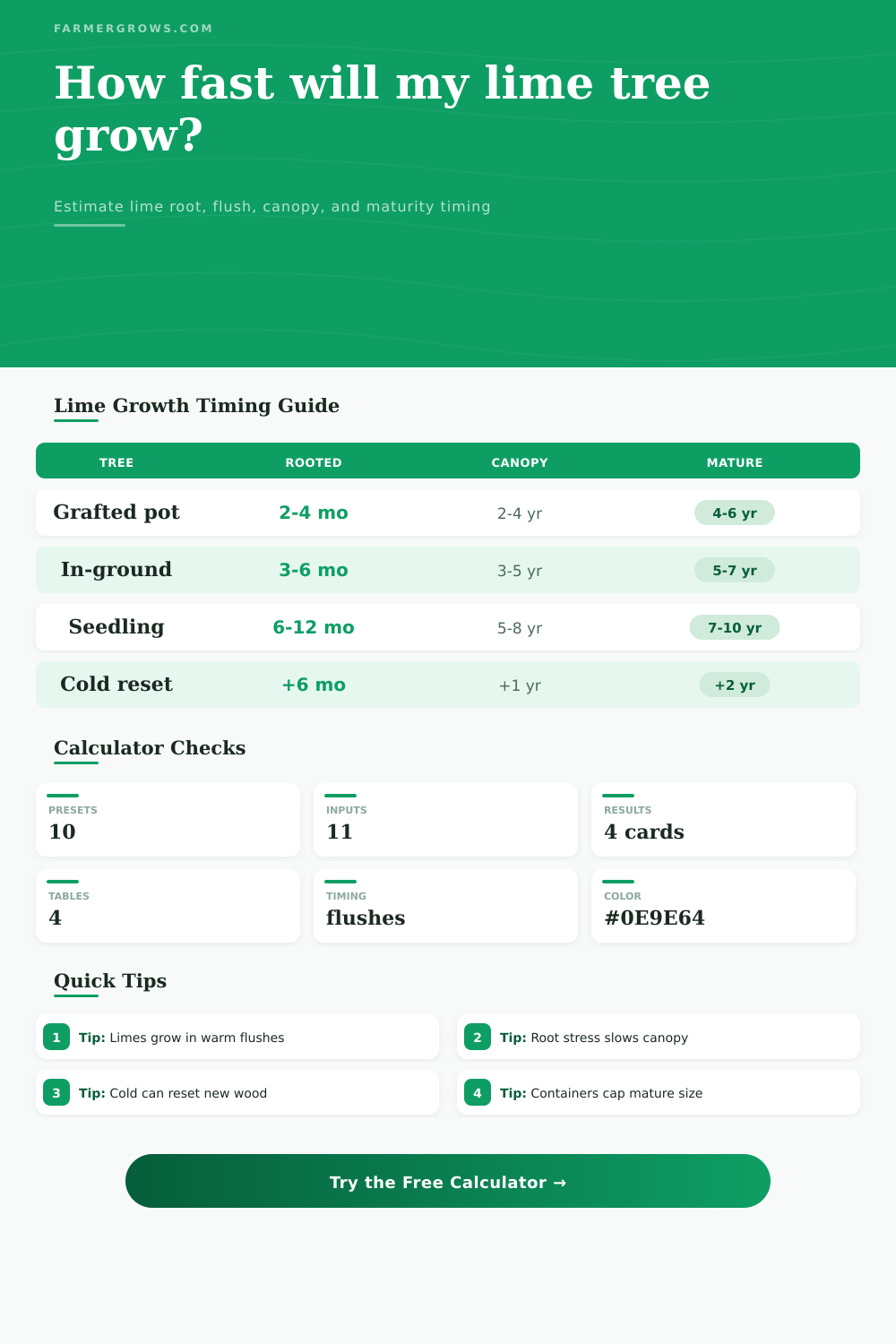
Lime Tree Growth Time Calculator
Estimate lime tree root establishment, next growth flush, canopy size, bloom readiness, and full productive maturity from variety, propagation, planting date, climate, container root room, pruning, sun, irrigation, soil drainage, and stress history.
Load a common lime planting, then adjust the fields for your real site. This growth calculator focuses on establishment and canopy timing, not only first fruit.
New limes usually pause above ground while feeder roots settle, especially after pot shifts or transplanting.
Leaves and shoots arrive in flushes during warm, bright weather rather than as even weekly growth.
Container trees stay compact; ground trees fill faster when water, nitrogen, and drainage are steady.
Grafted limes mature sooner than seedlings, but cold injury and root restriction can reset the clock.
Your Lime Growth Timeline
Enter your lime tree details to estimate establishment, flush growth, canopy size, and maturity timing.
| Stage | Typical timing | What changes it | Growth sign |
|---|---|---|---|
| Transplant pause | 2 to 8 weeks | Root disturbance, potting mix, heat, and watering swings | Leaves hold color but shoots barely move. |
| Feeder root push | 2 to 6 months | Warm soil, oxygen, drainage, and steady moisture | New leaf tips start after irrigation becomes easier to manage. |
| First strong flush | 1 to 4 months in warm weather | Sun, nitrogen, pests, and pruning timing | Soft green shoots extend from branch tips. |
| Framework building | 1 to 3 years | Root room, wind, pruning, container size, and cultivar vigor | Scaffold branches thicken and hold repeated flushes. |
| Productive mature shape | 4 to 10 years | Propagation type, climate, cold injury, and root limits | Annual bloom, leaf renewal, and stable canopy size. |
| Lime type | Growth habit | 5-year size cue | Timing note |
|---|---|---|---|
| Key or Mexican lime | Fast, thorny, heat-loving | 8 to 14 ft in ground | Quick in warm zones but sensitive to cold setbacks. |
| Persian or Tahiti lime | Moderate to vigorous | 10 to 16 ft in ground | Common yard lime with steady canopy expansion. |
| Bearss lime | Vigorous Persian-type selection | 10 to 18 ft in ground | Often fills faster when drainage and feeding are strong. |
| Makrut leaf lime | Slower, compact, leaf-focused | 5 to 10 ft in containers | Can stay shrubby while still producing useful leaves. |
| Rangpur lime | Vigorous citrus relative | 12 to 20 ft in ground | Fast canopy in warm climates, often used where vigor matters. |
| Root setting | Growth ceiling | Repot cue | Calculator effect |
|---|---|---|---|
| Open ground | Highest canopy potential | Mulch ring expands each year | Fastest canopy and maturity path. |
| 15 gallon pot | Small patio tree | Dries quickly or roots circle bottom | Slower canopy with earlier root restriction. |
| 25 gallon pot | Useful patio size | Water runs down sides or growth stalls | Moderate delay, manageable with root refresh. |
| 45 gallon pot | Large patio tree | Top-heavy canopy and reduced flush size | Near-ground growth for dwarf or patio goals. |
| Root-bound tree | Low new growth until corrected | Wilting, yellowing, or tiny flushes | Adds delay and reduces size estimate. |
| Condition | Growth effect | Timing impact | Planning cue |
|---|---|---|---|
| Frost-free tropical | Frequent flushes | Short establishment and fast canopy | Watch pests and avoid overfeeding soft growth. |
| Warm subtropical | Strong spring through fall growth | Standard lime timing | Protect young trees during unusual cold snaps. |
| Cool coastal nights | Slower winter and spring starts | Adds a small delay to flush timing | Prioritize sun, wind shelter, and warm soil. |
| Indoor wintering | Low-light dormancy or leaf drop risk | Delays flush until outdoor warmth returns | Use bright light and avoid soggy winter roots. |
| Cold or root injury | Canopy rebuild phase | Can reset 6 to 24 months of growth | Prune after regrowth shows live wood. |
Read flushes, not daily height: Lime trees often sit still, then push a wave of leaves and shoots when warmth, light, and root moisture line up.
Roots set the clock: If a lime is root-bound, waterlogged, or freshly repotted, canopy growth usually waits until feeder roots recover.
Prune after growth starts: Hard pruning before a stressed tree resumes active growth can lengthen recovery and delay the next flush.
Containers need planned upgrades: A pot can keep a lime movable and protected, but the tree needs periodic root refresh to avoid stalled growth.
This calculator estimates planning windows for lime growth. Local rootstock, fertilizer, salinity, wind, pests, potting mix, soil temperature, water quality, and winter lows can shift real timing.
Plant a lime tree in spring; await its fruit. Nothing happen aboveground; leaves remain a beautiful dark green. Your neighbor’s lemon produce, meanwhile. Water, fertilize, fret: Something’s wrong, right?
It’s not neglect on the part of the tree; it’s an investment period, when energy goes underground more than up. Before feeding the heavy weight of fruit load or even supporting much top growth, new feeder roots has to settles into their new home, in time, and establish themselves in the root system. Don’t mistake a healthy pause for failure; the calculator will help you see the hidden phase involved.
How Lime Trees Grow
Limes don’t get their leaves on gradually each day, they come in spurts (known as flushes). Knowing this tell you where to expect things to happen. For lime trees, a flush happens if there is enough soil moisture. It must not be soaked or dry. A warming trend and enough light is also needed. The youngest wood that has softened to start stretching out need some nitrogen. That’s what signals the tree: Now go! Push another round of leaves and growing shoots.
Don’t prune immediately after a flush passes; if you do it while the wood is still tender, you’re cutting off very tissue destined to create the plant’s framework. Either plan to cut back in step with these natural cycles, or wait till they’ve hardened off. That all depends based off the time line and the setting.
A seedling in a small pot is not like a grafted tree in the ground. Because they’re confined in plastic, their roots cannot pushes out into the surrounding soil seeking oxygen and water. Without such freedom, the root system can’t keep pace with the needs of a hungry tree wanting to grow a large canopy. That’s where the grafted tree has an advantage. But then again, that’s different than being stuck in a small pot. There, immediately, the plant’s potential is curbed. You gain portability and control; you lose ultimate size.
And that’s what the tool on the page takes into account, root room (and shows how), for instance, a fifteen-gallon pot will limit your tree long before it attain its genetic potential size. Not that it ceases to grow completely, but rather its vigor levels off when roots have encircled the bottom of the container.
How patient are you? Your base-line patience level is set by the propagation type: With a grafted tree (made from mature scion wood), you get off to a running start, skipping the “juvenile” phase. The seedling must grow slowly, at its own pace, earning each inch upward. A grafted Persian lime may reach the same size as a seedling in just three years; the seedling might take seven. This doesn’t mean one is better than the other; it just means you need to have different expectations for each. If you started from a pit because it was free, know that now you are paying in time, not money.
It is a reset. Stress always does. Most commonly, cold injury resets the clock completely in marginal zones: “It may have survived a hard freeze intact,” the text says, “but it will be back at square one, having had all its newly emerging buds stripped off and having to heal itself.” That healing means resources goes to repairing cell damage rather than building new branches or flowers. And so you’ll get a half-dozen-month-or-more lag before another robust flush emerges.
This calculator takes such setbacks into account by nudging your growth window backward. It’s like remembering that any recent struggle influences how fast things will happen next.
It all comes down to one thing: soil drainage. Since citrus roots requires both air (oxygen) and water, they cannot stand a soggy soil environment. Rotting from poor drainage halts all plant growth. No matter how much fertilizier you apply, if your soil is stagnant; meaning it remains sodden following rainfall, you’re stuck. Steady moisture within good-draining soil promotes healthy root function but won’t drown the system.
So there are three elements: What does mature mean to you? (Not just how big was the initial crop, but how big would this be to support another year’s fruit, with a sound structure?) When do you expect it to reach that state? And what might that look like in terms of size? Refer to the size-expectation charts above to get an idea of what to expect. These charts shows realistic limits instead of ideal ones. Plan now, before the tree outgrows the space available for it in the ground or even in a container. Make room for its root system and the rest will follow.