Orange Tree Growth Time Calculator
Estimate orange tree flowering, first useful fruit, full bearing year, canopy size, harvest season, and frost timing from cultivar, rootstock, propagation, planting style, heat, water, pruning, and crop load.
Load a realistic orange planting, then adjust the tree age, rootstock, heat, frost, container size, irrigation, pruning, and crop load to match your site.
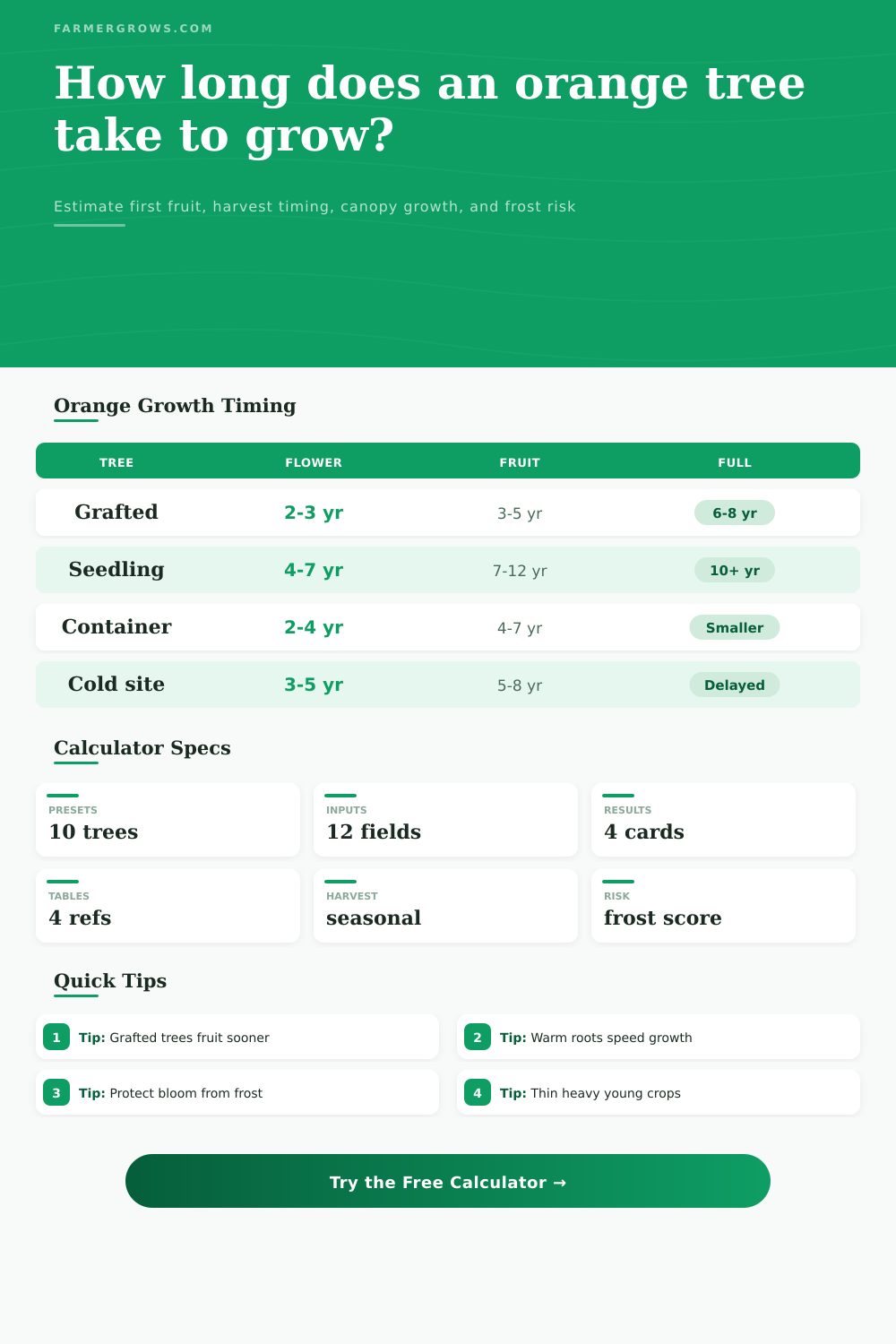
Grafted orange trees start with mature scion wood. Seedlings must pass a juvenile phase before regular bloom and fruit.
Trifoliate and dwarf rootstocks compact the tree; vigorous sour orange or rough lemon types build canopy faster in warm soils.
Oranges need warm months to size and sweeten fruit. Cool coastal or protected sites can flower on time but finish fruit slowly.
A small early crop is normal. A heavy crop on a young tree can slow root and canopy growth for the next season.
Orange Growth Estimate
Choose a preset or enter your orange tree details.
Timing Breakdown
| Orange type | First useful fruit | Harvest season | Timing note |
|---|---|---|---|
| Navel oranges | 3 to 5 years grafted | Winter into spring | Often dependable for home trees, but young crops may be small until canopy fills. |
| Valencia oranges | 3 to 5 years grafted | Late spring through summer | Fruit can hang late, so new bloom and old fruit may overlap on mature trees. |
| Blood oranges | 3 to 6 years grafted | Winter to early spring | Color improves with cool nights and warm days; cool sites may finish slowly. |
| Early sweet oranges | 3 to 5 years grafted | Fall into winter | Useful for early harvest planning where freeze risk arrives later in winter. |
| Seedling oranges | 7 to 12+ years | Unknown until mature | Juvenile phase and fruit quality are unpredictable. |
| Setup | Growth effect | Full-bearing effect | Watch-out |
|---|---|---|---|
| Flying Dragon dwarf | Compact and slower canopy | Easy harvest, smaller crop | Best for patio or very small yards. |
| Trifoliate semi-dwarf | Moderate growth with cold tolerance | Good small-tree balance | Needs compatible soil pH and drainage. |
| Carrizo / C-35 | Balanced citrus growth | Common home-orchard timing | Water stress delays canopy fill. |
| Vigorous rootstock | Fast canopy in warm soils | Large potential crop | Can outgrow small spaces and need pruning. |
| Container planting | Root-limited growth | Earlier flowers, lighter yields | Pot volume and watering rhythm control results. |
| Climate setting | Growth pace | Fruit finish | Protection cue |
|---|---|---|---|
| Zone 8 protected | Slow to moderate | Depends on protected heat | Protect young trees below the upper 20s F. |
| Zone 9 | Moderate | Good with warm summers | Cover young trees and watch bloom frost. |
| Zone 10 | Strong citrus pace | Reliable sweetness in warm sites | Manage irrigation and heat waves. |
| Zone 11+ | Fast vegetative growth | Some oranges need cooler nights for peak flavor | Prune for airflow and disease pressure. |
| Greenhouse container | Steady but root-limited | Can finish well with light and warmth | Hand pollination is rarely required but airflow helps. |
| Care factor | Speeds timing | Slows timing | Practical target |
|---|---|---|---|
| Sun | 8+ hours and open canopy | Shade below 6 hours | Place where winter and summer sun reach the tree. |
| Water | Deep, even irrigation | Drought swings or soggy roots | Moist but aerated root zone. |
| Nutrition | Small regular citrus feedings | Starvation or excess nitrogen flush | Feed during active growth, avoid late tender flush in cold areas. |
| Pruning | Light shaping and deadwood removal | Hard cuts that remove fruiting wood | Build structure first, then maintain access and airflow. |
| Crop load | Thin overloaded young branches | Letting a young tree carry too much | Favor canopy growth until the tree is sturdy. |
Use graft age wisely: A grafted orange can flower young because the scion is mature, but the first meaningful harvest still waits on roots, leaves, and branch strength.
Protect the first winters: Young trunks, graft unions, and tender flushes are easier to save than a full canopy after cold damage.
Do not over-prune: Citrus fruits on mature leafy wood. Hard pruning often trades next season's crop for vegetative regrowth.
Read fruit color carefully: Orange peel color can shift before sugar is ready. Use the harvest window as a guide, then taste-test mature fruit.
This orange tree growth estimate is for planning. Actual timing changes with cultivar strain, nursery quality, rootstock, soil temperature, salinity, irrigation, nutrition, freeze history, disease pressure, and local heat patterns.
Dig a hole for new orange tree, set the roots, plant it, and water it in. Maybe you’re dreaming of winter fruit and sticky-sweet juice? Wrong: Citrus take time. Layer by layer, the tree matures and begin to produce enough fruit to harvest. Knowing that helps you not freak out too early, and not make bad decisions when you are impatient.
What’s the single largest variable in your hands? How did you start the tree? Grafting insert mature (non-juvenile) wood onto another stock. Therefore, grafted trees enter life with an adult’s timing, and begin flowering early, often in just a couple of years. Seedlings, on the other hand, require multiple years to develop branches and foliage before they’ll bloom. That means waiting from 7 to 12 years. Prune seedlings hard, as if you want flowers, and you kills any hope of ever getting one.
How Long to Wait for Oranges?
This is where rootstock enter the equation. It influences the strength of top growth, and therefore also its space requirements. A dwarfing rootstock, such as Flying Dragon, holds those trees back to small sizes. Great for the small yard or for patio pots; but that’s limiting on your overall yield. Vigorous rootstocks, like rough lemon or sour orange, push canopy fast in warm soil conditions. They’ll quickly fill up big orchard spots; just be sure you anticipate their size, because they may well outpace your fence line. Use the table of references to pair your anticipated space with root vigor so you’re not surprised by an oversized tree in five years.
What’s the speed limit? It is about the climate. You may have heard that heat units count. More than you’d imagine. Warmer months are necessary to build up the sugar content in oranges as well as get them sized properly for fruit. Even though a cool coastal location can cause flowers to appear on schedule, it frequentely causes them to fall off. Then they make little sour fruits because summer didn’t burn hot enough to get job done. And then there is frost, which is also a timing matter. Young trees are tender in their early years, and it is easier to protect the graft union or trunk during those first couple of winters than to replace a dead tree later on. Plug in your local low temperatures, and the calculator do the math. It tells you how fast your growing conditions will support a specific cultivar, giving you an idea of whether that is a reasonable expectation for your site.
Don’t be fooled by a premature crop, just because your tree produced fruit early doesn’t mean that it’s mature enough to go at full throttle. A third-year orange tree may bear a few fruits, which look like a good sign (yay, it’s healthy!). But really: The fruit is taking energy from branches and roots. Thinning those fruits instead forces the tree to invest in its skeleton and become stronger next season. Force the tree to focus on growing branches and roots rather than making snacks, and thin out those early crops now. Yes, you are throwing away food, but you’re buying yourself a stronger tree down the road.
This is an engine driven by water and sun. Aim for 8 hours of direct sun a day. Anything less slows down the photosynthesis, postponing not just flavors but also ripening of fruit. Water must be consistent. Deep irrigation promote deep rooting, but frequent shallow watering keeps roots up top where they are vulnerable to being cooked by heat. The table below spells it all out. Moisture wins over spotty soaking every time.
Ready doesn’t necessarily equal ripe (which isn’t orange). It could of been orange-peel time before juice time; so taste. When you suspect the fruit is ready: Taste it. If it’s still tart, let it hang on. There are no laws about the harvest window, just guidelines. Get to know those rhythms and learn to work with tree rather than fight it.
Plant for the long haul. Thin out early crops and protect young growth. Wait for branches to sag under the proper weight of fruit. All that patience pays off in flavor, something no quick fix can replicate.