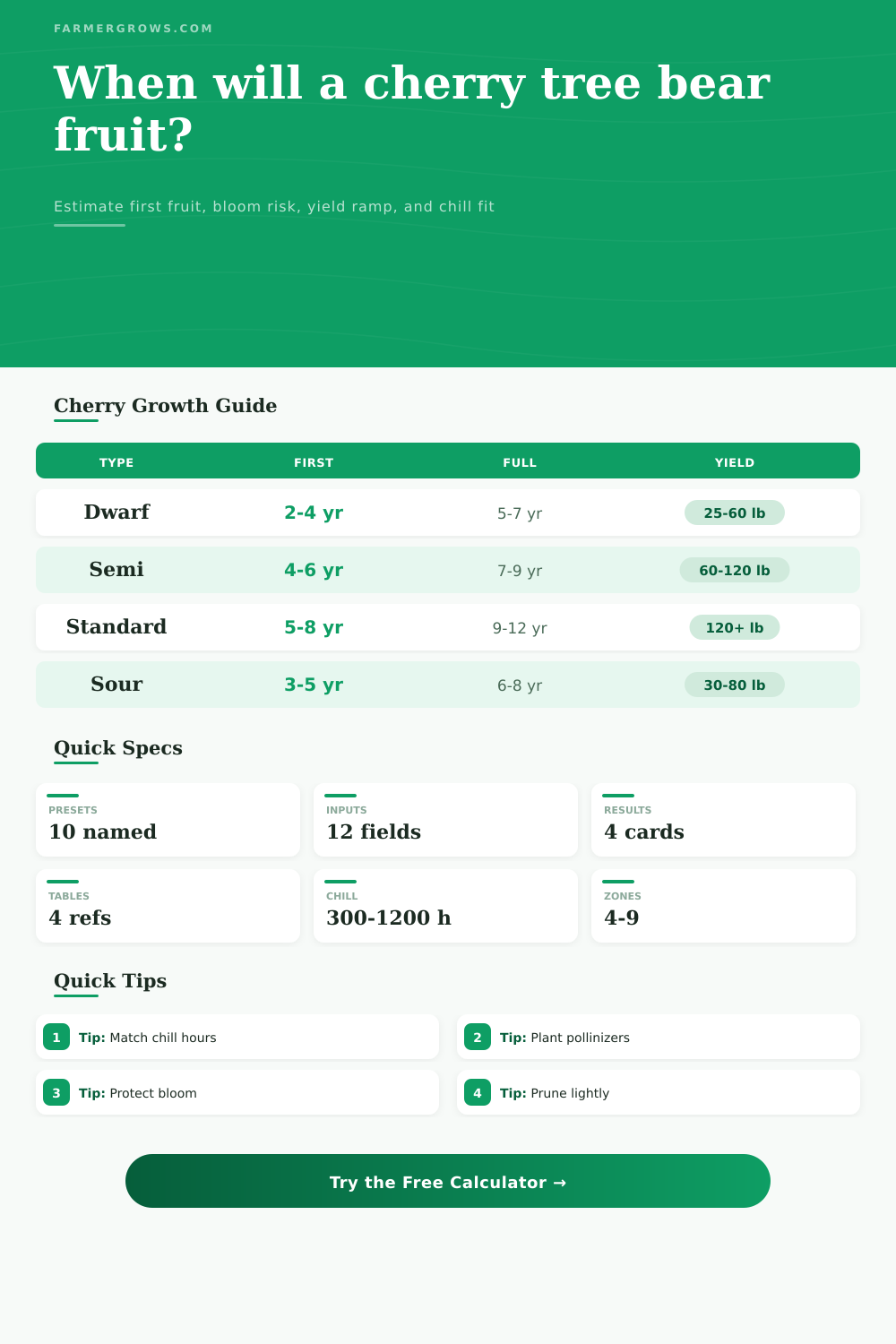
Cherry Tree Growth Time Calculator
Estimate when a sweet or sour cherry tree will bloom, carry its first useful crop, reach full bearing, and produce mature yields based on cultivar, rootstock, tree age, chill hours, pollination, pruning, frost risk, soil vigor, and irrigation.
Load a realistic cherry tree setup, then adjust dates, climate, rootstock, pollination, training, and crop load to match the tree in your yard or orchard block.
Dwarfing Gisela-style rootstocks usually crop sooner, while Mazzard and seedling standards spend more years building canopy before heavy yields.
Sour cherries often self-fruit and bear earlier. Sweet cherries can yield more, but pollination and frost exposure matter more.
Enough chill gives even bloom and leaf-out. Too little chill causes scattered flowers, weak set, and a slower bearing ramp.
Light structural pruning speeds fruiting. Heavy heading cuts can push vegetative regrowth and delay the first meaningful crop.
Cherry Growth Timeline Results
Results update as you change the cherry tree settings.
| Tree age | Expected stage | Crop level | Management priority |
|---|---|---|---|
| Planting year | Root establishment and scaffold selection | Remove fruit | Water deeply, protect trunk, and choose wide crotch angles. |
| Year 2 | Framework expansion | None to very light | Train leaders, avoid heavy heading, and prevent weed competition. |
| Year 3-4 | First useful crop on dwarf or sour trees | 5-35 lb depending on type | Keep limbs supported and net before birds learn the tree. |
| Year 5-7 | Strong bearing ramp | 25-90 lb on many home trees | Maintain light penetration, pollination, and steady moisture. |
| Year 8+ | Mature production for larger sweet cherries | 60-150+ lb where adapted | Renew fruiting wood, manage cracking, and protect harvest. |
| Chill class | Typical requirement | Cherry examples | Timing note |
|---|---|---|---|
| Low chill | 300-500 hours | Royal Lee, Minnie Royal, some warm-climate sweets | Useful in mild winters but may bloom early in changeable springs. |
| Moderate chill | 500-800 hours | Stella, Lapins, Sweetheart in suitable regions | Often fits zone 7-8 sites with reliable dormant rest. |
| High chill | 800-1100 hours | Bing, Rainier, Montmorency, many classic cherries | Best for colder winter sites with lower uneven-bloom risk. |
| Very high chill | 1100+ hours | Cold-region selections and some late bloom types | May fail in warm winters but can avoid premature warm spells. |
| Bud stage | Approx. risk temperature | Crop effect | Planning action |
|---|---|---|---|
| Dormant bud | Variety and hardiness dependent | Low spring crop risk | Choose adapted cultivars and avoid frost pockets. |
| Swollen bud | Low 20s F can damage buds | Moderate risk as buds advance | Watch cold snaps after warm spells. |
| Full bloom | About 27-28 F is concerning | Open flowers can be lost | Use covers on small trees and avoid pruning that advances bloom. |
| Petal fall / tiny fruit | About 28 F can injure fruitlets | Set may thin sharply | Delay crop estimates until fruit survival is clear. |
| Factor | First crop effect | Mature size effect | Watch-out |
|---|---|---|---|
| Gisela 5 or similar dwarf | Earlier fruiting | Smaller tree, high early productivity | Needs support, irrigation, and careful crop load control. |
| Gisela 6 / Krymsk 5 | Early to moderate | Semi-dwarf balance | Still needs pruning discipline and soil moisture. |
| Mazzard or seedling | Slower first crop | Large tree and high potential yield | Long wait, ladder height, and more bird-net difficulty. |
| KGB, UFO, or spindle training | Can speed usable cropping | Controlled wall or bush system | Needs annual renewal cuts and consistent limb selection. |
Pollination: Many sweet cherries need a compatible partner with overlapping bloom, while sour cherries and self-fruitful sweets are more forgiving for single-tree plantings.
First crop: A young cherry can flower before it should carry weight. Thin or remove early fruit if limbs are weak, especially on dwarfing rootstocks.
Water: Deep, even moisture supports fruit size and tree growth, but waterlogged soil can stunt cherries and increase root disease risk.
Protection: Birds, rain cracking, late frost, and bacterial canker can matter as much as age. Treat the estimate as a planning range, not a harvest promise.
Cherry growth estimates vary by cultivar strain, nursery quality, rootstock, microclimate, soil drainage, disease pressure, pruning system, and local frost pattern. Use the calculator for planning and compare it with local extension guidance and your own tree observations.
A cherry sapling goes into ground in the spring, with dreams of snacking and pie come summertime, but it might take three or four years before that tree yield any fruit. Nature doesn’t run on linear clockwork, as though we were building something. Fruit-bearing depends on factors such as strength of the pollinating partners; how long it takes the tree to establish itself; its inherent vigor in the chosen rootstock; how many chill hours is experienced; and the exact timing of these events.
The number-crunching for all this (after you plug in your locale’s climate details and which variety you’re planting) are done by calculator up top. No more guesswork on conversions and coefficients.
Why It Takes Time for Cherry Trees to Grow Fruit
It’s important to understand: A cherry tree isn’t a machine you turn on; it’s an organism. It will need to establish its root system, then begin directing energy toward reproduction. That’s why the age of nursery stock and planting date are factors. You don’t have much work in a one-year-old whip, who must find his feet first.
Then there’s the issue of picking a good rootstock: The timeline gets even extended beyond your wishes if you choose poorly. Gisela dwarfing rootstocks hurry things along: They limit the size and makes the tree put more energy into fruit. But standard rootstocks take much longer to bear fully, trading off short-term satisfaction for long-term security.
Another variable that trips up many gardener is chill hours. Sweet cherries (most of them) need several hundred hours of temperatures under forty-five degrees F during winter dormancy. Without sufficient chill where you grow it, those buds don’t break evenly in springtime. Flowers bloom unevenly, fruit doesn’t form well, and the crop look like a small snack instead of a full harvest.
This page has a tool to see if your area will deliver the chill needed by variety’s genetics. This is a simple fit check that keeps you from purchasing trees appropriate to Minnesota but growing in California, for instance.
Growing cherries introduces one more wrinkle: They require pollination. Many beloved sweet cherry varieties aren’t self-fruitful and rely on a nearby partner with overlapping blooms to move the pollen well. Plant a Bing and you may bear flower buds annually. But no fruit at all if there’s nobody nearby to help.
For those who only want a single tree, self-fertile types such as Lapins or Stella do away with that issue. To account for a pollinizer within range, or select a self-fertile type, the calculator will adjust according for your potential yield. It is a little something, but it is hugely important for how much you will actualy harvest.
Frost damage is a big factor again for everyone who grows any kind of stone fruit. Sometimes, the warm spell that triggers their blossoms comes just before the final killing frost and then…wham. Gone. Those fragile blooms are toast after one night if your normal spring temps has been crazy hot/cold swings.
To get you a risk score (not that it predicts what the weather will do next April), the tool takes into account both the probable bloom window and your zone’s usual last frost date. That way you know the overall statistics and may choose where to plant according, or cover things up to reduce the risk. Knowing the risk ahead of time is managing expectations.
Pruning practices also affect how soon a tree goes into production. A young tree with heavy heading cuts will push vigorous (green) vegetative growth, which bears no fruit, but light structural pruning that opens up the canopy let more light in to encourage early formation of flower buds. Training system affects the math of when you see your returns, so there are settings for this in the calculator.
Your tree won’t be what it’s going to be ten years from now, though. It’ll take several years to ramp up from nothing into full-scale production. You might get one or two pounds in year three and double that by year five. You will reach mature production only after seven or eight years, so you aren’t discouraged by the years when things come up short.
This isn’t just a matter of virtues like patience (though yes: Patience is indeed necessary in agriculture). These estimates let you time yourself realisticly so you know how much patience to muster, what meal planning will mean and how much netting you might need. Part of the deal is waiting for this thing to grow; knowing exactly how long you should of waited makes the waiting easier.