Blueberry Spacing Calculator
Plan blueberry bush spacing by bed length, bed width, row spacing, cultivar vigor, hedge or individual plant style, pollination group, pine bark mulch depth, and expected mature yield.
Load a real cultivar and planting style, then tune the site dimensions, row spacing, mulch depth, bed width, and pollination mix for your field or garden.
Best for hand picking, air flow, pruning access, and mixed cultivars in a home garden.
Uses closer in-row spacing so plants fill together into a productive ribbon after establishment.
Needs more row spacing to keep equipment from brushing canes and compacting the root zone.
Bed width controls how many rows fit while pine bark mulch protects shallow blueberry roots.
Blueberry Layout Results
Enter your dimensions and spacing to estimate rows, bushes, mulch, and yield.
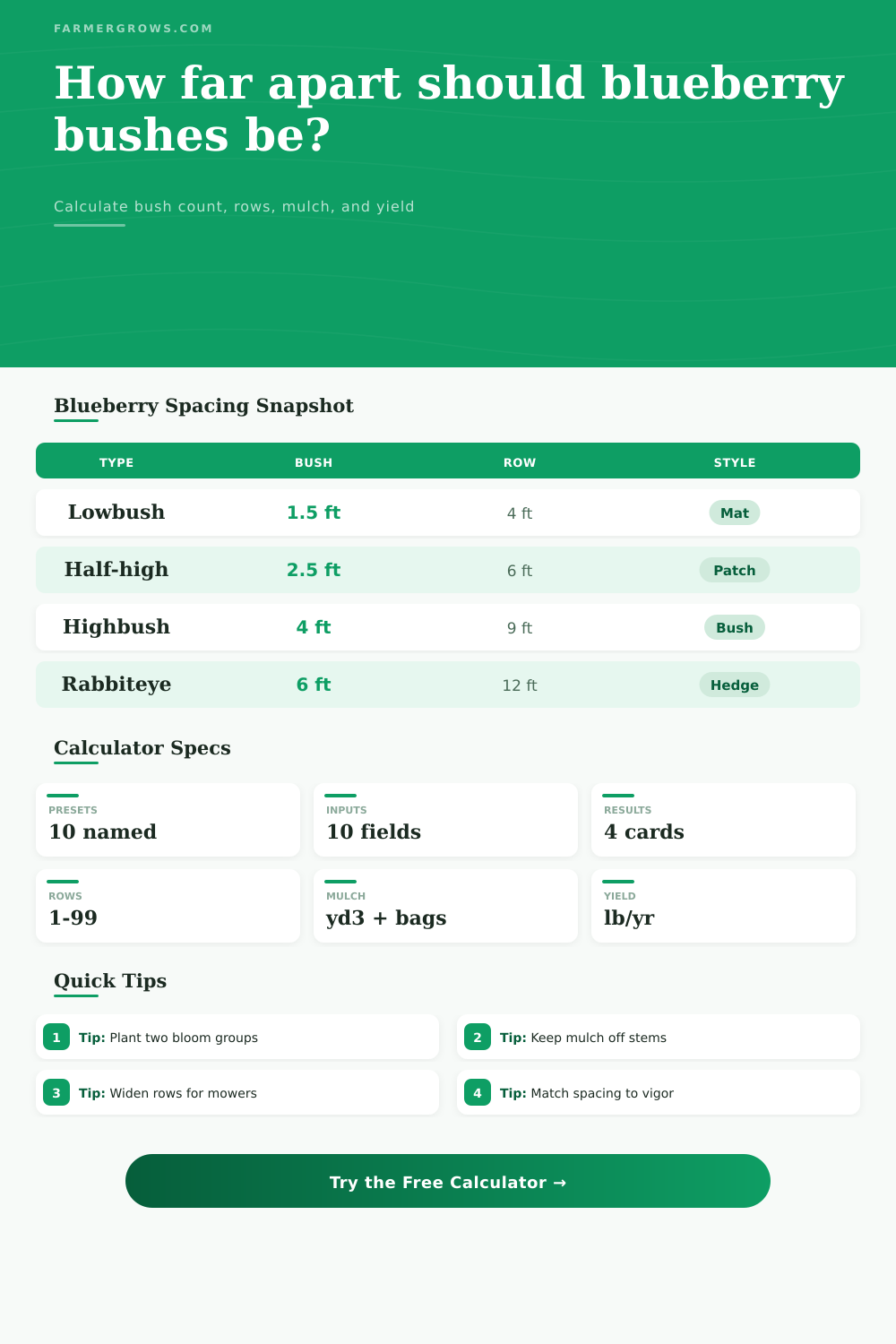
| Blueberry type | Common cultivars | Bush spacing | Row spacing | Typical mature yield |
|---|---|---|---|---|
| Northern highbush | Duke, Bluecrop, Elliott | 4 to 5 ft | 8 to 10 ft | 5 to 12 lb/bush |
| Southern highbush | Legacy, O'Neal, Misty | 3.5 to 5 ft | 8 to 10 ft | 4 to 10 lb/bush |
| Rabbiteye | Powderblue, Tifblue, Climax | 5 to 7 ft | 10 to 14 ft | 8 to 18 lb/bush |
| Half-high | Northblue, Northcountry | 2.5 to 4 ft | 5 to 7 ft | 2 to 7 lb/bush |
| Dwarf patio highbush | Sunshine Blue, Top Hat | 2 to 3.5 ft | 4 to 6 ft | 2 to 5 lb/bush |
| Lowbush | Wild lowbush strains | 1 to 2 ft | 3 to 5 ft | 0.25 to 1 lb/plant |
| Cultivar | Type | Bloom group | Vigor | Spacing note |
|---|---|---|---|---|
| Duke | Northern highbush | Early | Moderate | Works at 4 ft for home rows |
| Bluecrop | Northern highbush | Mid | Moderate-high | Give 4 to 5 ft for pruning |
| Legacy | Southern highbush | Mid | High | Use wider spacing in warm sites |
| Elliott | Northern highbush | Late | Upright | Good in hedge or bush rows |
| Powderblue | Rabbiteye | Late | High | Needs a compatible rabbiteye nearby |
| Sunshine Blue | Dwarf highbush | Mid | Compact | Closer spacing suits patio beds |
| Pollination plan | Planting ratio | Best for | Yield effect |
|---|---|---|---|
| Single self-fertile cultivar | 100% one cultivar | Very small gardens | Baseline fruit set |
| Two matching bloom groups | 50/50 or 2:1 | Most highbush rows | Often stronger berry size |
| Early, mid, late overlap | One row each or mixed rows | Long harvest window | Improves resilience |
| Rabbiteye compatible pair | At least 2 cultivars | Powderblue, Tifblue, Climax | Important for heavy crops |
| Pine bark mulch depth | 1 cu yd covers | 2 cu ft bag covers | Use case |
|---|---|---|---|
| 2 in | 162 sq ft | 12 sq ft | Annual refresh layer |
| 3 in | 108 sq ft | 8 sq ft | Common blueberry bed depth |
| 4 in | 81 sq ft | 6 sq ft | New plantings and hot sites |
| 6 in | 54 sq ft | 4 sq ft | Deep rebuild, apply in lifts |
Pollination tip: Even self-fertile highbush blueberries usually crop better with another cultivar that blooms at the same time. Rabbiteye plantings especially benefit from compatible pairs.
Root-zone tip: Blueberries have shallow roots. Keep pine bark mulch broad and even, but leave a small open ring around crowns so wet bark is not piled against stems.
Use local extension guidance for soil pH, chill hours, and cultivar selection. This layout calculator estimates spacing and materials, not site suitability.
If your first blueberry bush came home with you as a twig relative to the mature shrub beside it, I know what you’re thinking: Instant impact! That’s not going to happen; these creatures needs time and room to spread out.
How far apart should they be? It depends if you want an orderly, disease-free row of bushes or just a tangled mess. If you give them proper spacing, there will be berries… Lots of them. The tool does the math for you based off the size of the bed where you plan to plant, leaving you to think about “how” rather than “geometry. To grow healthy blueberries, you need space. Fungal diseases loves high humidity and poor air circulation, both which prevail when plants is crowded.
Why Planning Blueberry Planting Is Important
Left to their own devices, a full-grown Northern highbush such as Bluecrop will splay out wide and require four to five feet between plant in the row, and as much as 10 feet across, with enough space to prune them without hitting neighboring plants. Not just a made-up number: You want light reaching down through the plant’s canopy, and space to keep them clean by pruning off any diseased bits without banging anyone else on the head.
Dwarf varieties is a great compromise for those with small yards (or wallets). They fit nicely into narrow runs or even patio beds that would get swamped by highbush variety, while still yielding good crops in half the area.
There’s more: pollination. Many beginner gardeners forget about it. While some varieties can pollinate themselves, most are much better pollinated by being planted alongside another variety of roughly similar bloom time. This means not only higher fruit set but also bigger berries. Because rabbiteye blueberries is native to the warmer south and must have a compatible partner for pollination, growing only one bush will be a disappointment.
The calculator will account for it; adjust for mixed plantings so that you’re taking biological compatibility into account as well as hole-counting. It’ll also calculate how much extra space to allow if you want to mix early- and late-blooming plants for an extended harvest season.
Mulch is one of the most underrated parts of a good blueberry plan. This plant like to stay moist because its roots are shallow and spread out, and it is also sensitive to changes in temperature. Pine bark mulch acts as an insulating blanket to keep those roots cool in summer and moister all year round. It also gradually breaks down to help with their pH requirements, as these are ericaceous plants.
Growers aim for three-inch thickness of mulch over the root zone area (which if you’ve got several rows going, can translate into a lot of volume). Knowing precisely how much you need will save you from having to stop midway through mulching or having to store heavy bags in garage for years.
Remember: Patience is always a good thing, especially when it comes to yield expectations. New blueberry plants aren’t heavy producers the first year, or even the third. They are still only halfway mature. Waiting until new plants hit their stride can make it seem like you’ll never get any fruit, but knowing the growth curve will help set more reasonable expectations.
Yield depends on vigor. It also depends on whether you’re growing rabbiteyes or highbush types. A mature rabbiteye may offer up a near-double bucketful compared to a highbush bush, which might provide just a bucketful. Knowing which cultivar you’ve planted and how old it is gives the tool an estimate of what you might expect down the road, so that you know about how much yield awaits you, rather than promising yourself instant gluttony.
In the end, spacing is a way to buy yourself some time. A wider aisle makes it easier for you to harvest when those full-sized bushes gets bushy later on, right? And good mulching helps reduce water stress in hot weather. Enough cross-pollination (meaning: having the correct pollination partner) reduces wasted flowers, which is good.
So take the time to plan your layout; rushing into planting is easy but spending an extra few minutes planning the grid will save you from having to dig up errors later. You should of known: measure twice, plant once, let the berries do their thing.