Fruit Tree Spacing Calculator
Estimate tree count, rows, in-row spacing, pollinizer trees, replacement trees, orchard density, canopy fill, and mature harvest from a real planting block.
📋Named orchard presets
Use a preset as a realistic starting point, then adjust the spacing, buffers, pollinizer share, and replacement allowance for your site.
🌿Planting block inputs
Block dimensions are measured outside edge to outside edge. The calculator subtracts headlands and side buffers before counting tree positions.
Orchard layout results
Calculated for a 420 ft x 240 ft block with 12 ft rows and 4 ft in-row spacing.
Detailed spacing breakdown
📊Orchard metric grid
🔀Spacing comparison grid
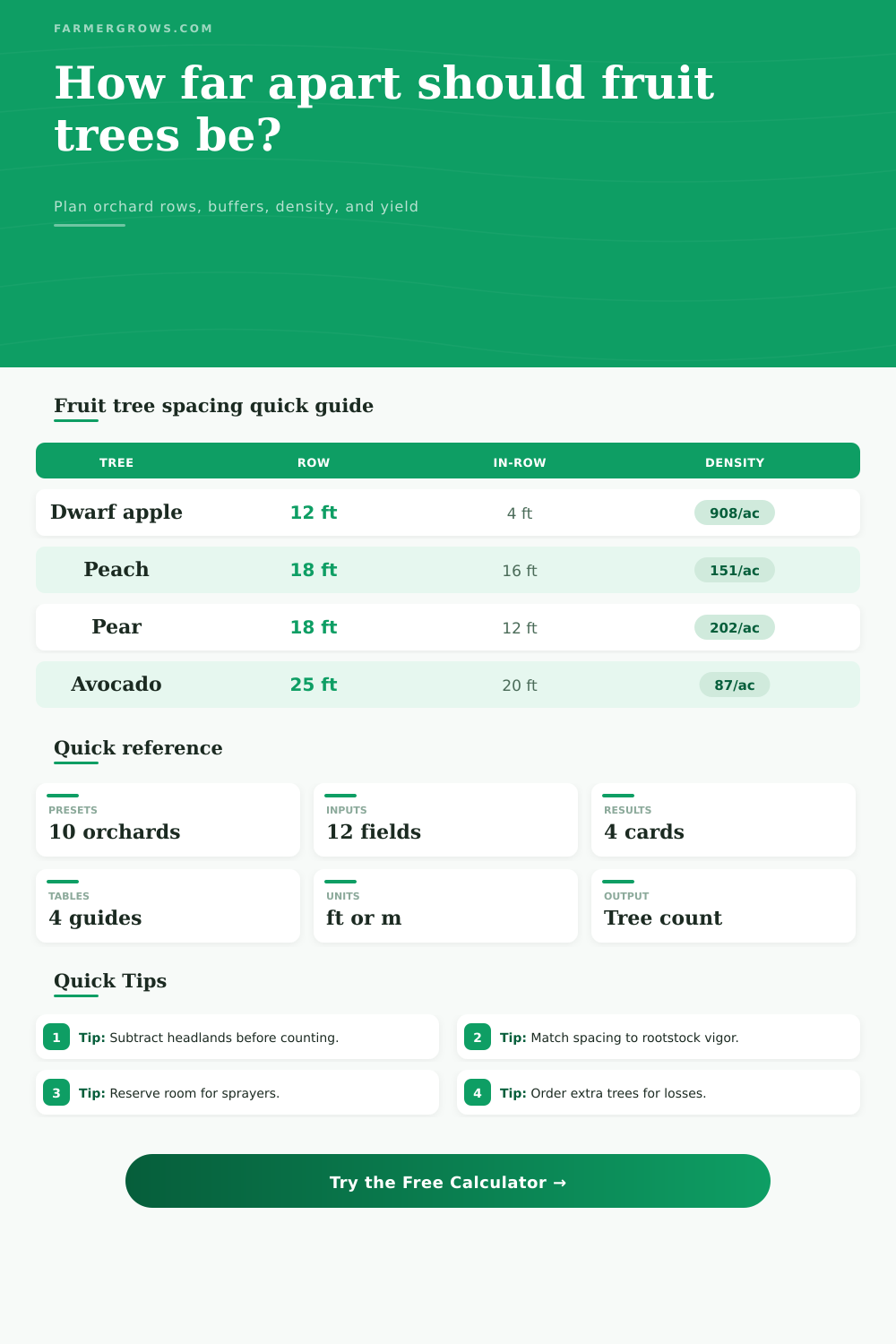
Compare the current layout against tighter, species-reference, and wider patterns. Density uses the center-to-center spacing formula: 43,560 divided by row spacing times in-row spacing.
Keep headlands outside the tree count when tractors, sprayers, bins, or mowing turns need clear space. Counting trees right to the fence usually overstates the order.
Dwarf, semi-dwarf, and standard rootstocks can change canopy width more than the fruit variety itself. Let the mature canopy and training system guide final spacing.
📘Reference tables
| Tree type | Row spacing | In-row | Typical use |
|---|---|---|---|
| Dwarf apple on M.9 | 10-12 ft | 3-5 ft | Tall spindle trellis |
| Semi-dwarf apple | 16-18 ft | 10-14 ft | Central leader |
| European pear | 16-20 ft | 10-14 ft | Central leader or trellis |
| Peach or nectarine | 16-20 ft | 14-18 ft | Open center |
| Sweet cherry | 18-22 ft | 16-20 ft | Standard or Gisela systems |
| Avocado | 20-30 ft | 15-25 ft | Hedgerow or wide canopy |
| Row x tree | Trees/ac | Trees/ha | Best fit |
|---|---|---|---|
| 12 x 4 ft | 908 | 2,244 | High-density apple |
| 14 x 6 ft | 519 | 1,282 | Compact trellis fruit |
| 18 x 12 ft | 202 | 499 | Pear or semi-dwarf apple |
| 18 x 16 ft | 151 | 374 | Peach, plum, apricot |
| 25 x 20 ft | 87 | 215 | Avocado or citrus |
| 30 x 25 ft | 58 | 143 | Mango or large canopy |
| Crop situation | Pollinizer share | Pattern | Note |
|---|---|---|---|
| Self-fruitful peach | 0% | Main cultivar block | Bees still improve set |
| Many apples | 5-10% | Every 3rd or 4th tree | Bloom overlap matters |
| Sweet cherry | 10-15% | Compatible rows or inserts | Check S-alleles |
| Pear blocks | 10-15% | Alternating rows or inserts | Varieties must overlap |
| Avocado A/B types | 10-20% | Mixed flowering type | Regional climate matters |
| Mango or citrus | 0-10% | Usually cultivar dependent | Local cultivar advice wins |
| Feature | Typical allowance | Why it matters | Calculator input |
|---|---|---|---|
| Headland | 15-30 ft | Turns, bins, gates | Headland buffer |
| Side fence | 8-20 ft | Canopy spread, mowing | Side buffer |
| Equipment alley | Every 8-12 rows | Harvest and spray access | Alley interval |
| Trellis setback | 3-6 ft | End posts and anchors | Headland buffer |
| Canopy clearance | 2-5 ft | Light and airflow | Spacing choice |
| Replacement trees | 2-10% | Losses after planting | Replacement buffer |
Spacing guides are planning references. Local rootstock performance, soil vigor, irrigation, pruning, slope, equipment width, and disease pressure can change the final layout.
An orchard is a long-term experiment in patience and geometry. You can prepare the soil and plant the best rootstock available. But if you set them to closely, they’ll fight one another for air and light. If they are too widely spaced, you waste yield potential of land and leave money on the table.
When I enter my block dimensions, the spacing calculator do the rest of the math, saving me from having to guess how much wider than normal each row should be for equipment access or anything else. It is not merely about cramming as many trees per acre. This makes it a system that will work at harvest time when fruit is heavy and sprayers must turn around.
Why Tree Spacing Matters
A number of acres sounds good right? That’s a starting point most growers begin with. But it doesn’t account for the shape of field. Does it make a difference if the field is a square with wide alleys versus a rectangular block with narrow rows? The tool takes into account your exact size (length x width) then removes side buffers and headlands from total to determine where to place trees.
This is one spot where many amateur plans go awry. You’ve calculated trees based off gross acreage. Next thing you know you can’t get the tractor down the end of row or there’s no room left after the fence line. The calculator requires that you factor in all these buffers ahead of time so what you’re counting are tree within the plantable area only; not the distance your sprayer will turn around.
The trick when it’s time to choose between standard and high density: How are you going to train the tree? Are they strong varieties? Or are they like dwarf apples on M.9 rootstock that will never get big enough to crowd one another in tightly spaced four-foot intervals if trained well and trellised? Other trees. Standard cherries, for example, or avocados… Are too wide naturaly to be confined into such narrow spaces, so they require significantly more growing room.
Adjust the input for your tree’s full canopy diameter according to which rootstock you are planting. Unless you do, you may find yourself stuck with an incomplete, unfilled-out canopy. This means you’re wasting valuable space where weeds will take hold and sun will shine directly on the ground rather than on the fruits themselves. This is wasted potential.
There’s another layer that everyone simplifies to their own peril: Pollination. Cherries and many apples are not self-fertile, requiring other pollinator varieties among the block. The calculator has a slider to enter a percentage of pollinizer trees, and also sets those apart from total number of your main crop.
Why? Because with some varieties of fruit, if they’re not marketable, you don’t want 20 percent of your orchard bearing fruit you aren’t going to sell anyway. For most commercial blocks a five to ten percent mix is generally fine (as long as there’s overlapping bloom time). The reference table on the page spells that out neatly by type of crop. It also reminds you that though bees do all the heavy lifting, they has to be able to move from one tree to the next easily. Flowers must be spaced close enough together.
Your practical constraints are what you can do with what you’ve got. Your design must include wider alleys periodically to allow turning around and harvesting bins without squashing the outlying rows… Even in a high density block of apples. Entering an equipment alley interval into the input will remove corresponding number of rows so they aren’t included in the tree count. That way you won’t crowd yourself in the long run, a minor sacrifice for massive operational gain down the road.
Likewise, if you order a 5-10% replacement buffer, even for graft failures, drought, wildlife, etc., you’re covered right away. But once the trees is on the ground, you can never reposition them, you’ll have to go back and plant more. What it provides isn’t just a number of rows: It provides an estimate of how many plants are planted per acre and a harvest range based off mature yield assumptions.
This allows you to plan for picking and thinning crews as well as roughly estimate revenue. Planting densely leads to higher yields in the beginning years. However, it will require more pruning to keep trees open. There is a trade-off between working hard upfront and having lots of low-maintenance tree later on.
How do you know when you’ve spaced them out far enough? You want your trees to have plenty of elbow-room to grow… But not too much empty space between each other. Planting orchards is more than biology, it’s also an engineering problem involving airflow, water, and sunlight. And it begins long before you sink the first post in the ground.
With this tool, you can play with various scenarios, adjust the buffers, and determine how even slight tweaks alters the overall density and number of trees on your property. After playing around with these variables, you’ll have a better idea of how they’re interconnected, and planting won’t feel like such a gamble anymore. It’ll be more of a calculated investment.