
IT’S THE END OF MAY, AND there’s this one fuzzy thing on your lawn that has you suddenly wanting to freak out. It makes sense; what we see is often unfamiliar. Most of these creatures are harmless visitors, simply passing through as they grow into butterflies or moths. Learning to identify them transforms a scare into a teachable and appreciative moment. A visual guide will get you breaking things down without degree in biology.
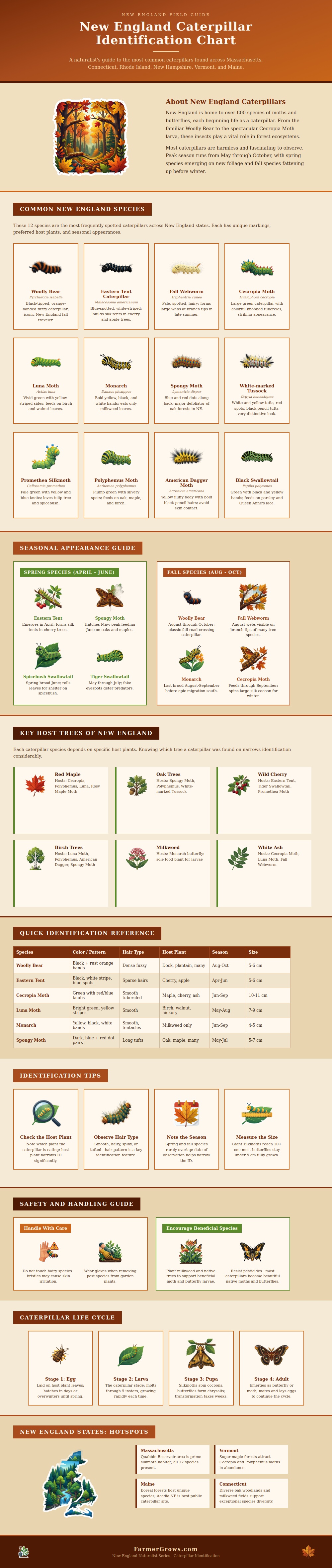
Caterpillars aren’t remembered by Latin name as much as by their host plant. What does an insect eat? Where it eats that is far more important than what pattern of colors it wear. For instance: If you spot a green guy with yellow stripes on a birch or walnut tree, he’ll be a Luna Moth caterpillar in waiting. On oaks, you’ll see red and blue spots on larvae, most likely Spongy Moths. Knowing the connection makes for easier identification, since you can stop looking at each individual hair if you already know what insect-eats-what. We tend to get caught up thinking about the bug instead of where it lives.
How to Identify Caterpillars in Your Garden
One helpful hint: Nature is seasonal; use it to help with ID. For instance, the ones above are an early spring creature: the Eastern Tent Caterpillar. It appears before apple and cherry trees has fully grown their leaves, forming scary-looking silk tents. They are not typically bad enough to strip a tree’s leaves entirely, but they gone soon. Others come later, including in the fall; the one mentioned above appears in August or September and is called a Woolly Bear. Its orangey band and black tips give it its name, and folklore says thickness of the band foreshadows how severe the upcoming winter will be. No correlation there, scientists say, but we keep right on believing. By late summer you may see messy tents made by Fall Webworms at ends of branches.
Another fast hint is size: The larval form of giant silkmoths such as the Polyphemus moth, left, and Cecropia (above) can reach several inches long; despite their narrow body shape, they look strange in that stage. Their body surface tends to be smooth, not covered with hair, and frequently they’re attached to an ash or maple tree. Butterfly caterpillars such as the Monarch (below) tend to be more compact and about the same size throughout, mostly. Typically smooth-bodied, they help you know when to keep your distance, and thus not go looking for how many spots.
But certain insects are safer than others: It’s a good idea to wear gloves when touching any spiny or hairy larvae, especially those whose ID isn’t known to you. For example, the American Dagger Moth caterpillar (above) sports noticeable black bristles, which will give you a bad rash if they touch your skin. If something appears armed or ornate, don’t touch it; not only for your own protection but also so the critter can grows in peace.
It’s all over fast, but not without drama: Yes, these insects go through complete metamorphosis (egg to adult) and change completely along the way. They eat and grow; then they spin a cocoon or form a chrysalis and molt several times. How can we support such a life cycle? Plant native trees, and don’t use unnecessary pesticides. Most gardeners want lush gardens, but you have to accept that some eaten leaves are price of a healthy ecosystem.
The next time you spot a caterpillar on your land, take a moment to look and see its size, when it appeared, and what plant it’s feeding on. Chances are it’s not an invader, but simply a neighbor whose presence will contribute to a healthy ecosystem.