
Sometimes you buy A packet of seeds in a pricey herb, maybe, and when you shake it there’s just some paper rustling around inside. It’s not just bad luck or empty packaging; there is actualy a microscopic amount of material in there. But think about it: By weight, you’re actually holding a microscopic amount of biological material.
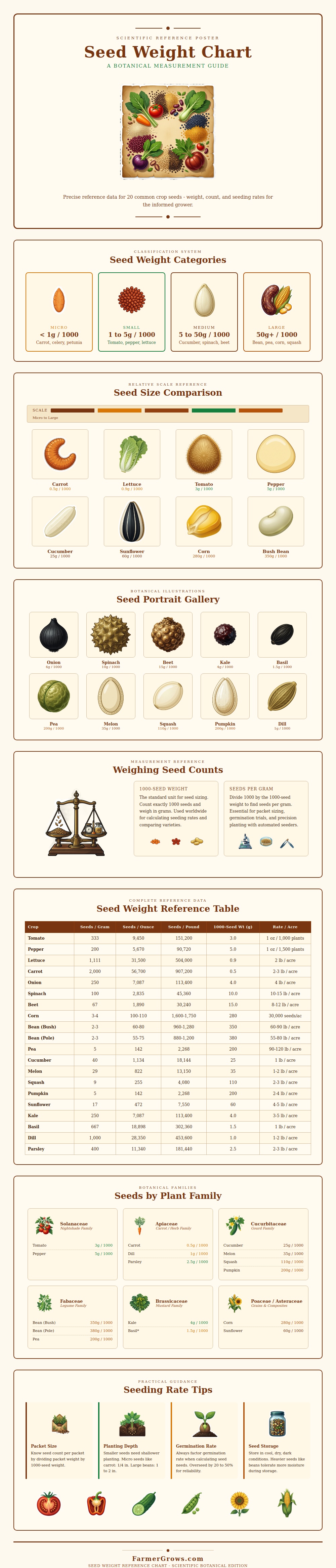
Even though the seed container might look like it has a lot in it, the truth is that knowing the weight of things change everything about how you garden. It converts the guesswork of it all into a planned strategy. Here’s a chart (above) that explain it all, using exact data for familiar crops. Exactly how many thousands of seeds do you have? What does that mean for your seeding rate?
How Seed Weight Helps You Plant Better
A seed is not all the same thing: They don’t even measure up as units of measure. Some are tiny; others large. Some is dense and some are fluffy. For instance, if I held 1000 carrot seeds between my fingers, it would of be like holding dust. If I had 1000 bush bean seed, by comparison, they’d feel like pebbles; little stones. That matter for every aspect of how we plant them and store them. A few grams of big seeds like squash or corn will go across an acre, whereas you’d have to hold on hands full of microseeds such as celery or carrot to do the same job.
The table above breaks this down into categories… Micro, small, medium, and large, to show where each of your garden crops fit in the botanical world. Why? Because home gardeners purchase seed by the packet, not by the pound. Knowing that tomato seeds weighs about three grams per thousand will allow you to make an educated guess at the number of plants inside that 0.5-gram packet. It contains about 160 seeds. And suddenly that little envelope seems worth more then ever before.
Why? How do you know if you’re underseeding with big seeds, or over-seeding with teeny ones? The answer has as much to do with psychology as anything. When you begin to think of seeds in terms of weight and see them as something to be measured, you’ll plan out what you sow more accurately. They are no longer scattered; they is only placed.
If you’re not sure how much something might require, remember: Seeds of closely related species tend to be alike. The nightshade family (peppers, eggplants, tomatoes) tends toward small- to medium-sized ones. Beans and other legume are large-seeded. Cucurbits vary quite a bit; they include medium-sized cucumbers, giant squash, and pumpkins. Why? Because generally speaking, seed size connects with the energy reserve the growing plants started out with. More seed equals more fuel to get up and going early, whether in tougher ground or after being covered with thicker layers of soil.
Plant a bean an inch or two deeper than usual; no problem. Plant a carrot that deeply and it’ll never come up. Size also weighs into this (pun intended). Seeds that are larger, like corn and beans, which have strong outer coverings, weather extremes and humidity more readily different than tiny, tender micro seeds. Dill or basil seeds left in a damp basement? Forget it; they’ll be dead well before those dried peas ever sprout. Keep them stored in their proper environment: dry, cool and dark, says the information on the subject.
Here is a little something to think about. And it matters. Many gardeners blame the seed brand when improper storage of fragile varieties are actually the culprit for losing viability. Many gardeners blame the seed brand when it’s actualy improper storage that is the real culprit. The germination rate affects the math as well. Always expect some loss, even if you measure out perfectly.
Sow extra by at least twenty to fifty percent. This way, any natural losses or bad weather does not result in gaps in the row. The more difficult it is to count your seeds (like micro seeds), the greater this buffer needs to be. Don’t try to count each carrot seed, trust the average weight and give yourself some wiggle room.
That’s right: GARDENING is more physics than magic. The weight of things you grow can help you plan better. You can have more confidence in how much space you’ll need, how many resources you’ll use, and what results you can expect. Next time you examine that packet, recall: That’s a certain quantity of potential energy inside there, expressed as a weight (in grams) and numbered in thousands. Be respectful; then watch your garden reward you for being thick and plentiful instead of scattered and hopeful.