
There’s the seed packet you’re staring at, and you know that all you have to do is stick it in the ground and presto! Something will happen. You have watered the soil, checked the temperature, and waited. You water the garden and hope for rain. Keep your eye on the thermometer. Wait. Nothing. Dig around the seeds and discover they are either rotting or shriveling up on you.
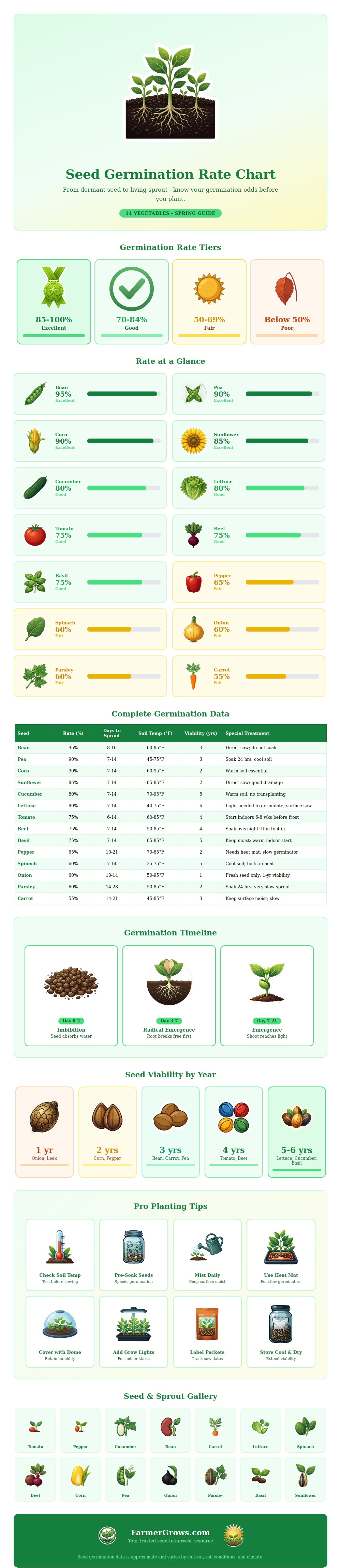
This kind of frustration comes from just one little misconception. You assume that all seed want the same thing. They don’t. To do this I divided all the popular seeds into four categories. Excellent, very good, fair and poor; from easiest to hardest to get going (chart above). Why? Because knowing where each falls on that scale informs how involved you’ll need to be.
How to Grow Seeds Successfully
With an easy crop, such as peas and beans, you can really slack off. Get the timing wrong by a day or two? Forget to soak them or slightly misjudge the soil warmth? No problem. Soak too long (or don’t bother soaking at all)? No problem. Scatter away. The carrots and parsley, and many other vegetable, are at the opposite extreme: Poor to fair, meaning there’s a bit of a barrier between you and success. Parsley takes forever (up to 4 weeks), and carrots also prefers steady moisture on the surface without being waterlogged. Treating a carrot seed like a bean seed are a recipe for disappointment. Tighten your belt and wait longer; meet them halfway.
When the plants don’t do anything up top, learning to read the timeline down below makes all the difference for managing your expectations. First comes imbibition: Water soaks into the dry seed, causing it to swell. It may take just days. But we won’t see any change until later. First comes emergence of the root, which anchors; only then does the shoot begin to push upward toward the light. Don’t yank on a seedling too soon, thinking it’s stuck. Chances are good you’ll be pulling off its tender new root system. They mistake quiet for defeat, when in fact things is working underground.
What’s driving this behavior? Mostly it’s temperature. According to the information, heat-loving crops such as cucumbers and peppers hit a wall when the soil stays cold (see chart below). Cool-season crops such as peas and spinach thrives with cooler temperatures. Planting a tomato in still-chilly soil after an early spring thaw will cause it to rot rather than sprout. Knowing what each crop likes best, its range of preferred temperatures, is a handy clue to when to sow what, and the chart give a rough range for each one. You don’t need to buy a soil thermometer; just pay attention to recent temperatures to understand why some years are good and others are not.
Another factor to keep in mind is viability (how long seeds last), which also affects the success rate. Basil and lettuce may be good for five or even six years; onion for maybe just one. Think of your onion seeds as gasoline, you’d never put stuff from a decade ago in your car, would you? But it looks okay, so you do, and whammo. It doesn’t ignite. Again, read the package first. Fresh seed is especially important for those items with a short shelf life.
There is always something that can be done to close the gap between less-than-perfect seed to a bountiful crop: With those stubborn seeds that refuse to sprout, like beans or parsley with a tough hull to get through, a day of soaking will soften the shell and give you a leg up on getting growing. Some plants are more reluctant and take longer, like peppers. Using a heat mat warms the soil to the perfect range. It is all about warming things up. All these measures has little expense but big payoff. Removing some obstacle to progress shifts the odds in your favor.
Gardening isn’t magic. It’s all about meeting certain biological requirements. Every seed contains an encoded list of do’s and don’ts. Honor those differences: That’s how you shift from guesswork to planning. The chart is like a road map of what to expect. And where to put your energies. Focus first on the easy wins, to gain confidence, then attack the fiddly ones armed with patience and proper tools.
A seed is A CONTRACT: Every time I sow that first packet in the ground, I am making a pact, not just promising myself a crop. I supply the conditions; it supplies the growth. Know your seed’s demand and you’re not battling nature anymore, you’re cooperating. It’s sprouting time.