
PLANT A pair of elderberry bushes, then wait for the harvest. But that is not what happens: many bush have only leaves and hardly any berries at all. Frustrating, right? What went wrong?
The problem usually isn’t the soil or the sunlight; it’s probably this: pollination. Though each individual elderberry flower has both male and female parts (they’re called perfect flowers), they don’t always fertilize one another. Self-fertilization is fine in theory, but not ideal. For best results you want them to be cross-pollinated… And hope for heavy fruiting clusters worthy of the effort.
How to Grow More Elderberries
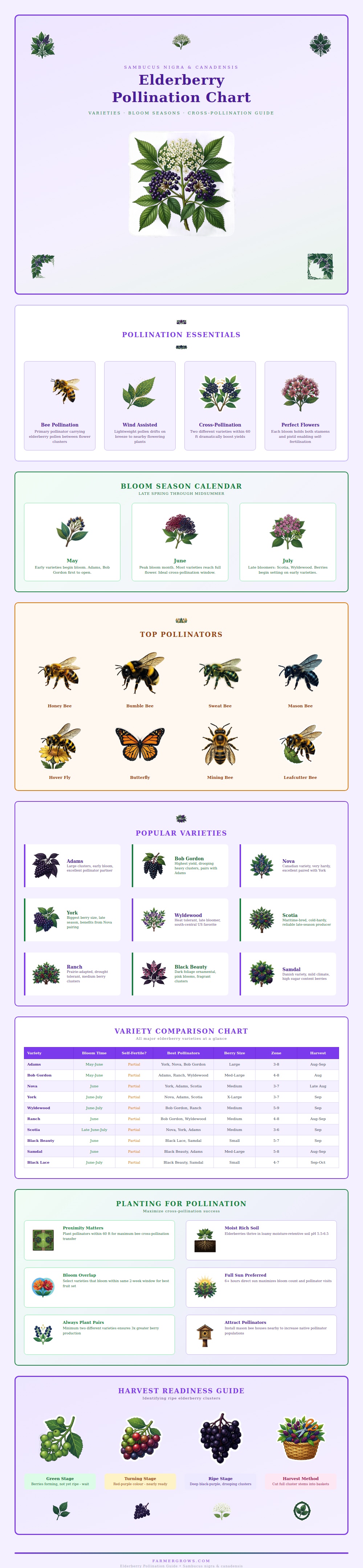
This chart (above) tells you which ones works well together. It’s not rocket science; you won’t have to get out your botany degree to figure this one out, but yes, you’ll want to pay attention to the bloom time. You can’t plant an early blooming variety beside a late-season one and expect them to work together.
To have that kind of increase, up to three times as much… You has to plant two different kinds within sixty feet of one another. Why? Because while bees are efficient little workers, they aren’t unlimited in how far they travel. In fact, they like to keep things closer if there’s a big temperature spike or some blustery breeze.
We all know that we depend on the honey bee, but there is many other pollinators that come to mind besides them… And the graphic includes some of the main ones: hover flies, mason bees and bumble bees. In fact, their weight help the bumble bee do an especially good job, since they actualy vibrate the flower, shaking pollen loose more effectivly than a gentle tap would. That mechanical process is crucial to successful fruit set.
A simple mason bee house can helps shift the pollination balance in favor of more bumbles if you find yourself short on any wild pollinator in the garden. Essentially, you are paying specialized workers to work on your berries.
The other half of the equation is timing. Most varieties bloom in May and June. First come the early birds (like Adams, or Bob Gordon), then those who pick up later in July (like York, or Scotia). With that range of bloom time, even if there’s a cold snap, someone should of had their partner.
In an area where spring weather can be dicey, that’s good, but even otherwise, having that range assures that at least one of each variety has its flower match. The chart indicates that for example, York pair well with Nova, because the bloom times overlap so much. That is the key. No overlap, and you’re just decorating your garden with shrubs.
Sun and soil feed the process. But they don’t drive it; without them, there would be no process. Elderberries prefer lots of direct sunlight and a moist but well-drained soil (a loamy soil). The more sun, the better: more flowers, which means more for your pollinators to do. It is a simple feedback loop.
But here’s what else: These aren’t sticklers in terms of pH. Five point five to six point five is just fine. Fix the bed if you’re dealing with pure sand or a really hard clay. The plant will already have enough trouble establishing roots; it doesn’t need to spend its time struggling instead of flowering.
The only way you’ll know if you have succeeded, however, is when the berries go fully black-purple. Any green? Wait. Any red-purplish color? Almost there. Heavy with sugar, they hangs in a heavy mass beneath themselves. Don’t crush them against the earth; cut off the entire cluster and carry it home in a basket.
The reward of all that planning is waiting for all the seasons, inviting the bees, and matching the varieties. Now you get to reap what you have sown. You did more than just grow things. You orchestrated a little ecosystem in your backyard. And when those first dark berries land on the tray, you will recall why you took the time with the chart at all.
The flowers don’t last long. But the harvest does.