Seed Potato Planting Depth Calculator
Plan cut seed potato piece cover, trench bottom depth, in-row spacing, row count, hilling height, and soil volume before planting a bed, field row, or grow bag.
Seed potato pieces need enough cover to stay moist and dark, but not so much that sprouts struggle through cold or heavy soil. This calculator keeps the planting depth separate from the later hill so the seed piece and developing tubers both get the cover they need.
Seed Potato Depth Plan
Use these values to plant seed pieces, estimate seed count, and stage hilling before tubers reach the light.
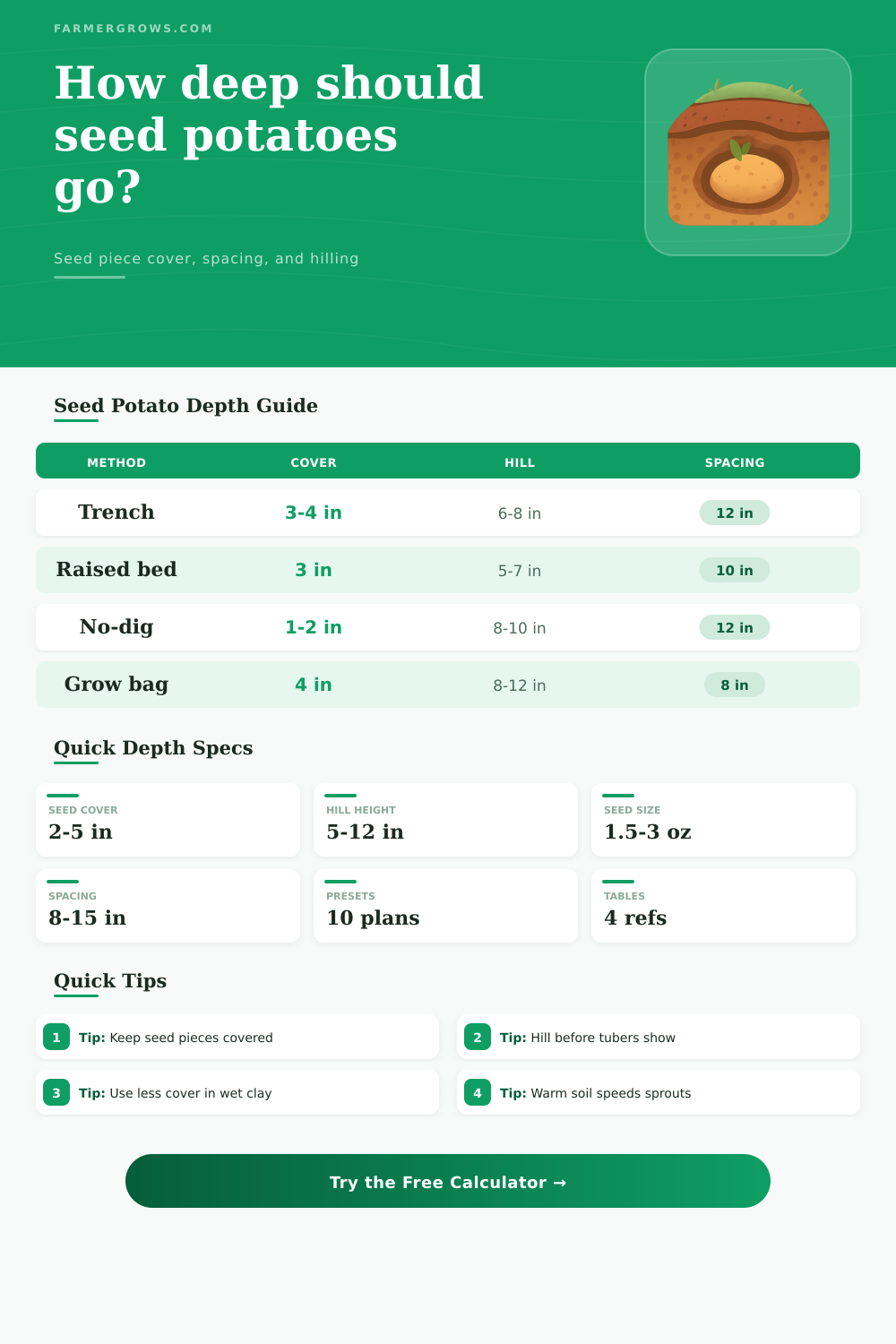
Seed Piece Cover by Method
| Method | Starting cover | Bottom depth | Hilling target | Best use |
|---|---|---|---|---|
| Trench row | 3 to 4 in | 5 to 6 in | 6 to 8 in | Maincrop rows where soil can be pulled from both sides. |
| Raised bed | 3 in | 4.5 to 5.5 in | 5 to 7 in | Loose garden beds that warm early and drain quickly. |
| Flat planting | 3 to 4 in | 5 to 6 in | 6 to 8 in | Small gardens where hilling is done with compost or soil. |
| No-dig bed | 1 to 2 in | 2.5 to 4 in | 8 to 10 in | Seed pieces set on soil then covered with compost and straw. |
| Grow bag | 4 in | 5.5 to 7 in | 8 to 12 in | Containers topped up as stems reach above the mix. |
Soil and Weather Adjustments
| Condition | Depth change | Reason | Watch point |
|---|---|---|---|
| Wet heavy clay | Reduce 0.5 to 1 in | Wet soil stays cool and oxygen-poor around cut surfaces. | Wait if soil smears instead of crumbling. |
| Dry sandy soil | Add 0.5 to 1 in | More soil cover slows drying around the seed piece. | Irrigate before hard crusting forms. |
| Cold soil below 45°F | Hold shallow or delay | Sprouts emerge slowly and cut pieces are exposed longer. | Use cured seed and avoid waterlogged beds. |
| Chitted seed pieces | Reduce 0.25 to 0.5 in | Short sprouts need less buried travel to reach light. | Handle sprouts gently while covering. |
| Fresh-cut seed | Reduce 0.25 to 0.5 in | Less cold wet cover lowers decay pressure. | Cure pieces when time allows. |
Seed Piece Spacing and Stock Estimate
| Crop type | In-row spacing | Seed pieces per 100 ft | Seed stock at 2 oz |
|---|---|---|---|
| Early new potatoes | 8 to 10 in | 120 to 150 pieces | 15 to 19 lb |
| Fingerling potatoes | 8 to 10 in | 120 to 150 pieces | 15 to 19 lb |
| Maincrop all-purpose | 10 to 12 in | 100 to 120 pieces | 13 to 15 lb |
| Russet storage crop | 12 to 15 in | 80 to 100 pieces | 10 to 13 lb |
| Seed increase stock | 6 to 9 in | 133 to 200 pieces | 17 to 25 lb |
Hilling Soil Volume Reference
| Hill height | Hill base width | Volume per 100 ft | Metric equivalent |
|---|---|---|---|
| 5 in | 16 in | 1.03 yd³ | 0.79 m³ |
| 6 in | 18 in | 1.39 yd³ | 1.06 m³ |
| 8 in | 20 in | 2.06 yd³ | 1.58 m³ |
| 10 in | 22 in | 2.83 yd³ | 2.16 m³ |
| 12 in | 24 in | 3.70 yd³ | 2.83 m³ |
Add soil or compost when stems are about 6 to 8 inches tall, leaving some leaves exposed so the plant keeps growing strongly.
Cured seed pieces tolerate normal cover better than fresh cuts. In wet soil, plant slightly shallower and hill later after stems are established.
In mid-March, you wonder: Should I plant my seed potatoes shallow or deep? If only you’d had this dilemma before! But the question isn’t quite that simple, because you have to balance keeping soil warm enough for sprouts to emerge with providing enough insulation so the tubers don’t turn green in sun later on. Most gardeners is guessing. Some put their crop in cool, wet soil where it rots. Others let it see daylight too soon.
Here’s the calculator (above), where entering just soil type and row length will tell you how deep to plant. Why? How do we know that these two inputs produce an accurate answer? One input, initial cover, protects the cut surface of the seed piece until its shoots poke out, but the other input, the amount of eventual hill, serves a different purpose.
How Deep Should You Plant Potatoes?
In heavy clay, planting deeper than recommended on the calculator might leave that initial cover sodden and cool long enough to invite rot before the plant ever has a chance to wake up. No wonder: Oxygen is as important as moisture, and this tells the calculator to recommend less initial cover when you are sowing in dense soil. On the other hand, quick-draining sandy soil can be unstable until the sprout emerges; it wants just a little more initial cover to stabilize root zone, but then the sprout can get going.
What people think of as “deep” isn’t necessarily dark; depth and darkness aren’t synonymous. Waiting too long to hill a shallow-planted potato may mean all those tubers ends up being green. How much compost or loose soil will I need to pull up and hill over stems later? This shows how much material you will need for hilling, as seen in the reference table.
Trenching the rows require different soil management than no-digging and using straw beds. For instance, in a grow bag, you gradually add mix as the plant enlarges. So at the end, you have a lot more high cover than initial depth. It is not a one-time deal, but it is a staged process.
Soil temperature is another factor. When the soil’s less than forty-five degrees Fahrenheit, germination takes longer. A seed planted deeply in cool earth will spend weeks navigating dirt instead of reaching for light. All that extra time underground makes it more likely some disease will attack the tender tissue. The calculator accounts for that, too, and advises you to plant more shallowly in cooler weather. It doesn’t change much, but it makes a difference because acting quickly is best protection here. Get the thing going fast so something like slugs or even wireworms (ahh!) don’t get interested.
There’s the variety element to it, too: “Early” waxy types tend to be grown shallow (as you’d expect, wanting quick emergence), while maincrop russets is better protected, as their tubers set further down in the root system over time. By factoring that in with variations on recommended depth of coverage and spacing, the tool takes those variables into account. Is it storage crops for the winter months? Or is it new potatoes for an early-summer meal? Timing affects the strategy, which is why you may assume all potatoes goes in the ground alike (but nope).
Most people make this one: They fail to account for condition of their seed piece. A freshly cut potato has exposed wounds that can rot. To prevent this, cure your potatoes for several days to allow the cuts to harden off (callus over). This makes them more resistant to rotting when planted deeply in moist soil. If you are impatient and don’t bother with curing, you’ll need to plant shallow and hill early when the stems emerge. Convenience vs. Crop success; take your pick.
Bottom line: Potatoes are all about minimizing your risk. You’re gambling that things (soil), weather, water, oxygen… Will cooperate long enough to get them well-rooted before harvest time. Minimizing that risk means getting the depth correct. The only question (or answer) is how? If you have a mathematical mind, there’s a specific calculator for that. Or use gut feel instead; the objective is still the same. Protect the seed from rot and light until it can hold up its end of the bargain. Then, let ’er rip. It goes from dirt to dinner.