Pecan Trees Per Acre Calculator
Estimate pecan orchard density, total trees to plant, order reserve, pollenizer count, productive acres, row length, and permanent stand after planned thinning.
Use this calculator before staking a pecan orchard or comparing spacing plans. It keeps the clean trees-per-acre formula visible while adjusting for productive acreage, access lanes, survival, reserve trees, pollenizers, and future thinning.
Pecan orchard density plan
Spacing and acreage summary will appear here.
| Spacing plan | Row spacing | Tree spacing | Square-grid trees/ac | Typical use |
|---|---|---|---|---|
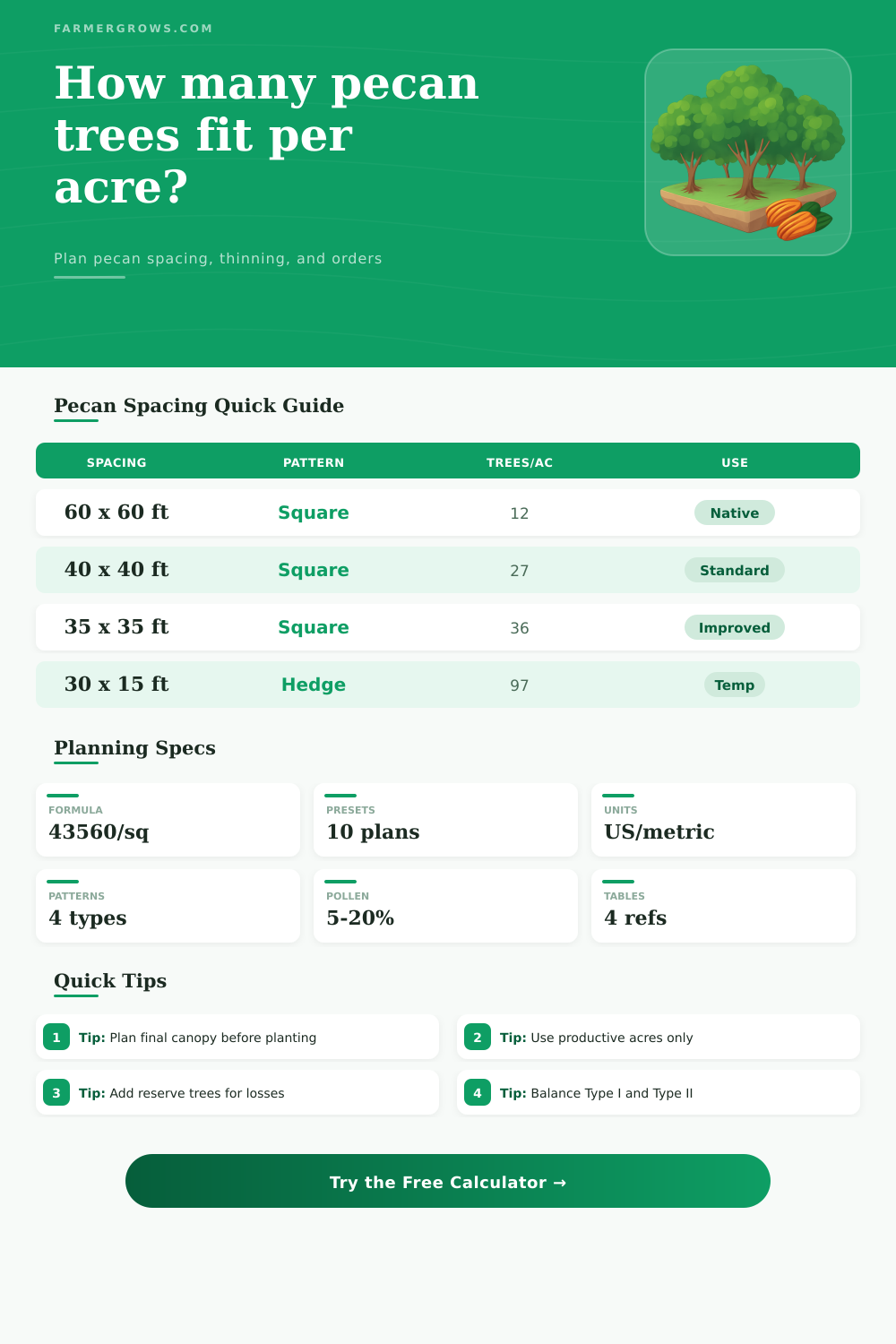
| Native or pasture pecans | 60 ft | 60 ft | 12 | Large mature canopies, grazing, or very low-density blocks |
| Traditional improved orchard | 40 ft | 40 ft | 27 | Long-term permanent stand with broad equipment alleys |
| Improved medium block | 35 ft | 35 ft | 36 | Moderate establishment density where pruning is expected |
| Closer managed block | 30 ft | 30 ft | 48 | Early canopy use with later crowding checks |
| Temporary filler plan | 25 ft | 25 ft | 70 | High initial count that should include a removal plan |
| Hedge or trial rows | 30 ft | 15 ft | 97 | Specialized system needing strict light management |
| Pattern | Footprint factor | Density effect | Example with 40 ft spacing | Planning note |
|---|---|---|---|---|
| Square or rectangle grid | 1.000 | Base formula | 27 trees/ac | Most common way to estimate permanent pecan spacing |
| Triangular staggered rows | 0.866 | About 15% denser | 31 trees/ac | Can improve land use but complicates row operations |
| Hedgerow trained rows | 0.930 | About 8% denser | 29 trees/ac | Use only where pruning and light control are realistic |
| Quincunx filler system | 0.500 | Initial count doubles | 54 trees/ac | Center filler trees should be treated as temporary |
| Gross acres | 40 x 40 ft | 35 x 35 ft | 30 x 30 ft | 25 x 25 ft |
|---|---|---|---|---|
| 1 acre | 27 trees | 36 trees | 48 trees | 70 trees |
| 5 acres | 136 trees | 178 trees | 242 trees | 348 trees |
| 10 acres | 272 trees | 356 trees | 484 trees | 697 trees |
| 20 acres | 545 trees | 711 trees | 968 trees | 1,394 trees |
| 40 acres | 1,089 trees | 1,422 trees | 1,936 trees | 2,788 trees |
| Planning allowance | Low | Typical | High | Use when |
|---|---|---|---|---|
| Productive acre deduction | 0% | 5 to 12% | 20% | Roads, ponds, poor soil, or non-orchard corners reduce plantable acres |
| Headland and access loss | 2% | 5 to 10% | 18% | Sprayers, harvesters, irrigation mains, and turn rows need room |
| First-year tree loss | 3% | 5 to 12% | 20% | Drought, transplant stress, wildlife, or weak nursery stock raises losses |
| Extra order reserve | 3% | 5 to 10% | 15% | Remote blocks or single shipping windows justify more reserve trees |
| Pollenizer share | 5% | 10 to 15% | 20% | Use compatible Type I and Type II cultivars for better nut set |
| Temporary removal | 0% | 25 to 50% | 60% | Filler, quincunx, or high-density systems need a future stand target |
Permanent density matters most. Pecan trees can stay productive for decades, so compare the final stand after planned filler removal with mature canopy width, sunlight, equipment access, and soil water capacity.
Pollenizers count as real trees. The calculator separates pollenizer share from total tree count, but those trees still occupy orchard positions and should be mapped across rows for pollen movement.
Pecans are a 20-year investment: the trees take two decades to come into production. So when laying out an orchard, there’s no room for error. You’ve dedicated your time, money, and water to a plan that will dictate every crop for decades. Space the trees too closely, and they’ll choke one another; space them too far apart, and you’re wasting precious acres until their crown start filling in. It’s basic math, but not-so-simple strategy. You must balance short-term cash flow with long-term tree health.
The first thing most growers do is look at the spacing grid. For example: A standard forty-by-forty-foot square creates roughly twenty-seven trees per acre. This leaves plenty of space between the trees for your harvesting equipment and their large mature canopy. Go down to a tighter grid such as thirty-five-by-thirty-five feet, and you get closer to thirty-six trees per acre, which requires some more consideration when it comes to managing light and pruning.
How to Plan Your Pecan Orchard
The calculator does all the multiplying for you, so you don’t have to worry about dividing and getting lost; instead, you can focus on what these numbers mean for you. Enter your bare acreage here, and it’ll spit out an actual planting map to consider with reality in mind. In reality, you lose a little bit at the beginning (before digging that first hole). You’ve got corners and roads and ponds and places along your edges where an irrigation main runs or whatever… It’s never a perfect field end-to-end. And this is why you need to know what your productive acreage is. If nine out of ten of your ten acres will be viable to plant on, the calculator instantly reduces your overall number of trees. The common error in ordering is too much stock based off gross acreage, not taking into account what portion of it can actualy support plants. That difference keeps you from ordering saplings that you won’t have a place for.
And then there is the biology: Who will get whom pregnant? Pollination. Pecans are famously particular about who dates whom. Some split up into what’s called Type I and Type II flowering patterns. In other words, a block of identical trees may not have overlapping pollen windows, meaning they may not set much fruit. Plan on saving some of your planting budget for pollenizers. You’ll generally need roughly 10 percent of the total number for that reason. The calculator divides that figure, so you are clear on which portion is for pollenizers versus the bulk of your main crop. This amount is not hidden within larger quantity but is shown separately.
Another silent budget buster is tree loss, even if they’re planted perfectly. Saplings will die within the first year from transplant shock, drought stress, or being eaten by wildlife. It’s not pessimistic to plan on losing 5-10% of your trees… It’s simply good inventory management. An order reserve percentage will account for exactly how many more trees you need beyond what you’ll be planting (so that the holes you dig is filled by trees and not Swiss cheese within months). The tool adds those reserve numbers to your final purchase list so you don’t get caught short-stocked come springtime.
If you’re considering early returns: Filler trees create instant density, which is useful if you want to make some money while waiting for your permanent crop to bear. Plant a row of the fast-growers between each of your permanent pecans and then take them out before they sap light and water from your long-term crop. You could double (or triple) the number of trees that you initially put in the ground, but with a firm plan to pull them out in a few years’ time. Run that scenario through the calculator; it will show how much more productive you can be if what you plant today lasts forever.
All that said, deciding on density is always a balance between reward and risk. More space means easier maintenance but slower full production. Closer spacing means more aggressive water management and harder pruning, but faster canopy closure. To get a quick glimpse at either extreme; from native pastures to an intense hedge system, check out the reference tables on this page. They’ll help you compare your concepts against the industry standard. Then, with an idea of how each factor will change things, you can start reading the numbers; and they’ll begin to tell you their story about your place. That story is what makes an orchard thrive… Or simply survive.