Fruit Trees Per Acre Calculator
Estimate orchard tree density, total trees, row count, tree order quantity, productive acreage, pollenizer count, and canopy footprint from real fruit tree spacing plans.
Use this calculator before ordering bare-root trees, marking rows, or comparing rootstock systems. The core density formula is 43,560 square feet per acre divided by row spacing times in-row spacing.
Orchard Density Results
Use the tree count as a planning estimate, then adjust for exact row staking, cultivar order, irrigation zones, and local rootstock guidance.
| Fruit tree or system | Typical row spacing | Typical in-row spacing | Trees per acre | Planning note |
|---|---|---|---|---|
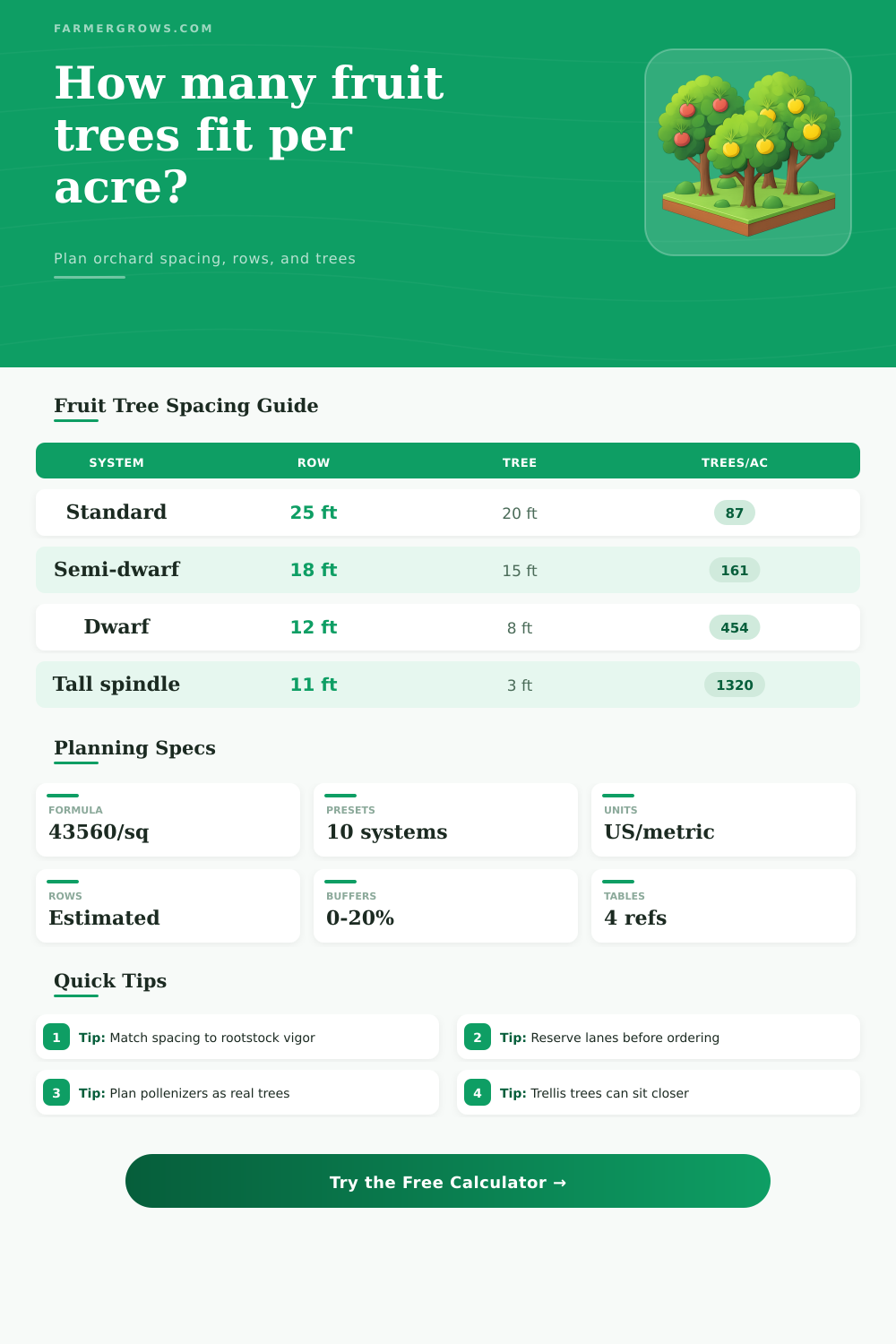
| Standard apple | 25 ft | 20 ft | 87 | Large mature canopy, easiest to underplant or mow |
| Semi-dwarf apple | 18 ft | 15 ft | 161 | Common mixed-orchard compromise |
| Dwarf apple | 12 ft | 8 ft | 454 | Usually needs permanent stake or support |
| Tall spindle apple | 11 ft | 3 ft | 1,320 | High-density system with trellis and training |
| Peach or nectarine | 18 ft | 18 ft | 134 | Open-center trees need light across the canopy |
| Sweet cherry | 22 ft | 18 ft | 110 | Use wider rows for ladders and shade control |
| Row x tree spacing | Sq ft per tree | Trees per acre | Acres per 100 trees | Metric density |
|---|---|---|---|---|
| 25 x 20 ft | 500 sq ft | 87 | 1.15 ac | 215 trees/ha |
| 20 x 20 ft | 400 sq ft | 109 | 0.92 ac | 269 trees/ha |
| 18 x 15 ft | 270 sq ft | 161 | 0.62 ac | 399 trees/ha |
| 15 x 12 ft | 180 sq ft | 242 | 0.41 ac | 598 trees/ha |
| 12 x 8 ft | 96 sq ft | 454 | 0.22 ac | 1,121 trees/ha |
| 11 x 3 ft | 33 sq ft | 1,320 | 0.08 ac | 3,260 trees/ha |
| Orchard size | At 25 x 20 ft | At 18 x 15 ft | At 12 x 8 ft | At 11 x 3 ft |
|---|---|---|---|---|
| 0.10 acre | 8 trees | 16 trees | 45 trees | 132 trees |
| 0.25 acre | 21 trees | 40 trees | 113 trees | 330 trees |
| 0.50 acre | 43 trees | 80 trees | 227 trees | 660 trees |
| 1.00 acre | 87 trees | 161 trees | 454 trees | 1,320 trees |
| 2.00 acres | 174 trees | 322 trees | 908 trees | 2,640 trees |
| Allowance item | Low | Typical | High | Use when |
|---|---|---|---|---|
| Headlands and turn rows | 5% | 10% | 20% | Tractors, sprayers, trucks, or ladders need turning room |
| Roads and irrigation zones | 5% | 10% | 15% | Mainlines, access lanes, hydrants, or frost lines cross the block |
| Tree order reserve | 5% | 10% | 20% | Use more for grafting losses, wildlife pressure, or distant suppliers |
| Pollenizer trees | 5% | 10% | 20% | Needed for many apple, pear, plum, and sweet cherry plantings |
| Wildlife or wind gap | 0% | 5% | 15% | Use where fence corners, windbreaks, or setbacks remove positions |
Rootstock sets the real spacing. A dwarf apple can work at 6 to 8 feet in home plantings, while standard trees may need 20 feet or more. Match the calculator spacing to the nursery rootstock and intended pruning system.
Rows are not just math. Leave space for sun, spray coverage, picking access, mower width, irrigation mains, and compatible pollenizers. The productive-area percentage keeps the final tree order closer to a usable orchard plan.
Why planting your orchard too close together is bad. Half your acre might be wasted in growing grass instead of fruit from trees. Profit or passion is in the space from the fence to the trunk. And an acre, no matter how you look at it, is only so much of a box: 43,560 square feet. It’s all up to the kind of tree you plant as to how you fill it.
You aren’t just buying plants; you’re buying access to future light and air and harvest. If the tree is grafted (and most fruit trees are), then its ultimate size will be determined by the rootstock. Even if your new baby plant comes home in a bag that doesn’t look very big at all, the tree’s growth still controlled by the rootstock.
How Many Trees Fit on One Acre?
Regardless. Standard trees has little need for pruning… But they do ask for lots of elbow room among their neighbors. On an acre, you’ll probably fit only about eighty-seven standard apples. That doesn’t sound like much. Space them twenty-five feet apart in the row and twenty feet between tree trunk. Otherwise, they’ll tangle together into a single green wall that rots from the inside out.
Low density makes sense for the backyard hobby grower. You can mow around easy. You can also walk beneath canopy without craning your neck to avoid hitting any of those branches. The whole geometry change when we switch to dwarf rootstocks. All of a sudden, those same acres are home to four hundred or more trees.
The tree remains small enough for training as a vertical column. Some high density systems, such as tall spindle orchards, gets up to a thousand trees per acre. Here they squeeze them down to three feet in-row spacing with an eleven-foot row width. Why? By forcing them to carry fruit earlier, the crop load forces the tree to expend less energy developing wood.
And the tradeoff? Intensity. These trees require constant attention, careful pruning, staking, and keeping the canopy open. You can’t ignore these tasks or you’ll lose the orchard in five years or less to structural failure or disease.
When planning your orchard, more than simple square feet come into play. Remember, this is a farm. We must leave space for tractors to turn at the end of all our rows. That means less productive land. And we can’t plant where irrigation mains or access lanes are located. That infrastructure eats up ground you’ll never use.
Once you determine your actual buffer space needs, the page’s calculator does the rest. It prevents you from underestimating how much land it takes to grow the number of tree you want. It’s tempting to think each square foot is productive land. But veteran growers know they lose fifteen to twenty percent of a block to setbacks and other infrastructure.
There’s one more thing that many people forget about till it’s too late: pollinators. Many fruit trees require another, compatible variety as a partner nearby, and both must bloom together in order to set any fruit at all. Figure out how much space you want to devote to fruit, and remember to budget for pollenizer varieties within that total tree count. Those aren’t extras; they’re key parts of the density plan. Leave room for them or you might have a gorgeous-looking garden, minus a single piece of fruit.
The page includes a reference table that allows you to see what the tree count will be for each acre at various spacings. That can help you visualize what it looks like when you step back to a commercial production block, versus a more home-garden-like space.
In the end, your choice comes down to deciding which system matches your yield goals and your ability to manage them. A wide-spaced system offer less up-front cost and easier care. A tight one gets you higher yields per acre, but requires daily attention. The most common errors arise when folks make plans for year twenty rather than day one. They grow trees too close together in order to achieve fast results. Then after the canopies blend, they complain nothin’ bears and nothin’ grows.
Planning with respect to the mature size of the rootstock allows space for easy movement around the block by tractors and other equipment. Not all good orchards are the densest ones. Some of the best orchards are those where each tree gets sufficient air and light to thrive without competing different than its neighbor for resources.
It all goes back to that initial box of 43,560 feet. Divide it any way you want, and you’ll have either a farm or a forest.