Trees Per Acre Calculator
Estimate base trees per acre, adjusted productive-acre density, total seedlings to plant, expected surviving stand, and order reserve for orchards, timber blocks, Christmas trees, shelterbelts, and agroforestry rows.
Use this calculator for planning density before staking. Enter spacing, productive area, access losses, and establishment assumptions to see both the clean spacing formula and the practical order count.
Tree density plan
Adjusted density and order totals will appear here.
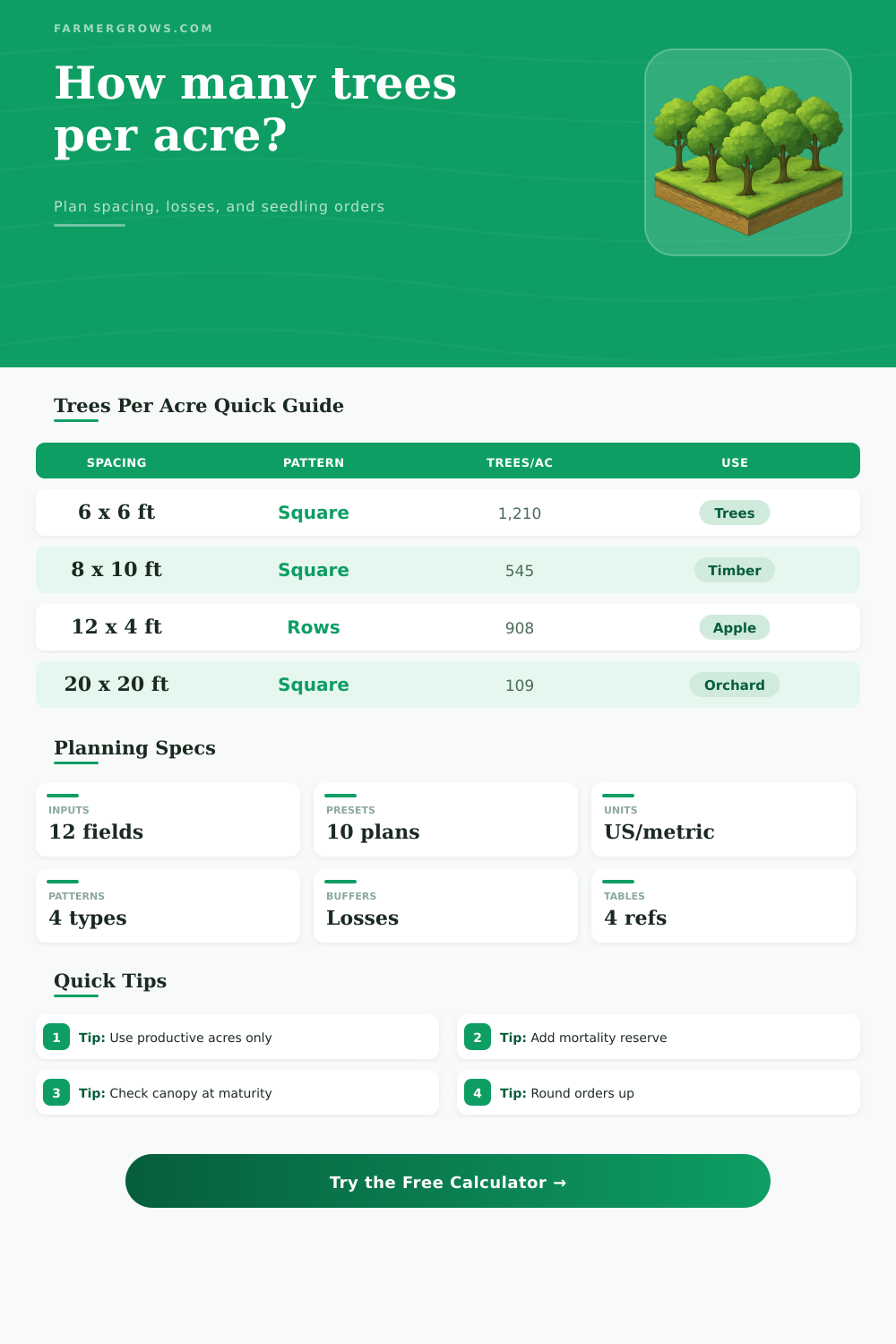
| Spacing layout | Sq ft per tree | Base trees per acre | Typical use |
|---|---|---|---|
| 4 ft x 4 ft | 16 | 2,723 | Nursery liners, coppice, or temporary high-density stock |
| 6 ft x 6 ft | 36 | 1,210 | Christmas trees, windbreak starts, and small conifers |
| 8 ft x 10 ft | 80 | 545 | Pine, hardwood, or mixed timber establishment |
| 12 ft x 4 ft | 48 | 908 | Trellised apple, trained pear, or narrow hedgerow fruit |
| 18 ft x 14 ft | 252 | 173 | Peach, nectarine, plum, and medium-canopy orchard blocks |
| 40 ft x 40 ft | 1,600 | 27 | Pecan, walnut, chestnut, and other large nut trees |
| Pattern | Footprint factor | Density effect | Best use |
|---|---|---|---|
| Square row grid | 1.000 | Standard density | Most orchards, plantations, and easy-to-stake layouts |
| Triangular staggered grid | 0.866 | About 15% more trees | Uniform blocks where every other row is offset |
| Hedgerow trained rows | 0.930 | About 8% more trees | Managed fruiting walls, screens, and row-focused systems |
| Cluster or mixed planting | 1.120 | About 11% fewer trees | Agroforestry clusters, mixed species, or irregular row breaks |
| Tree plan type | Common spacing range | Canopy caution | Planning note |
|---|---|---|---|
| Trellised apple or pear | 10 to 14 ft rows, 3 to 6 ft in-row | Keep pruning and trellis system consistent | High density works only with rootstock, support, and training. |
| Stone fruit | 16 to 22 ft rows, 12 to 16 ft in-row | Open centers need light on both sides | Wider rows help pruning, spraying, and harvest access. |
| Timber plantation | 8 to 12 ft rows, 6 to 10 ft in-row | Judge success by surviving stems | Mortality and future thinning are part of the density plan. |
| Nut orchard | 30 to 45 ft rows, 30 to 45 ft in-row | Mature crowns can close fast | Some blocks start denser and thin as canopies meet. |
| Windbreak rows | 10 to 16 ft rows, 6 to 12 ft in-row | Edge exposure increases losses | Species mix and replacement reserve matter more than exact acres. |
| Situation | Mortality input | Reserve input | Use this approach |
|---|---|---|---|
| Irrigated orchard, strong nursery stock | 3 to 8% | 3 to 5% | Order enough replacements for weak trees and planting mistakes. |
| Dryland timber or windbreak | 12 to 25% | 5 to 10% | Expect more replacements from drought, wildlife, and competition. |
| Remote block with no easy reorder | 8 to 18% | 8 to 15% | Extra seedlings can save a second delivery or missed season. |
| Planned thinning system | Normal mortality | Normal reserve | Use the thinning field for future stand density, not for order count. |
For layout accuracy: The trees-per-acre formula is exact for clean geometry, but headlands, waterways, gates, and turnarounds decide the real order quantity.
For long-term fit: Compare mature canopy width to the tighter of row spacing and in-row spacing before choosing the densest plan.
Maybe you’ve got five acres of land. And maybe you want to grow an orchard or a timber stand. Maybe you imagine rows of pines, or apples, that will yield fuel (or food) year after year. So you purchase your initial saplings. Because more seems like more profit, you go ahead and plant them close together.
A couple years later, the canopies intersects, halting airflow. One diseased tree infects another at a rate too quick to catch up. Density is more than just a math problem. It’s also a choice, about what your future needs are. How do you get it right? Consider light and access rather than just the desire to fill space. Let the calculator handle the geometry, while you focus on the logistics (and biology).
How to Space Your Trees
The concept sounds simple in theory, but it isn’t always easy to use. An acre contains 43,560 square feet. A tree planted in a ten-foot by ten-foot box takes up a hundred square feet, assuming they’re spaced at ten feet from any other tree in all directions. Four hundred and thirty-five trees per acre will fit into that acre. And that’s assuming ideal conditions; a perfect grid.
In reality, real land is far from perfect. You’ll have roads and drainage ditches that don’t run in perfectly straight lines. You’ll have headlands, which are places for the tractor to turn around. The percentage of your land that is truly productive is important, not the gross number of acres. If ninety-two percent of your five acres is actualy plantable, you are working with four point six acres. That’s going to change how many hundred seedlings your order is for. It’s going to change your cost per harvested tree if you guess wrong about how much land you’ve got.
Then there’s the matter of patterning. Staking out a square grid is straightforward, and understanding how it will fit is simple. Triangular? No problem. Those gaps between rows are filled in with trees, which means it holds about fifteen percent more than a square. Wider spacing isn’t a problem if you use wide equipment and want big lanes, but it is important when land cost more. To account for this, the calculator includes a density factor that depends on what kind of patterning you pick. Don’t worry, you don’t have to figure out the trigonometry; you simply need to realize that close-spaced plants require more severe pruning, sometimes even a trellis to keep the branches from tangling into a green curtain that blocks sunlight.
No one’s thinking about mortality when they plan on paper. A nursery plant isn’t bulletproof. In its first year it will suffer drought, pests, wildlife, and even planting mistakes. To expect none is negligent; it’s optimism bordering on insanity. Plan for 10 percent mortality, which means buying sufficient backup plants so that you can plug holes as needed instead of panicking during harvest time and discovering that half your block is bare. Tack on another five percent margin for weak-rooted or otherwise damaged plants that might arrive damaged. This ensures that you don’t have to call all around in high season, when all the best stock has been snapped up, and saves you money in the process.
Finally, look at how wide a tree will be when it matures. Planting something that will be 20-feet wide if left alone with only 12 feet between trees is setting up for strangulation. That means weak structure, poor fruit quality, and higher costs from having to do extra work to thin out the competition. On the plus side, high density works in orchard settings where the grower prunes hard to keep things shapely. In timber stands, they either wait until trees naturally start to thin themselves (self-thinning) or cut down what doesn’t make the grade. Knowing this time frame can save you from buying based only on how the trees look today rather than what they will produce later.
These are the reference tables. For common species there is some benchmark from which to start. For example, an apple trellis is often 4 x 12 feet. A pecan grove is 40 x 40. But these are starting points only; no laws. Market strategy, soil quality, and microclimate all change what is best. On a dryland site, one may want greater spacing. Less competition for water. Or if you are selling high-value fruit, you may be willing to pay for intensive management in a tighter block.
Counting stems is part of planning but so is managing expectations. Define your objective, such as timber volume. Are you looking for fruit per acre? Are you seeking wind protection? Then consider pattern, space, and what you assume will be lost. Numbers are provided by the tool. Judgment is yours. Not all planted acres are well planted ones. A well-planted acre is an acre that allows each tree to thrive; a balance that turns a crowded field into a productive asset.