Tomato Seeds Per Gram Calculator
Convert tomato seed weight into seed count, estimate grams needed for trays or transplant targets, and adjust the plan for germination, seed size, sample weights, and reserve seedlings.
Tomato seed counts vary by variety, cleaning, storage moisture, and whether the seed is raw or coated. Use a variety preset for planning, or weigh a counted sample for the most accurate seeds-per-gram value from your own lot.
Tomato Seed Weight Results
Your seed count and gram estimate will appear here.
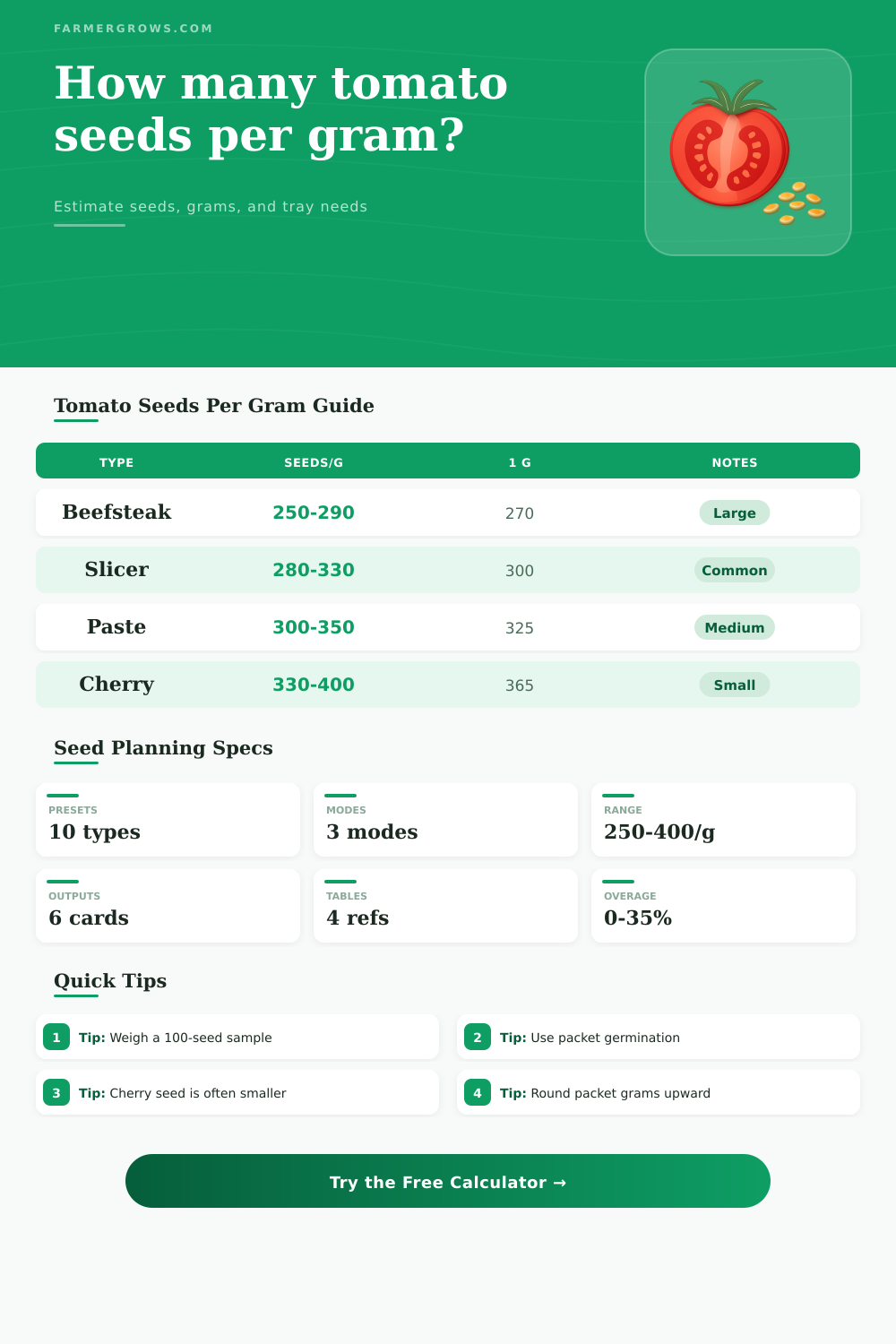
| Tomato seed lot | Planning seeds/g | Seeds per ounce | Weight of 100 seeds | Best use |
|---|---|---|---|---|
| Large beefsteak or older saved seed | 250-290 | 7,087-8,221 | 0.345-0.400 g | Use when seed is visibly large or slightly heavier from storage moisture. |
| Standard raw slicing tomato seed | 280-330 | 7,938-9,355 | 0.303-0.357 g | Good default for packets without a count but with a gram weight. |
| Paste, Roma, and sauce tomato seed | 300-350 | 8,505-9,922 | 0.286-0.333 g | Useful for market trays and larger sauce tomato batches. |
| Cherry, grape, and small-fruited tomato | 330-400 | 9,355-11,340 | 0.250-0.303 g | Use when the seed is small, clean, dry, and uniform. |
| Pelleted or coated tomato seed | 60-130 | 1,701-3,686 | 0.769-1.667 g | Use supplier count or sample mode because coating weight dominates. |
| Packet weight | At 270 seeds/g | At 300 seeds/g | At 365 seeds/g | Tray planning note |
|---|---|---|---|---|
| 0.10 g | 27 seeds | 30 seeds | 37 seeds | Small trial packet or rare heirloom sample. |
| 0.25 g | 68 seeds | 75 seeds | 91 seeds | Often enough for one light home-garden tray. |
| 0.50 g | 135 seeds | 150 seeds | 183 seeds | Enough for a 72-cell tray at two seeds per cell only when germination is strong. |
| 1.00 g | 270 seeds | 300 seeds | 365 seeds | Covers several trays or a mixed variety seed-starting day. |
| 5.00 g | 1,350 seeds | 1,500 seeds | 1,825 seeds | Small nursery or market-garden production quantity. |
| Counted sample | If sample weighs | Seeds per gram | 1,000-seed weight | Interpretation |
|---|---|---|---|---|
| 100 seeds | 0.400 g | 250 seeds/g | 4.00 g | Large or heavier tomato seed lot. |
| 100 seeds | 0.333 g | 300 seeds/g | 3.33 g | Typical raw slicing tomato seed. |
| 100 seeds | 0.286 g | 350 seeds/g | 2.86 g | Smaller or very dry raw seed. |
| 200 seeds | 0.570 g | 351 seeds/g | 2.85 g | Better sample size for mixed seed lots. |
| 50 pellets | 0.500 g | 100 pellets/g | 10.00 g | Coated seed; use pellets as individual seeds. |
| Seed-starting plan | Cells | Seeds at 1/cell | Seeds at 2/cell | Approx. grams at 300/g |
|---|---|---|---|---|
| Half 72-cell tray | 36 | 40 with 10% reserve | 80 with 10% reserve | 0.13-0.27 g |
| One 72-cell tray | 72 | 80 with 10% reserve | 159 with 10% reserve | 0.27-0.53 g |
| Two 72-cell trays | 144 | 159 with 10% reserve | 317 with 10% reserve | 0.53-1.06 g |
| One 128-cell tray | 128 | 141 with 10% reserve | 282 with 10% reserve | 0.47-0.94 g |
| 200-cell nursery flat | 200 | 220 with 10% reserve | 440 with 10% reserve | 0.73-1.47 g |
Use a stable scale: A 100-seed sample is usually enough for home planning, but a 200-seed sample gives a steadier average for mixed saved seed.
Separate count from vigor: Seeds per gram tells you physical seed count; germination and emergence decide how many usable seedlings you can expect.
Round grams upward: Tomato seed packets are small, so round up to the next tenth of a gram for trays and the next gram for production orders.
Handle coated seed separately: Pelleted seed weight mostly reflects coating, so sample mode or supplier seed count is more reliable than raw-seed tables.
To translate seed weight into number of plant, try our seed-counting calculator. It connects dots between the abstractions of grams listed on seed packets with reality of all those plant you’ll grow in your trays. It takes the guesswork out of estimating how much seed you need to fill a tray or start a backup batch. No more math before sowing.
Knowing how to count seeds per gram is beginning of knowing how to garden efficient, because knowing a seed’s raw weight doesn’t reveal its emergence rate. Or even whether it’s viable. What do those numbers tell you about your own growing conditions?
Why Seed Weight Matters for Your Garden
First: Tomato seed weight can range from variety to variety. That is why it’s dangerous to make blanket assumption about your seeds. Generally speaking, cherry and grape varieties has more seeds per gram than larger-fruited ones like beefsteaks. Also, those seeds are generally smallerer. The machine have presets that calculate density depending on what kind of tomato you’re working with. For instance, if you estimated the number of seeds in a gram of typical beefsteaks using standard guess for slicers, you might overestimate seed count. Then you’d be out of seed partway through the season. Many people wrongly think that all tomato seeds weigh the same, but biology is not the same across varieties.
These formulas are very much affected by moisture content in seed. Seed that is freshly saved will still holding some moisture; commercial seed has been dried down. That means it is heavier by weight (so there is fewer seeds per gram), but also more accurate. You can enter a custom weight for your own sample seed and adjust accordingly. A way to get an idea of what’s normal for your stash: weigh a hundred seeds yourself from whatever stash you’re working with. There’s no such thing as any generic table that can tell you that. That is what makes this tool different, and it turns vague worry about running out of seed into something you can act on and be exact about.
Theory meets reality in terms off germination rates and emergence percentages. Ninety percent is often stated on a packet, but this represent what might happen in an ideal lab setting. How does your soil mix or propagation mat stack up? The calculator distinguishes between seeds sown and ones expected to emerge as viable seedlings. For example, it offer the option of adjusting emergence (and including a reserve percentage) for lost seedling. It is common practice to sow two seeds per cell with ten percent reserve. You’ll be able to tweak these values and customize your own risk tolerance.
Coated (pelleted) seed complicates things, as coating increases the weight but not the biological potential of the seed. That means if you use a raw seed table for pelleted varieties, you’ll end up underestimating how many grams you actualy need. According to reference tables, coated seed may be 10X the weight of raw seed. There is far fewer coated seeds per gram. Unless you have information from the seed company about their count, use counts instead of generic weights for coated seed. Then, set your coated seed in special settings.
How will you set up trays? How much space are they taking? You want to plan your sowings based off what tray(s) you’ll be working with. More or fewer cells equals more or fewer seeds. The tool calculates how many grams of seed is needed for a specific tray size. No need to buy too much seed (or scramble to get more once you’ve filled half a tray). If you’re growing multiples of different things in various trays, that makes all the difference. Seed-count-per-gram knowledge makes sowing a no-brainer. No more guesswork; just plan.
It’s not math getting in the way, but background. Every packet’s contents are now known. You just translate the weight into a number of seeds and, therefore, viable plants.