Corn Seeds Per Hole Calculator
Estimate how many corn seeds to plant in each hole, station, or hill using seed tag germination, field emergence, target plants, spacing, row layout, and stand reliability.
Corn is usually thinned to one strong plant per spacing point, but cold soil, old seed, hill planting, and patchy emergence can change the best seed drop. This calculator uses a binomial stand check to find the smallest seed count that reaches your reliability goal.
Corn Seed Drop Plan
Enter your planting details, then calculate.
| Planting situation | Typical seeds per hole | Final plants | Spacing guide | Depth guide |
|---|---|---|---|---|
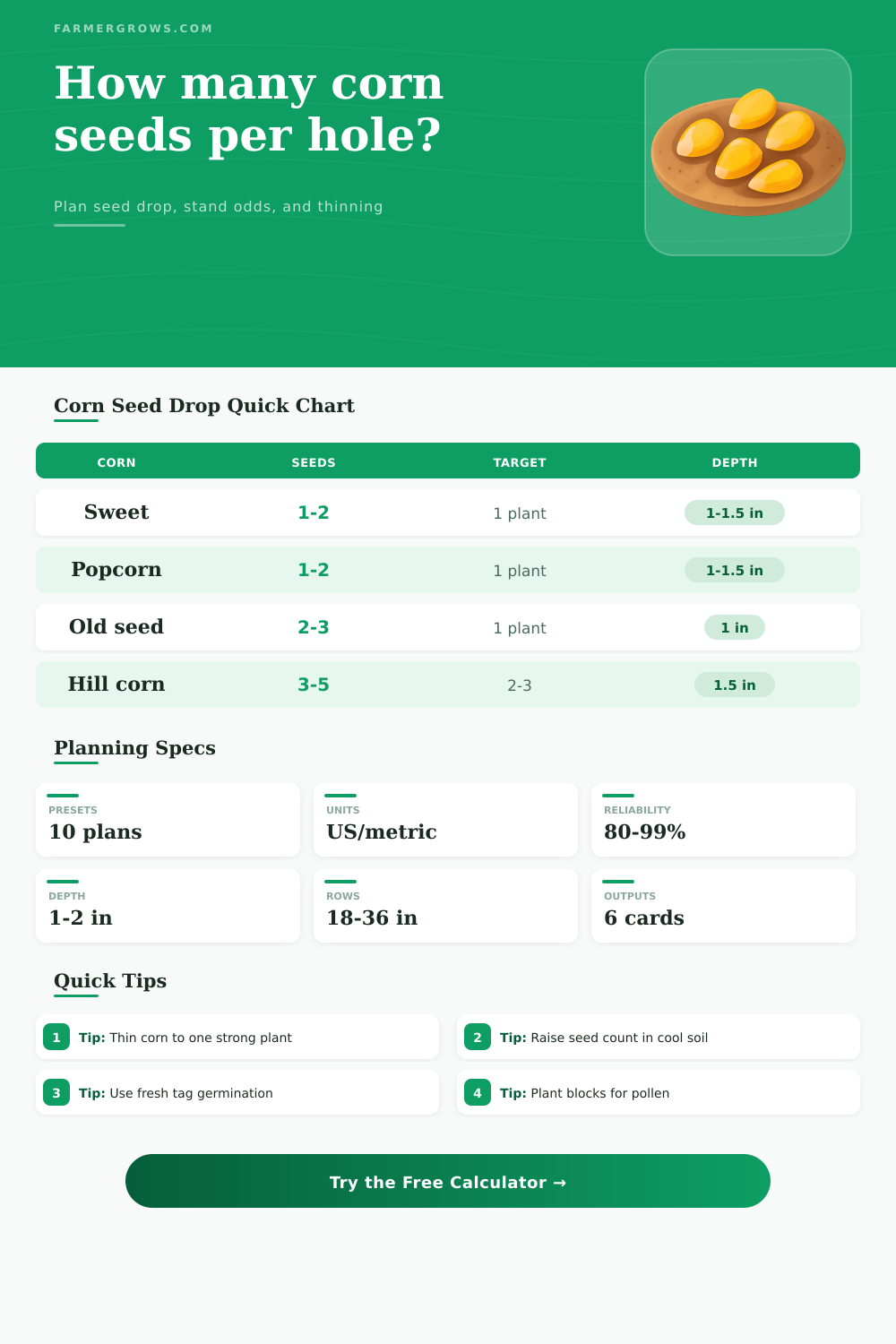
| Warm sweet corn block | 1-2 seeds | 1 plant | 8-12 in | 1-1.5 in |
| Early cool soil | 2 seeds | 1 plant | 9-12 in | 1 in |
| Old packet seed | 2-3 seeds | 1 plant | 10-12 in | 1-1.5 in |
| Popcorn garden patch | 1-2 seeds | 1 plant | 8-10 in | 1-1.5 in |
| Three Sisters hills | 4-6 seeds | 2-3 plants | 48-60 in | 1.5 in |
| Hand-seeded field corn | 1-2 seeds | 1 plant | 6-9 in | 1.5-2 in |
| Live seed odds | 1 seed succeeds | 2 seeds succeed | 3 seeds succeed | Best use |
|---|---|---|---|---|
| 95% | 95.0% | 99.8% | 99.99% | Fresh seed, warm soil |
| 85% | 85.0% | 97.8% | 99.7% | Good garden planting |
| 75% | 75.0% | 93.8% | 98.4% | Cool or uneven seedbed |
| 65% | 65.0% | 87.8% | 95.7% | Old seed or stress risk |
| 50% | 50.0% | 75.0% | 87.5% | Test seed before sowing |
| Layout | Dimensions | Row spacing | Hole spacing | Approx holes |
|---|---|---|---|---|
| Small sweet corn block | 12 ft x 10 ft | 30 in | 12 in | 48 |
| Four-row fresh patch | 25 ft rows | 30 in | 10 in | 120 |
| Popcorn strip | 20 ft rows | 24 in | 8 in | 90 |
| Three Sisters hills | Manual hills | 60 in | 60 in | 6-12 |
| Dwarf container row | 8 ft row | 18 in | 8 in | 12 |
| Soil condition | Depth tendency | Emergence effect | Calculator adjustment |
|---|---|---|---|
| Warm moist seedbed | 1.5 in | Fast and even | Higher emergence |
| Cold early planting | 1 in | Slower stand | Lower emergence |
| Dry topsoil | 1.5-2 in | Moisture seeking | Watch crusting |
| Heavy clay crust | 1 in | Uneven push | More gap risk |
| Hill planting | 1-1.5 in | Warmer mound | Target 2-3 plants |
Use probability, then thin: If the calculator recommends two seeds for a one-plant station, keep the strongest seedling and snip the extra at soil level.
Protect pollination: A perfect seed drop still needs nearby corn rows. Short blocks normally pollinate better than one isolated row.
A perfect stand of corn would have an ear on every plant and all the stalks would be the same height. No? That’s not what happens much. Insects or poor soil contact can leave empty voids in your row, while other spots might has multiple seedlings fighting for space.
That mismatch, what you expected versus what happened, is where math comes in: counting seeds per hole make your planting a planned chance instead of a shot in the dark. You are buying insurance against pests (wireworm) and weather (temperature swing). And you accept manual labor of thinning as cost of that security.
How to Plant Corn Seeds Correctly
Here’s where it gets complicated: Gardeners often conflate two different numbers. There’s the first number, the germination rate listed on the seed packet, which represents how many seeds should of sprouted in ideal laboratory conditions. And then there’s second number, field emergence, which reflects what actualy happens in your yard.
There’s the first number (the germination rate), which represent how many seeds should have sprouted in ideal laboratory conditions. And then there is the second number, field emergence, which reflect what happens in your yard. In cold soil, things take time to get going, and pests nibble away. A thick clayey soil can crust over, shattering tender stems. Birds can pluck out rows overnight.
When you mix those variables, you no longer assume that if 90 percent germinate, they’ll all be up, because they won’t. Rarely do. The calculator lets you enter separate adjustments for field conditions, which provide a more realistic view of what will emerge. It is different than sow a new crop in warm June earth than it is to attempt an early crop in cool April soil: with the former, you have time; with the latter, the chance of a failure per hole go through the roof.
With one seed per hole, if it doesn’t take, that’s game over for that planting… And corn isn’t particularly receptive to being replanted late in the game. So sow two seeds to double your odds of one taking.
There’s a catch, though: Two seeds can translate into two sprouters, two plants competing for light and space. One will prevail, or they’ll both peter out (or perhaps you’ll thin). That’s where confidence comes in. Set your confidence factor, such as wanting a 95-percent chance of having at least one plant in each hole. The tool tells you how many seeds per hole are needed to achieve that threshold based on your specific emergence odds.
The tradeoff is how much more seed you spend. Against the agony of the late thin.
Less is more: Thin! For some reason, many novice gardeners don’t want to disturb any seedling that look too good when it is time to thin. They just leave them alone. Then, when the time arrives to thin, they pull really hard and break off their roots! Instead, snip the weaker one at the soil level to keep the remaining plant’s roots intact.
You’ll have fewer, bigger ears if you are cruel and tender-minded from the get-go. When you spot two shoots per hole, pinch off the puny one at ground level without pulling it. This will not damage the root system of the other. This leaves it unharmed with no competition for sunlight. A little effort now leads to a big reward later.
Going easy here also means the plants goes limp in high winds; stunted, tall, or fallen plants often produce poorly filled-out ears. The spacing considerations includes pollination, too: corn is wind-pollinated, meaning pollen blows from the tassels at the top to the silks on the ears. If your plants aren’t close together, too widely spaced in a single row; you might not get good pollination because the pollen will just blow off.
To better capture that pollen in place, plant multiple short rows (or blocks), and the calculator can help you model these block setups. That way, you’ve got sufficient density for successful pollination but not so crowded that each station gets cramped. It considers both the in-row and between-row spacing. This means it take row width into account. It also calculates exactly how much that affects your overall hole count.
You adjust your settings for depth by soil type as well. Plant shallow in heavy clay to prevent crust problems. Plant deeper where the soil is sandy and dries fast, assuming the seed’s got enough get-up-and-go to force its way through. These tweaks affect the estimated emergence rates, which in turn affects how many seeds you’ll need; it’s not a set-in-stone rulebook but a dynamic system.
For example, old seeds requires higher numbers because their vigor is diminished, regardless of the date on the bag. Even a fresh bag of high-vigor hybrid corn may do just fine with a single seed each hole, under best conditions.
In short, a good stand starts long before that first green shoot appears above ground. And it starts with knowing that the natural world isn’t set in stone but rather based off chance. Adjusting your seed density to fit the degree of friendliness or hostility of your environment manages the risk. The principles are no different whether you’re growing field corn for grain or sweet corn for dinner back in the backyard.
Respect what soil conditions mean for emergence, buy sufficient insurance (with extra seeds), and thin aggressively to protect those who survives. When you look out on that last, even row of waving green stalks, it won’t seem like such a miracle of luck, but rather a result of careful preparation.