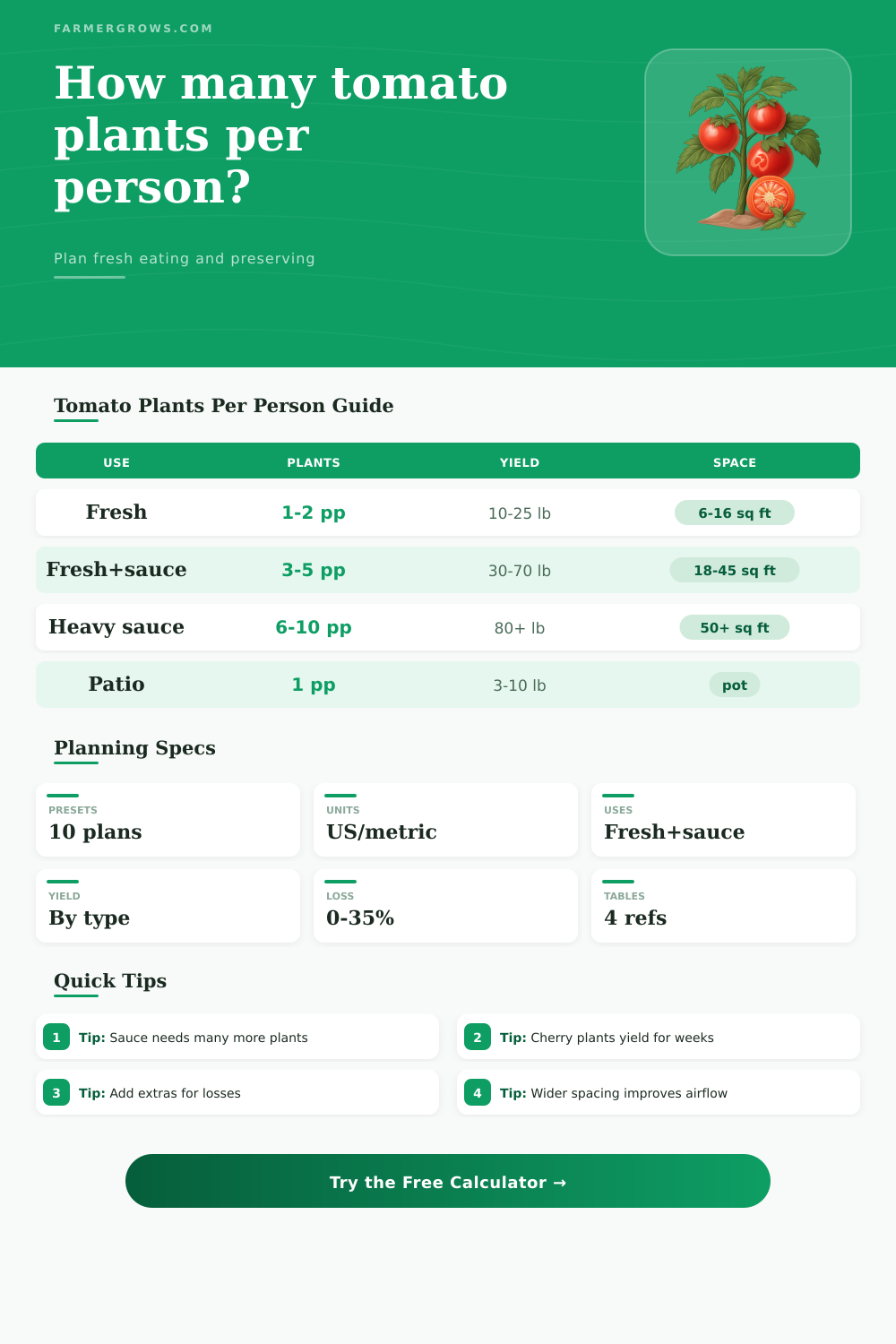
Tomato Plants Per Person Calculator
Estimate how many tomato plants to grow for one person, a family, fresh eating, salsa, sauce, preserving, seedling backups, and the garden space those plants will need.
Tomato plant count is not a single fixed number. A snacking household may need one or two plants per person, while a sauce-making household can need many more. This calculator turns household demand, harvest season, tomato type, expected yield, crop losses, and spacing into a practical planting plan.
Your Tomato Planting Plan
Enter household demand and growing conditions to estimate plants per person.
| Tomato type | Typical yield per plant | Best household use | Plant count effect |
|---|---|---|---|
| Cherry or grape | 8 to 20 lb per plant | Snacking, salads, lunch boxes | Often fewer plants for fresh use, more picking labor. |
| Medium slicer | 10 to 25 lb per plant | Fresh slices, sandwiches, mixed cooking | Balanced choice for most home gardens. |
| Paste or Roma | 8 to 18 lb per plant | Sauce, salsa, freezing, drying | Usually more plants because preserving uses many pounds. |
| Large beefsteak | 8 to 18 lb per plant | Big slices and fresh eating | Fewer fruit per plant, wider spacing, higher water demand. |
| Dwarf or patio | 3 to 10 lb per plant | Containers, small beds, balconies | More plants may be needed for a full household supply. |
| Training style | Common spacing | Area per plant | Notes |
|---|---|---|---|
| Caged indeterminate | 24 in x 42 in | 7.0 sq ft | Good airflow and harvest access for large plants. |
| Staked row | 24 in x 36 in | 6.0 sq ft | Works well with tying and some pruning. |
| Single-leader trellis | 18 in x 30 in | 3.8 sq ft | Dense system that needs weekly pruning. |
| Determinate block | 24 in x 36 in | 6.0 sq ft | Good for paste tomatoes and concentrated harvests. |
| Dwarf or patio | 18 in x 18 in | 2.3 sq ft | Use enough container volume for roots. |
| Household goal | Fresh demand | Preserving demand | Likely plant plan |
|---|---|---|---|
| One light tomato eater | 10 to 20 lb | 0 to 10 lb | 1 to 3 productive plants. |
| Two-person fresh garden | 30 to 60 lb | 0 to 25 lb | 3 to 6 slicer or cherry plants. |
| Family with sauce batches | 60 to 120 lb | 50 to 150 lb | 8 to 18 mixed tomato plants. |
| Heavy preserving household | 100 lb plus | 200 lb plus | 20 plus plants, often paste-heavy. |
| Risk factor | Low-risk setting | Higher-risk setting | How to adjust |
|---|---|---|---|
| Season length | 10 plus harvest weeks | Short or cool season | Add a larger crop buffer or use early varieties. |
| Disease pressure | Wide spacing, clean leaves | Humid, crowded planting | Use more spacing and extra plants. |
| Water reliability | Consistent drip or deep watering | Containers drying out | Lower yield expectation for patio crops. |
| Preserving goal | Occasional salsa | Large sauce pantry | Use paste varieties and more plants per person. |
| Seedling survival | Protected transplants | Wind, heat, pests | Start 15 to 30 percent extra seedlings. |
Separate fresh eating from preserving. Fresh salads may use a few pounds per week, but sauce and salsa can absorb an entire crate of tomatoes in one afternoon.
Match plant count to management time. A dense trellis can save space, but it only works well if you prune, tie, water, and harvest on schedule.
Plant a mix of types. A household plan often works best with cherry tomatoes for snacks, slicers for fresh eating, and paste tomatoes for preserving.
Use buffers thoughtfully. Add buffer for disease, weather, and sharing, but avoid crowding plants so tightly that the extra plants lower every plant's yield.
Mid-July can be tomato overload time: you go out and pick three crates of red things over 48 hours’ time, and then your friends politely decline more because they’re up to their eyeballs in them themselves. Or it could be that half the year goes by and you get just enough for four sandwich off two puny vines, but that’s no good either.
What gives? More often than not, it comes down to guessing at the number of plant to sow (rather than figuring out what a typical household consumes). The calculator do that math for you; all you do is plug in your preserving plans and how big each portion is. No need for you to calculate factors and conversions, just let it work its magic.
How to Plan Your Tomato Garden
The first error that most folks commit in growing tomatoes: They lump them all together as equal yields. One plant has dozens of little fruits spread out across a long season, while another has half a dozen heavier fruits plopped into your pail all at once. Whether it’s time to slice and dice or just snack depend on how the number of plants changes what you have to eat (see reference table).
Maybe you can get away with one or two plant between you if you’re looking for some fresh salad each week. Or maybe you’ve got six or seven vines going to achieve your weight target for frozen salsa come wintertime.
What’s the point? It is not about how pretty the fruit looks on the branch, but about the pounds of produce you can get to market after weather and disease have had their way with it. Change the shape: Preserving changes the overall layout of your garden plan. Demand for fresh eating is steady but modest; it’s usually measured in weekly servings. Sauce making is different because it is a volume game done in spurts. You may not open one jar of tomatoes for three months, then go through twenty pounds one afternoon, when you want to can some spaghetti sauce.)
If you just try to figure things out intuitively, this disparity will make for tricky planning. With the tool, you can split preservation goals into their own category, separate from fresh-eating demand. This way, you don’t overplan for salad bowl and underplant for the pantry.
And it factors in potential crop loss, which you tend to ignore till leaf edges begin to curl. Healthy gardens has about a 15 percent buffer zone. Crowded beds or humid conditions can drive losses far higher.
Another factor that seems abstract until you’re attempting to squeeze two dozen plants in a raised bed is space. Your selected row spacing and training method determine how much garden space the calculator assumes. A plant trained as a single-leader staked up will require less space per square foot than one caged. Tightening the spacing conserves ground area, but creates more work since thick foliage must be aggressively pruned to keep air moving. If it’s not, no matter how many healthy leaves you began with, fungal diseases will prevail. For good reason: Biology couldn’t give a hoot about the beauty of the rows when viewed from the driveway.
You often forget the reserves you carry as seedlings, but those reserves determine whether you survive transplant shock with your plan intact. Growing a few more (15-30 percent above) ensures there will be enough when something happens, pests, weather damage, a few fail in transit, etc., and it feels wasteful until you get hit by some late frost. That cushion is built into the final tally with the tool so all you see is how many seedlings to grow, not the ideal-but-theoretical survivors.
It’s mainly about knowing what it is you’re measuring. It isn’t how many plants you have, but rather how many pounds of edible fruit will be coming onto your table during a set period of time. That delivery rate is adjusted by every single variable: from companion crop spacing, to sun hours. Planting indeterminates in a cool climate (or even planting late) shortens your harvest window and lowers the yield per plant. More vines has to be used to reach the same target. The math is there to iron out those tradeoffs so you can realy see the price of each design choice.
Part of gardening is logistics; part is art. Logistics help keep the heartbreak out of it, though, particularly with tomatoes. You either have a large enough crop to eat all summer, can some to store for the winter, or share it. And you know you got that balance just right, both, if you get the counting correct.
You start way back before you put one seed in the ground. In fact, you start by calculating how large you want your tomato harvest to be.