Beans Per Plant Calculator
Estimate beans per plant, pods per plant, harvest weight, seed need, bed density, and row capacity for bush beans, pole beans, dry beans, lima beans, fava beans, runner beans, and edamame.
Use this calculator when planning bean plantings or comparing real harvest notes. It combines plant count, spacing, pod set, beans per pod, harvest efficiency, and crop type to estimate practical beans per plant and total yield.
Bean Harvest Estimate
Enter your plant stand and pod assumptions to estimate bean harvest.
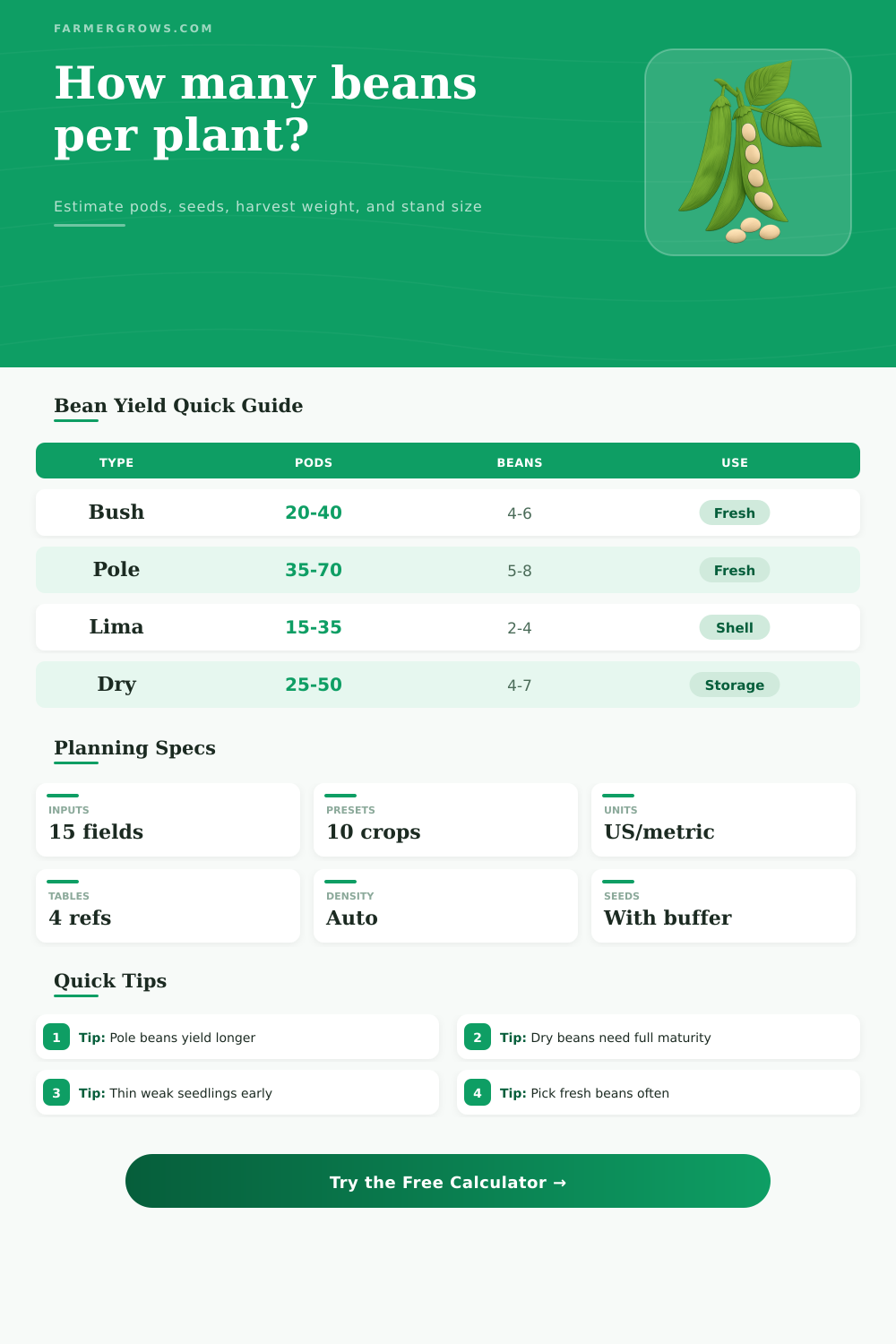
| Bean crop | Typical pods per plant | Beans per pod | Expected beans per plant |
|---|---|---|---|
| Bush snap beans | 20-40 pods | 4-6 beans | 80-240 beans before field loss |
| Pole snap beans | 35-70 pods | 5-8 beans | 175-560 beans before field loss |
| Dry bush beans | 25-50 pods | 4-7 beans | 100-350 dry seeds before culling |
| Lima or butter beans | 15-35 pods | 2-4 beans | 30-140 large beans before culling |
| Fava or broad beans | 10-25 pods | 3-6 beans | 30-150 large beans before culling |
| Runner beans | 30-60 pods | 5-8 beans | 150-480 beans before field loss |
| Harvest type | Useful weight input | Planning range | Calculator use |
|---|---|---|---|
| Fresh snap pods | Fresh pod weight | 3-7 g per pod | Multiplies harvested pods by pod weight |
| Fresh shell beans | 100-seed weight, fresh factor | 2.1-2.7 x dry seed weight | Estimates shelled fresh bean weight |
| Dry beans | Dry 100-seed weight | 18-70 g per 100 seeds | Multiplies clean seed count by seed weight |
| Edamame pods | Fresh pod weight | 2.5-5 g per pod | Uses pod harvest because pods are marketed whole |
| Spacing plan | Plants per sq ft | Plants per sq m | Best fit |
|---|---|---|---|
| 18 in rows, 5 in plants | 1.60 | 17.2 | Bush snap beans in beds |
| 24 in rows, 7 in plants | 0.86 | 9.2 | Pole beans on trellis rows |
| 15 in rows, 4 in plants | 2.40 | 25.8 | Dry bush bean block |
| 30 in rows, 8 in plants | 0.60 | 6.5 | Lima, runner, and vigorous vines |
| 24 in rows, 7 in plants | 0.86 | 9.2 | Fava or broad beans |
| Project | Plant count | Bean assumption | Likely harvest note |
|---|---|---|---|
| 4 x 8 ft bush bean bed | 60-80 plants | 120-180 beans per plant | Steady fresh picking for a short window |
| 8 ft pole bean trellis | 24-32 plants | 250-420 beans per plant | Longer harvest from fewer plants |
| 10 x 10 ft dry bean block | 220-300 plants | 110-240 seeds per plant | Dry weight depends on full pod maturity |
| 1.2 x 3 m allotment bed | 70-95 plants | 120-220 beans per plant | Good for bush snap or edamame blocks |
Use real pod counts: For the best estimate, count pods on five representative plants, average them, then update the pods per plant input.
Pick fresh beans often: Snap beans left to mature can slow new flowering, so harvest capture is often better with frequent picking.
Dry beans need patience: Dry seed estimates assume pods finish drying before heavy losses from rain, shattering, or animals.
Watch stand density: Crowded beans may set many pods but still lose yield if airflow, light, or water becomes limiting.
A packet of seeds tells you they will be abundant, but it never says exactly how much you will get or when, in August for example, you can expect to see the first results. The back label says: Plant them in full sun; space them four inches apart. Those instructions help the plants live, yet won’t help you prepare dinner.
There is a gap between their biological potential and the actual weight you see on the scale at harvest time, a gap where most home gardeners gets lost. Assuming that more always means more (as if a bean is a bean). Yet crowded rows sometimes yields fewer beans per square foot different than properly spaced ones because of things like poor air circulation and disease.
How to Estimate Your Bean Harvest
Knowing how many beans each one will add shifts the way we think about when to give up hope for fresh pods, how to space the seedling, and which variety to buy. After you assume about your rows and number of plant per row (above), the calculator takes over for the rest of the math. No more converting to decimals, no more multiplying by some coefficient; you just plug in numbers and let the calculator do its thing.
You have to think about things you might not yet care about in the abstract, but will when it affects what’s in your pantry: Did I really pick my beans regularly? That’s what the harvest capture rate input asks you to think about. The snap bean doesn’t know why you’re picking. So if you leave them on the plant long enough, the plant will eventually assume it has successfuly completed its task. Time to go dormant, time to stop sending up fresh flowers.
If you don’t have time to monitor the garden closely and only check every other day, your actual yield is going to be much lower even if technically you had 10 times as many pod. Enter a lower number for your harvest percentage, and you’ll get an estimate closer to what you’d actually weigh into jars or bags, instead of some idealistic number based off a perfect set of gardening conditions.
Some varieties will form a few pods per plant; others will produce many more. Depending on variety and structure (pods on upright plants called “poles” versus those growing on shrubby “bushes”), pod count can be all over the map. Depending on variety and structure (pods on upright plants called “poles” versus those growing on shrubby “bushes”), pod count can be all over the map.
With bushes, they’ll set a lot at once, often within three to four weeks time. That translates into a big splash and then… Unless you process them rapidly, they’re not so great. If you harvest regularly from pole beans, however, they continues producing month after month, climbing upward as they go. The result: Eventually a pole plant may outproduce a bush one in terms of overall number of beans, since its structure is different. But during the early part of the season, when we actualy want to pay attention to things, the bush plant does deliver its quota.
The tool accommodates this feature, allowing you to tell it what kind of plant you’re planting. Based on average performance data, it then calculates the expected number of pods per plant. (You could of tweaked those figures, too, if pests have diminished yields, or if your climate stretches the season further.)
Another place intuition trips us up: Spacing. A row looks like plenty of space when drawn on paper, but means leaving ground open to weeds. Planting closely together increases plant counts, as shown in the table of spacing equivalents on this page. This can be critical for crops like dry beans meant for storage, since more plants mean a bigger overall seed weight. For fresh eating crops, perhaps you could use slightly less close packing to make picking and light exposure easier.
Whatever it is, don’t make the mistake of sowing too thickly. You will then have to go through and pull out extra plant. This wastes labor and disorients surviving plants’ root systems.
Your last harvest is also indirectly affected by seed germination rate. Two-year-old seeds (for example) may not be as viable as new ones; you will require more of them to reach the desired stand. For that reason, the calculator has an input called seed buffer. Add ten or twenty percent up-front to account for poor soil seed contact, some rotting, and/or seed eaten by birds. Better to thin out a few extra sprouts than to end up with gaps between remaining plants, which reduces your overall area of production. That little tweak prevents your target “beans per plant” number from falling short due to having no plants in the ground at all.
So what? Growing beans isn’t an exercise in going for the highest possible number on paper… Ultimately it’s about getting the most consistent production over time. With some understanding of what each plant is probably capable of delivering, there’s no more guesswork: Will this be enough for eating fresh, or freezing, or maybe even drying?
Plant with intent, not hope. Space those rows accordingly for the specific variety you’ve selected. Expect what you are going to get. And if it doesn’t match what you see around you in your garden, don’t expect me to feel sorry for you. It’s not about a big bag of seeds in a pack, ready to let you down; it’s about continuous food delivery.