Potatoes Per Plant Calculator
Estimate how many potatoes one plant can produce, how much that harvest weighs, how many seed pieces you need for a target yield, and how planting choices change tuber size.
Potato yield depends on variety, seed piece size, stem count, season length, spacing, loose soil volume, water, hilling, disease pressure, and harvest losses. This calculator starts with a realistic per-plant yield model, then adjusts it to match your crop.
Potato Yield Estimate
Choose a preset or enter your crop details to estimate tubers, harvest weight, plant needs, and planting space.
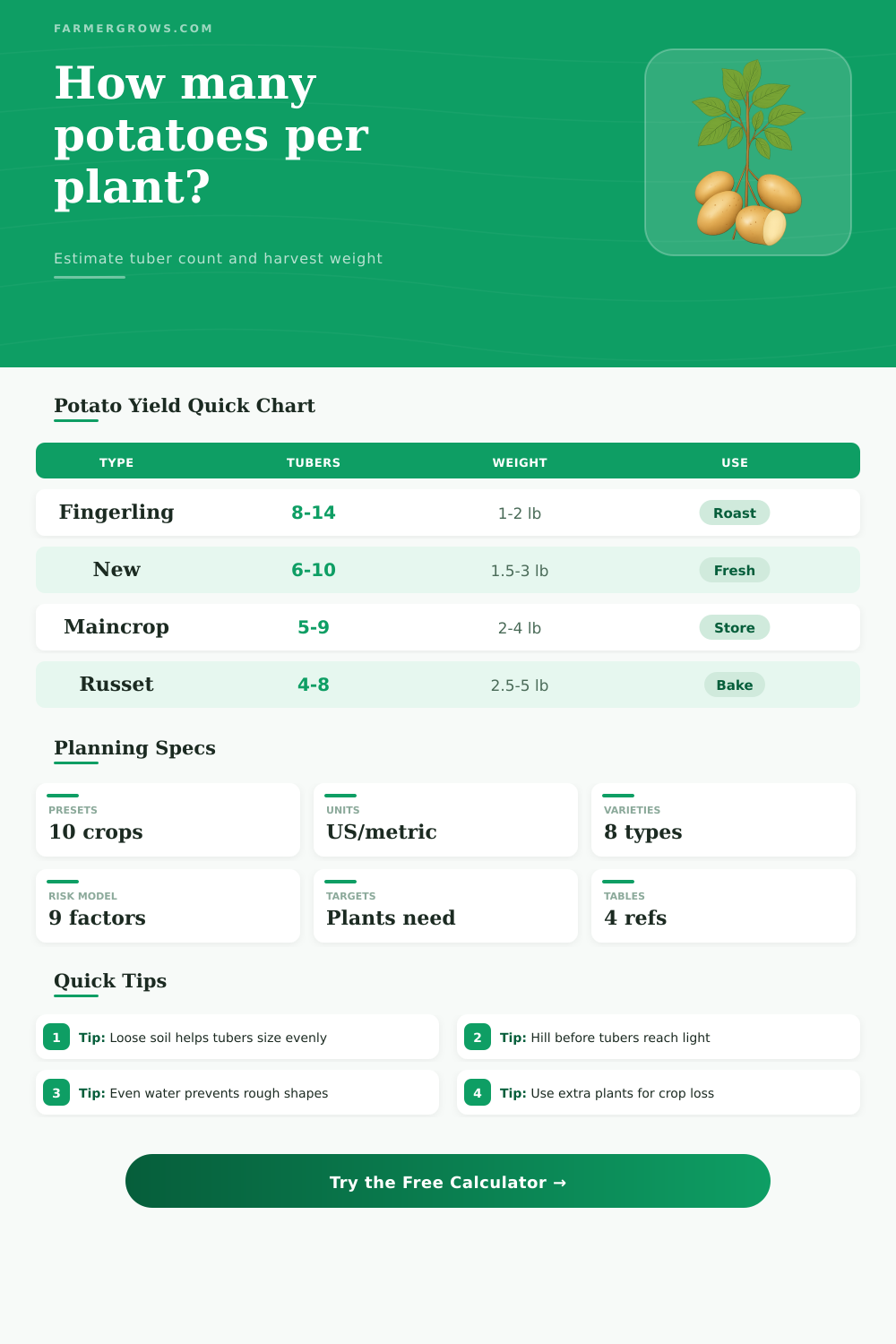
| Potato type | Typical tubers per plant | Typical lb per plant | Best harvest use |
|---|---|---|---|
| Fingerling | 8 to 14 small potatoes | 1.0 to 2.2 lb | Roasting, fresh market, specialty boxes |
| Early or new potato | 6 to 10 tender potatoes | 1.5 to 3.0 lb | Fresh eating before skins fully set |
| Red or yellow maincrop | 5 to 9 medium potatoes | 2.0 to 4.0 lb | General kitchen use and short storage |
| Russet or baking potato | 4 to 8 large potatoes | 2.5 to 5.0 lb | Baking, frying, and longer bulking seasons |
| Spacing plan | Plants per 10 ft row | Square feet per plant | Yield tendency |
|---|---|---|---|
| 10 in plants, 30 in rows | 12 plants | 2.08 sq ft | More smaller potatoes if moisture is steady |
| 12 in plants, 30 in rows | 10 plants | 2.50 sq ft | Balanced garden spacing for most maincrop potatoes |
| 15 in plants, 32 in rows | 8 plants | 3.33 sq ft | Favors larger tubers and easier hilling |
| 18 in plants, 36 in rows | 6 to 7 plants | 4.50 sq ft | Wide spacing for big russets or vigorous soils |
| Factor | Low setting | Good setting | Why it matters |
|---|---|---|---|
| Loose soil volume | Compacted or shallow | Deep friable hill | Tubers expand best where soil is loose, moist, and not waterlogged. |
| Season length | Early pull under 75 days | 95 to 130 days | Longer healthy foliage means more starch moved into tubers. |
| Water consistency | Dry-wet swings | Even moisture | Steady moisture reduces scab stress, cracking, knobs, and stalled bulking. |
| Hilling and light cover | Exposed tubers | Two hill-ups | Cover protects tubers from greening and increases usable forming space. |
| Seed piece vigor | Tiny or weak sprouts | Firm seed, 1 to 3 eyes | Healthy seed establishes stems quickly without wasting energy on excess shoots. |
| Harvest goal | At 1.5 lb per plant | At 2.5 lb per plant | At 4 lb per plant |
|---|---|---|---|
| 25 lb fresh eating | 17 plants | 10 plants | 7 plants |
| 75 lb family crop | 50 plants | 30 plants | 19 plants |
| 150 lb storage plan | 100 plants | 60 plants | 38 plants |
| 300 lb market block | 200 plants | 120 plants | 75 plants |
Count and weight are not the same. Dense planting and fingerling varieties can raise tuber count while lowering average potato size and total weight per plant.
Hill before tubers see light. Green potatoes come from light exposure and should be counted as culls, so hilling quality affects marketable harvest.
Watch late-season foliage health. Maincrop potatoes need healthy leaves during bulking; early dieback cuts yield even when plants looked strong earlier.
Plan seed by pieces, not just pounds. A pound of seed can create different plant counts depending on whether pieces are small, large, or planted whole.
One potato goes in; maybe a meal’s worth of food will come out. That’s what we hope for when planting a seed potato. More often than not, though, you find yourself disappointed when it is time to harvest and youve counted a couple tiny tuber instead of any big ones. What is the secret? Why do some get so big and others dont?
You must manage their growing environment; where those roots grows matters. You have to be able to manages the soil conditions, too, not just the planting of those seeds. You don’t need to guess, let the calculator do the math based off your conditions.
How to Grow Big Potatoes
Many first-time growers think they are covered as long as they select a high-yielding variety like Yukon Gold. Then they assumes they’ll get the full amount. Wrong! The variety simply establishes the possible maximum; how much you actualy harvest depends on your care. Sure, you can grow a big Russet potato, but only if you plant in good soil. In heavy clay, it won’t be big.
Potatoes require growing space; they also prefer loose soil so that their tubers can expands without difficulty. If your ground holds water, or is heavy and clumpy, the potato plant will have to use precious energy forcing its way out of the ground instead of filling itself with tuber flesh. This ultimateley yields less weight in the bag. If your soil conditions aren’t great, the calculator adjust the predicted weight downward. Perfect isn’t necessary; you simply want to give potatoes some wiggle-room.
Another critical aspect of size and shape is consistent water. Extreme moisture conditions aren’t good for potatoes either. If they have a dry spell followed by lots of rain, the inner part will expand before the outer part can accommodate it, resulting in cracked skins and eventually damaged tubers that tend to get tossed. So again, steady moisture promotes equal growth (hence the water-reliability factor in the model). With erratic rainfall, plan accordingly by watering regularly to reduce stress during bulking.
You can also use planting distance as a way to adjust tuber size. With closer spacing, there are more plants per row, but they’re competing for space and so become smaller-sized potato. When potatoes has wider spacing, each has room to grow in its own lane, which typically means fewer tubers per plant but bigger tubers overall. That’s what happened when I moved my potato rows from a tighter twelve inches apart to an easier-to-work-with eighteen inches (the reference table reflects this shift). A few big ones to bake with? Or lots of little ones to toss into a salad? You choose.
That’s why proper hilling helps: It prevents emerging tubers from being exposed to sun. Exposure to light makes tubers turn green and poisonous. Also, proper hilling provides extra space on the underground stems for future tuber growth (more soil volume means more room for more tubers). Not hilling? You’re limiting your yield potential right when things should of kicking into high gear. The calculator accounts for good hilling by giving more credit to better mounds.
Finally, plan on some loss. Not every potato that goes into the ground will end up in your market basket, so don’t count on harvesting as many potatoes as you planted… Some will rot in the field (if it’s wet), some will be diseased or otherwise ruined by pests, and some will just be too small to sell. Factoring in a reasonable amount of culls helps avoid getting shocked at harvest time when the real number isn’t what the theory said it would be. It is better to fall short of a grand expectation and meet a modest one.
Potatoes are a mix of genes and growing conditions. The variety is your decision; the rest, the spacing, the watering, the soil, is up to you. When you learn the parts, they assemble into a puzzle. You can plan instead of guess. Then the day the crop arrives, you will finally see what made the difference.