Pea Plants Per Square Foot Calculator
Estimate pea plant density, usable bed area, row count, seed packets, trellis length, succession sowings, and harvest potential for snap, snow, shelling, dwarf, and pea shoot plantings.
Use this calculator before sowing peas in beds, rows, containers, or a square foot garden. It combines spacing, germination, survival, edge clearance, support style, and succession rounds to estimate realistic pea plants per square foot.
Pea Planting Estimate
Your pea spacing results will appear here.
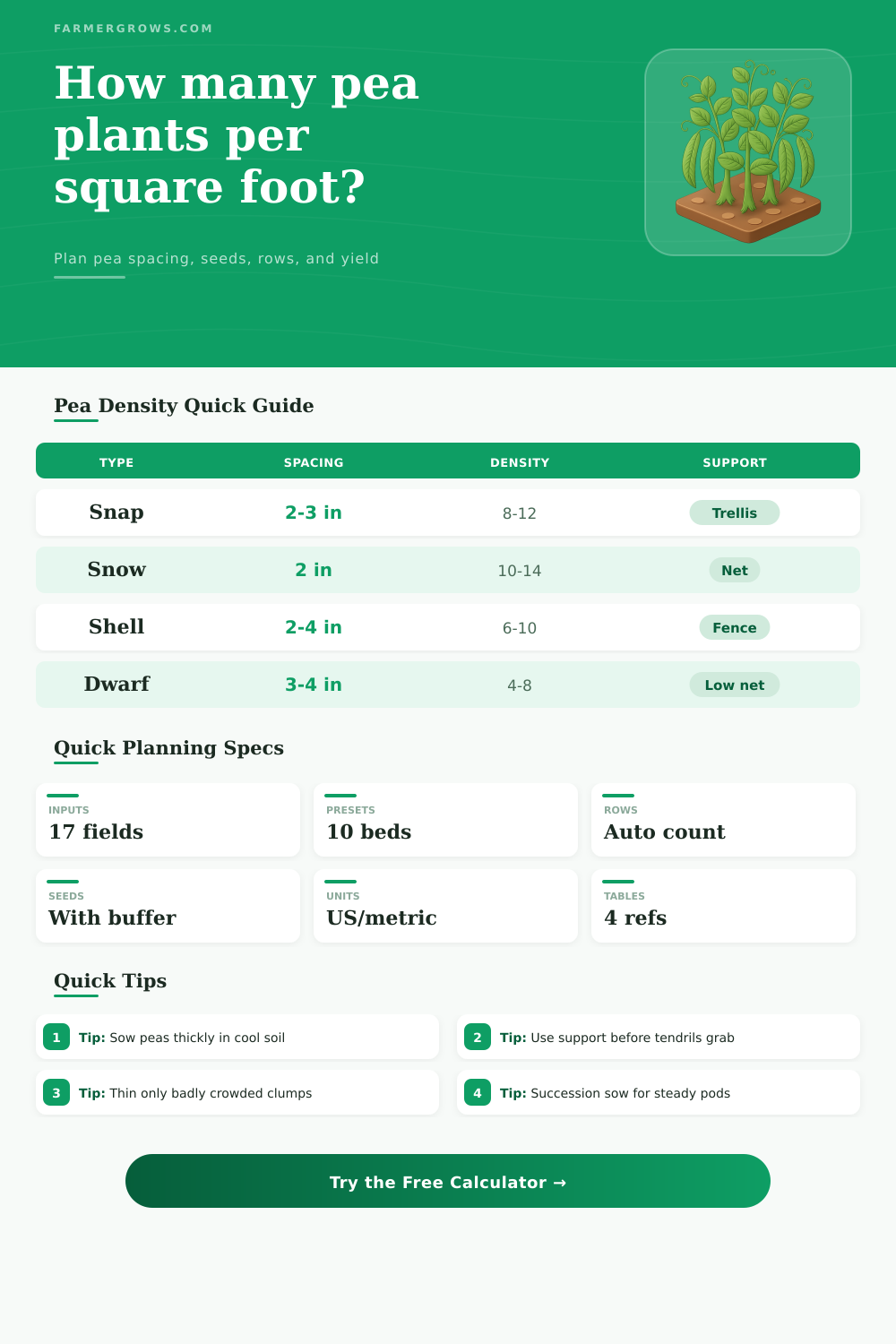
| Pea type | Typical in-row spacing | Row spacing | Plants per sq ft target | Best support |
|---|---|---|---|---|
| Snap peas | 2 to 3 inches | 6 to 12 inches | 8 to 12 | Netting, fence, or cattle panel |
| Snow peas | 1.5 to 2.5 inches | 6 to 10 inches | 10 to 14 | Fine netting or twine trellis |
| Shelling peas | 2 to 4 inches | 12 to 18 inches | 6 to 10 | Fence, brush, or short trellis |
| Dwarf peas | 3 to 4 inches | 12 to 18 inches | 4 to 8 | Low netting, brush, or no support |
| Tall climbing peas | 2 to 3 inches | 6 to 12 inches | 8 to 12 | Tall netting or sturdy panel |
| Pea shoots | 0.5 to 1 inch | 1 to 2 inches | 40 to 100 | Usually harvested before support |
| Planning item | Rule of thumb | Calculator use | When to adjust |
|---|---|---|---|
| Seeds per ounce | About 90 to 120 pea seeds | Packet estimate uses 100 seeds per ounce | Large-seeded varieties may be lower |
| Stand rate | Germination x survival | Raises seed count for real field loss | Cold, wet soil lowers emergence |
| Double row trellis | Two rows per support line | Support length uses the longer bed side | Add end posts for windy sites |
| Succession sowing | Repeat every 10 to 21 days | Multiplies total seeds and harvest | Stop before heat or hard frost |
| Harvest yield | 2 to 6 oz pods per plant | Uses your oz per plant entry | Weather and picking frequency matter |
| Situation | Density choice | Support height | Practical note |
|---|---|---|---|
| Early spring sowing | Moderate to dense | 2 to 6 ft by variety | Cool soil slows emergence, so a seed buffer helps |
| Late spring warmth | Moderate | Strong airflow helps | Heat shortens harvest, so avoid extreme crowding |
| Fall crop | Moderate | Install early | Sow with enough time before frost for pods to mature |
| Containers | Moderate | Low or narrow support | Keep moisture steady because peas dislike drying out |
| Pea shoots | Very dense | None | Harvest at 4 to 8 inches before plants compete heavily |
| Project | Area | Spacing plan | Approx plants | Seed note |
|---|---|---|---|---|
| 4 x 4 square foot block | 16 sq ft | 8 plants per sq ft | 128 plants | Plan 150 to 170 seeds |
| 4 x 8 trellis bed | 32 sq ft | Double row, 2 in spacing | 170 to 220 plants | Good for snap peas |
| 20 ft fence row | 20 row ft | 2 in spacing | 120 plants | Needs about 140 seeds |
| Patio container strip | 6 sq ft | 3 in spacing | 24 to 40 plants | Use dwarf peas |
| Pea shoot tray | 2 sq ft | Dense broadcast | 100+ shoots | Seed by weight if possible |
Set support first: Pea tendrils begin grabbing quickly. Installing netting, twine, brush, or panels before seedlings flop makes dense plantings easier to manage.
Do not over-thin: Garden peas tolerate close spacing when roots stay cool and soil moisture is steady. Thin only clumps that block airflow or picking access.
Watch soil temperature: Cold wet soil can reduce emergence. Raise the germination loss setting when sowing very early, in heavy soil, or after prolonged rain.
Harvest often: Frequent picking keeps snap and snow peas producing. Missed pods signal the plant to mature seed and can shorten the useful harvest window.
When spacing peas in a garden bed, it’s not just about how many seeds will fit where. Think also of access for harvest; think of root health and airflow. If they is too close together, the stems compete for sunlight and there is no circulation between them. Still conditions invite powdery mildew, leading to tattered foliage and a shorter harvest window.
Don’t guess whether 20 or 50 plants are too many for a certain space. There’s a calculator tool for that, one that’ll tell you exactly how many plant per bed (based off the size of the bed and how far apart you want them). Cool-season crops like peas, which also fix nitrogen, don’t like being crowded, which locks moisture away from their roots; but you want some crowding (for yield) and you need some room (for air to circulate).
How to Space Peas in Your Garden
Not all seeds will sprout. Some percentage of seed will die at any stage as they grows into seedlings and then to maturity (adjust to match this with the tool). If ten percent doesn’t sprout, how long does it take the others to get up? It takes longer in cooler soils, so add a little buffer in case of underplanting. Those percentages change your final number of plants, and that matters.
Spacing depends on the type of pea, too. Thin vining snow peas grow on netting. They are usually planted at ten to fourteen plants per square foot. These peas don’t require as much horizontal room than other types and can even be planted somewhat closer. They are light climbers.
Thicker-podded snap peas (on a trellis; typically eight to twelve plants per square foot), require more room because they’re a heftier vine. Bushing shelling peas, which also need air circulation to avoid rot, have a more compact growth habit and require less vertical support, though they may become top-heavy in an overly crowded bed. Dwarfs, which is small, work well for planting in pots or narrow beds with just four to eight plants per square foot, no collapse!
Most plans go wrong at the support structure end. Don’t put up netting, for instance, once vines get growing; they’ll wrap their tendrils around it, and then what? It becomes a tangled mess that only gets worse if pulled out, meaning half the crop comes up with it. Build your twine or fence before sowing seed.
How much support do you need, exactly? The calculator has your back: It calculates linear feet of support required from your plan. If you plant two rows side by side, as in this double-row pea-trellis plan, you get twice the yield per foot of garden space. However, it also means you need strong posts. A single row of mature peas will be heavy, and two rows will snap a flimsy support. Efficient, yes, but beefy supports is essential.
Succession sowing results in a harvest that lasts weeks to months. With peas, succession sowing means repeated sowings of tiny amounts, 10 or 20 days apart, rather than all at once, because they bolt fast if it’s too hot, and will keep producing a fresh crop right on into summer. That way, you never run out of seed mid-spring because you grew more using the tool. And it helps you picture what the work load is going to be, too. Unless you have a giant batch to freeze, don’t do it all at once.
Another reality of harvesting: There’s always loss in the process. Some pods don’t make it; they pop off and fall to earth when we’re not looking, or they overexpand and burst open. A 12-percent loss rate may sound pessimistic, but it helps keep your estimates realistic. Are you expecting that one bed to produce twenty pounds? Maybe yours will be delayed by weather, or you’ll just miss picking some along the way, and end up with only eighteen. It is still a good harvest.
On the page, there’s a table of references that breaks down the specifics of space-per-variety. These can be helpful checklists if you’re double-checking what you enter in. But where it gets good is when you understand the tradeoff. More plants mean tighter spacing. This means less labor at planting, but more at harvest and a greater risk of disease. Each plant with a little elbowroom flourishes… But requires more bed space per yield. No right or wrong answer here; just what makes sense given your time availability, climate, and soil.
Get a sheet of paper and a pencil. Start by deciding what size bed you want. Then go backwards. Calculate the space. Subtract the space for posts or pathways. Then, divide that number by whatever you want the spacing to be. Instantly, the calculator makes your general notion real. It makes it possible to buy just enough seeds, unroll just the right amount of netting, and know how long before you see the first pods. Better planning than hope any day, and believe me, if you don’t leave the plants some elbow room, the vines won’t thank you.
You should of used a moddern approach to ensure the most luxurius growth. Actually, more plant is better for yield.