Bean Plants Per Square Foot Calculator
Estimate bean plant density, row count, seed quantity, trellis length, bed utilization, and harvest potential for bush beans, pole beans, dry beans, lima beans, fava beans, and compact container plantings.
Use this calculator before sowing beans in beds, rows, containers, or field blocks. It combines bed dimensions, edge clearance, row spacing, in-row spacing, plants per station, germination rate, and thinning survival to estimate practical bean plants per square foot.
Bean Planting Estimate
Your bean spacing results will appear here.
| Bean type | Typical in-row spacing | Typical row spacing | Practical plants per sq ft |
|---|---|---|---|
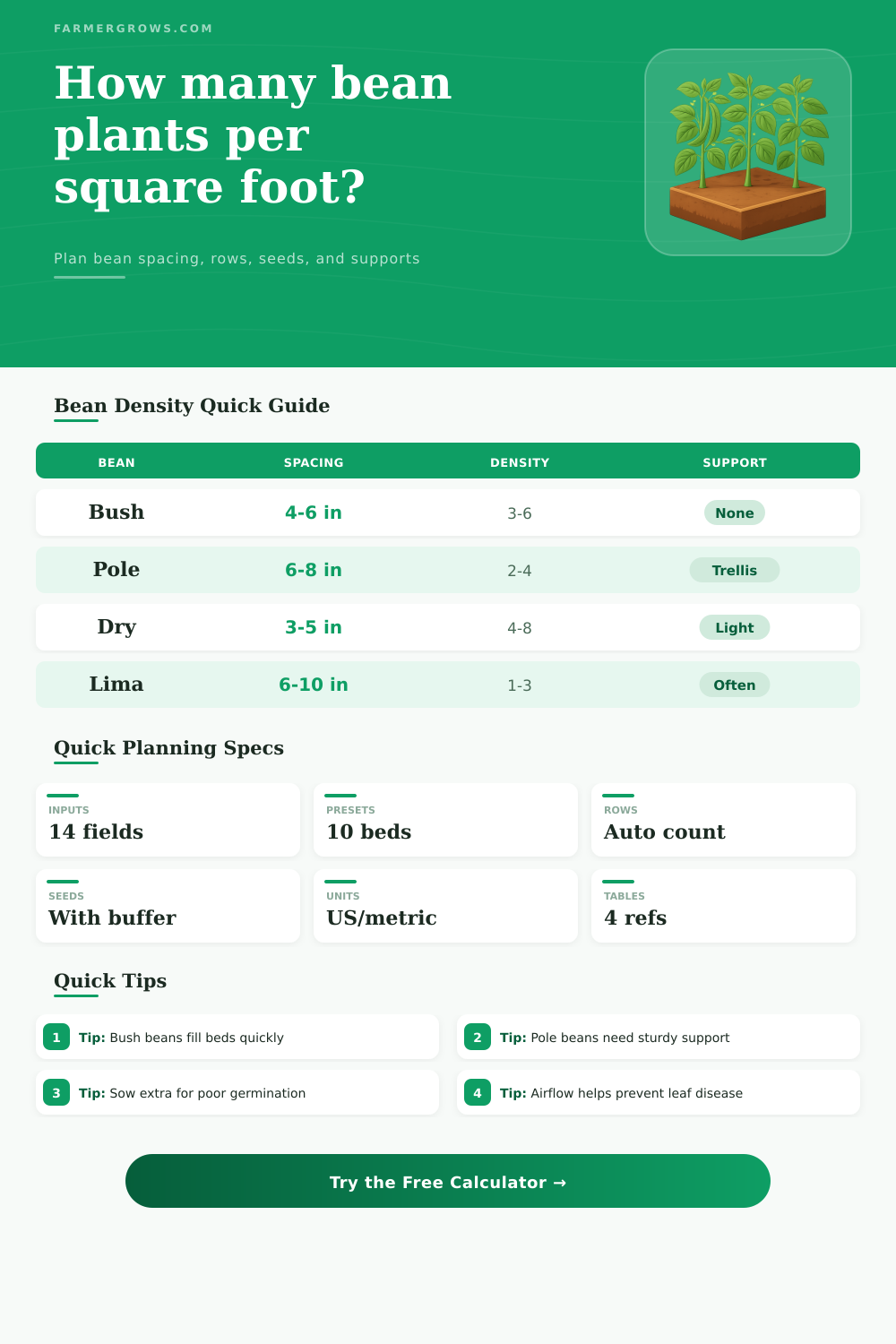
| Bush snap beans | 4-6 inches | 18-24 inches | 3-6 in intensive beds |
| Pole snap beans | 6-8 inches | 24-36 inches | 2-4 when trellised |
| Dry bush beans | 3-5 inches | 15-24 inches | 4-8 with good airflow |
| Lima or butter beans | 6-10 inches | 24-36 inches | 1-3 depending on variety |
| Fava or broad beans | 6-8 inches | 18-30 inches | 2-4 in cool weather |
| Edamame soybeans | 3-6 inches | 18-30 inches | 3-7 for harvest blocks |
| Grid spacing | Plants per sq ft | Plants per sq m | Best use |
|---|---|---|---|
| 3 x 3 inches | 16.0 | 172.2 | Too tight for most beans |
| 4 x 4 inches | 9.0 | 96.9 | Dry beans with strong thinning |
| 5 x 5 inches | 5.8 | 62.0 | Bush snap beans in beds |
| 6 x 6 inches | 4.0 | 43.1 | Pole beans or fava rows |
| 8 x 8 inches | 2.3 | 24.2 | Lima beans and vigorous vines |
| Planned final stand | 80% germination | 85% germination | 90% germination |
|---|---|---|---|
| 25 plants | 32 seeds plus buffer | 30 seeds plus buffer | 28 seeds plus buffer |
| 50 plants | 63 seeds plus buffer | 59 seeds plus buffer | 56 seeds plus buffer |
| 100 plants | 125 seeds plus buffer | 118 seeds plus buffer | 112 seeds plus buffer |
| 200 plants | 250 seeds plus buffer | 236 seeds plus buffer | 223 seeds plus buffer |
| Project | Area | Spacing plan | Approx final plants |
|---|---|---|---|
| 4 x 8 ft bush bean bed | 32 sq ft | 18 inch rows, 5 inch plants | 63-76 plants |
| 8 ft pole bean trellis | 16 sq ft | Two rows, 7 inch plants | 26-32 plants |
| 10 x 10 ft dry bean block | 100 sq ft | 15 inch rows, 4 inch plants | 250-310 plants |
| 1.2 x 3 m allotment bed | 38.8 sq ft | 45 cm rows, 12 cm plants | 75-95 plants |
Check the canopy: Dense bean stands can be productive, but if leaves stay wet after watering or rain, widen spacing or reduce rows for better air movement.
Match support to habit: Pole, runner, and vigorous lima beans need trellis length or pole stations ready before vines start to twine.
Plan seed count: Direct-seeded beans are usually sown a little heavy, then thinned to the best stand after emergence.
Use succession sowings: For fresh snap beans, several smaller sowings often give steadier harvests than one overfilled bed.
New gardeners make their first mistake: They assume if they plant more seed, then they’ll have more food. They fill the bed with seed, water it, and wait, but what do they end up with? A tangle of thin stems, covered in powdery mildew (no good air flow!). The plants fights for light, so the beans are like toothpicks. Ouch! Painful lesson in density.
Once you plug in the dimension of your bed, along with how close together you want to space things, this calculator does all the math for you, spares you the conversions, and the guessing at coefficients. Not all beans is equal. Some have more “footprint” than others. For example, some varieties of bush beans grows into compact plants that produce their pods close to the soil. These are like carpets because they can be planted closely together without risk of collapsing.
Why Plant Spacing Matters for Healthy Beans
Vines (pole beans) require horizontal space where leaves can air out and also vertical structure to climb on. You’ll notice if you try cramping them into a row-spacing plan intended for bush beans, those bottom leaf won’t dry off quickly after an irrigation or rainfall. Humidity equals trouble: an invitation to fungal diseases that will destroy your crop before you even see results.
The table at right make it easy to understand: What’s the minimum distance between rows? How about between plants within a row? How much space does it take up? It’s not just geometry; it’s reality. Few people gets full germination with a packet of seeds. Some get eaten by slugs, some get dug up by birds. Soil temperatures vary across the bed.
So there’s a field for germination percentage, and that makes sense because you can enter the likely percent you expect (and maybe you’re sowing on a cool spring day, so drop the number if your soil is heavy clay). The tool will adjust total seed quantity you need accordingly; adding a little cushion; to make sure you have plenty to reach your desired plant spacing, allowing for losses here and there. Again: a tiny tweak that keeps the gaps out of your rows, avoiding any frustration.
Spacing isn’t only about touching; it is also about light and air. More air means less disease. Intensive square-foot gardeners adore tight grids. This is fine for root vegetables or leafy greens. Not so for beans, which create a canopy of leaves that holds moisture, inviting disease to move quickly when leaves remain wet. By planting further apart or wider between rows, you’ll have better air flow among the canopy. You will also have healthier plants with fewer chemical interventions and drier foliage. This makes harvest a little easier, as there is no need to break tender stems or trample half the bed to get those pods.
The density equation is different than succession planting. Sow all your beans now and guess what? You’ll have one giant heap of beans to eat, then nothing. Most gardeners prefers a steady supply of fresh green beans over several weeks. With the calculator, you can enter in more than one sowing cycle. It adjusts your seed need accordingly but maintains the actual density per square foot that’s reasonable during each planting period. There is less waste, fewer plants crowding each other out, and a longer-lasting productive garden.
Layout is also dictated by your support structures. There’s a difference between a teepee, a trellis, and a cattle panel (and they each require their own spacing and load capacity). Twining types of pole beans climbs up a support structure. The denser the support structure, the less they’ll wander off onto other nearby plants. For example, if you’re making a three sisters planting, the vine of the pole beans would get tangled with the squash or corn. By knowing what kind of support structure you want to include, the tool can help you figure out how many plant you can safely grow on it without creating an impossible-to-pick-through knot.
Last: What will you do with the beans? Some crops (such as dry beans destined to be stored) may do better with a bit closer spacing than fresh snap beans would. That’s because you’re after the entire pod when it’s brown and dried. So there’s not much value in the plant structure itself; just how many healthy vines produces fruit. Lima beans in particular are vigorous plants that get big and want plenty of space to grow their buttery-seed goodness. Even though on-paper the plant count appears high, crimping them results in lower yields per plant, as well. With legumes, quality can trump quantity.
Planning ahead saves time and seed later: Beans do not like to be moved after they’re in the ground. Get your spacing right on paper first, then thin them out; it’s painful, but necessary because you’ll need to pull up some healthy little plants to make room. You will have a stronger, healthier garden from day one. From chaos to design. Less worry-time about disease, and more dinner-picking-time.