Pepper Plants Per Square Foot Calculator
Estimate pepper plant density, row count, plants per row, reserve seedlings, square-foot layout, and harvest range for bell peppers, jalapenos, poblanos, cayennes, habaneros, and mixed garden beds.
Pepper spacing changes with plant habit, pruning, climate, and how easy harvest access needs to be. Use close spacing for compact hot peppers and wider spacing for large bell, poblano, and long-season chinense plants.
Pepper spacing snapshot
Enter your bed size and spacing to estimate plants per square foot.
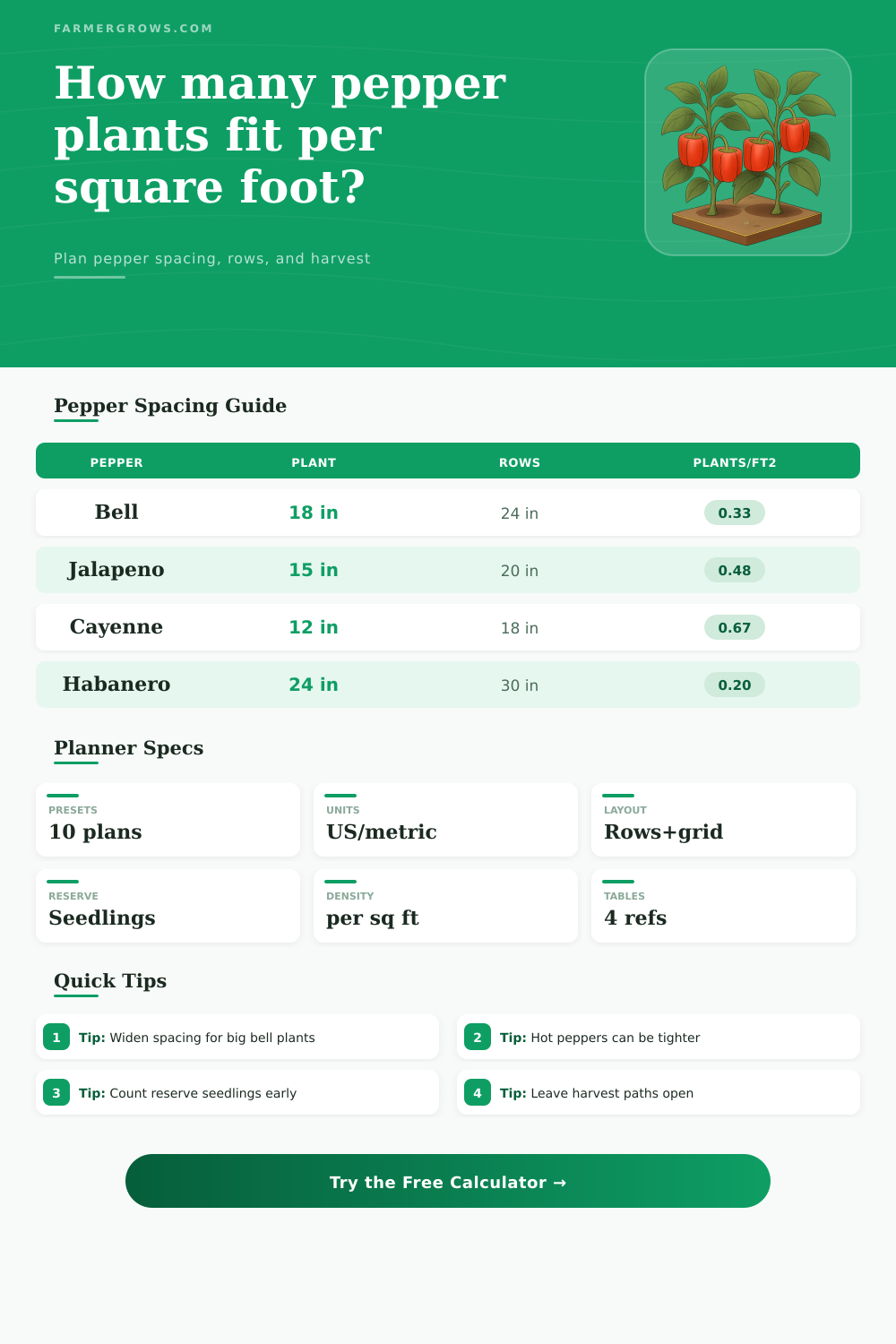
| Pepper type | Typical in-row spacing | Typical row spacing | Plants per sq ft | Notes |
|---|---|---|---|---|
| Bell pepper | 18 to 24 in | 24 to 36 in | 0.17 to 0.33 | Wider spacing helps airflow and fruit size. |
| Jalapeno or Fresno | 14 to 18 in | 18 to 24 in | 0.33 to 0.57 | Good raised-bed density with repeated harvest. |
| Banana or frying pepper | 16 to 20 in | 20 to 30 in | 0.24 to 0.45 | Moderate canopy, easy picking rows. |
| Poblano or ancho | 18 to 24 in | 24 to 36 in | 0.17 to 0.33 | Large branches and heavy fruit need support room. |
| Cayenne or Thai | 12 to 16 in | 16 to 24 in | 0.38 to 0.75 | Upright hot peppers tolerate tighter spacing. |
| Habanero or bonnet | 24 to 30 in | 30 to 42 in | 0.11 to 0.20 | Broad plants need extra heat, air, and harvest room. |
| Plant spacing | Row spacing | Plants per sq ft | Plants per 100 sq ft | Best fit |
|---|---|---|---|---|
| 12 in | 12 in | 1.00 | 100 | Very tight dwarf or trial plants only. |
| 12 in | 18 in | 0.67 | 67 | Cayenne, Thai, compact hot peppers. |
| 15 in | 20 in | 0.48 | 48 | Jalapeno, shishito, snack peppers. |
| 18 in | 24 in | 0.33 | 33 | Bell peppers and mixed beds. |
| 24 in | 30 in | 0.20 | 20 | Habanero and vigorous poblanos. |
| 30 in | 36 in | 0.13 | 13 | Very large, long-season plants. |
| Bed or plot | Area | Spacing used | Approx plants | Layout note |
|---|---|---|---|---|
| 4 x 4 raised bed | 16 sq ft | 18 x 18 in | 7 to 9 | Works for compact bells or jalapenos. |
| 4 x 8 raised bed | 32 sq ft | 18 x 24 in | 10 to 14 | Two rows with harvest from both sides. |
| 4 x 16 raised bed | 64 sq ft | 18 x 24 in | 21 to 28 | Good mixed pepper family bed. |
| 30 in x 50 ft row | 125 sq ft | 18 x 30 in | 33 to 40 | Single market row with walking space. |
| 3 x 20 ft hot bed | 60 sq ft | 15 x 18 in | 30 to 36 | Dense hot-pepper block with staking. |
| 10 x 20 ft patch | 200 sq ft | 24 x 30 in | 36 to 45 | Wide layout for large plants and airflow. |
| Pepper group | Planning yield per plant | Spacing pressure | Harvest planning cue | When to widen |
|---|---|---|---|---|
| Bell peppers | 2 to 4 lb | Medium to high | Fruit size drops if plants crowd. | Humid sites or heavy foliage. |
| Jalapenos | 1.5 to 3 lb | Medium | Frequent picking keeps plants productive. | When rows are hard to see. |
| Poblanos | 2 to 4 lb | High | Large fruit can bend branches. | When staking is limited. |
| Cayenne types | 0.8 to 2 lb | Low to medium | Upright plants fit denser rows. | When leaf disease is common. |
| Habaneros | 1 to 3 lb | High | Long-season plants become wide bushes. | Always in humid climates. |
| Greenhouse peppers | 4 to 8 lb | Managed | Pruning and support define spacing. | If light penetration is weak. |
A mixed bed should be spaced for the broadest pepper type, not the smallest transplant. One habanero or poblano can shade several tighter hot peppers if the layout ignores mature width.
Plants per square foot can look efficient while the bed becomes difficult to pick. Leave enough row and edge room for hands, stakes, labels, airflow, and repeated harvest rounds.
T he scene: An empty garden bed where you intend to stand, with a flat of twenty pepper seedling, wondering what to do with them. How to make it work? The impulse is to crowd them in, since surely there will be more fruit if there are more plants. Then comes August, and crowded-looking stalks yields little misshapen peppers. Why did this happen?
Spacing isn’t only about looks or even neatness. It is also a question of reaching the fruit, having air flow, and providing root access. Most of us guess about our spacing, until something doesn’t come up, and we call it the weather.
Why Pepper Spacing Matters
After you plug in your pepper type and how big your beds will be, this calculator does all of the math for you (avoiding the kind of mistakes where you end up short on rows or ordering too many plants). And it translates vague rules into something concrete: How many plants will I have? What should my harvest weigh? That way you’ve got a clear target ahead of time when you go out to dig.
It’s also got a reference table showing the spacing for each type, though knowing why numbers differ will help even more. Habaneros want room to stretch their legs so they can get big fruit; jalapenos and cayenne is upright and fare better in more densely planted spaces. Plant too many habaneros together and they’ll block sunlight from one another, leading to issues with humidity.
When you think about rows in terms of how many plants can go into each it’s tempting just to space them out along the length and forget it. What matters even more is vertical space: the width of your planting area (sometimes called the “row spacing”). If you plant a bunch of jalapenos twelve inches apart in a ten-foot row, yes, that might get you fifteen peppers. But with an eighteen-inch-wide row, what happens when the plants gets big? How much room do you have to move around?
The tool helps you make a decision: Can I get really dense and close-packed, or do I need a grid that gives me room to walk? You’ll know when you’ve got too little space because there’s no way to see all the pods. You won’t be able to pick them quickly while they are still firm so one might go bad and rot everything else. Remember that ventilation aids pepper health… So adjust the above numbers based off your climate. Wider spacing, if it’s humid where you live, helps leaves dry faster after rain.
Some people grow them closer than this (the reason: trapping warmth) if your region is cool and the season short. It is a risky bet, but it is occasionaly successful. The calculator lets you plug in expected transplant success rate. Not every seedling survives summer shock. Buy a fifteen percent reserve (meaning buy enough to account for lost ground), so you shouldn’t of had to make a mad dash in July when there’s nothing left at the nursery.
Plant Count, or yield planning, links what’s growing to what you’ll eat at the end of the day. One bell pepper plant grown with plenty of room may bear three pounds of fruit; another crowded up against its neighbors might only bear half as much (using its energy for making foliage rather than fruit). So the calculated range of possible harvests you get back represents not just how many plants there are but also how healthy they’re being kept by their spacing. It transforms a plot of ground into an estimate of how it will produce.
As with other gardening, it’s also about managing expectations (not just soil nutrients). No amount of coaxing will make a plant bear heavier then its environment supports. But you can make sure that the environment doesn’t conspire against it by giving it insufficient growing space. Go with the recommended distance for your variety; then if foliage will be heavy, or if your summer turns out to be wet, add some space.
At harvest time, reach into the row and see how hard it was to get in there in springtime: You want room for your hands. Often an added inch makes all the difference between a productive season and a frustrating one.