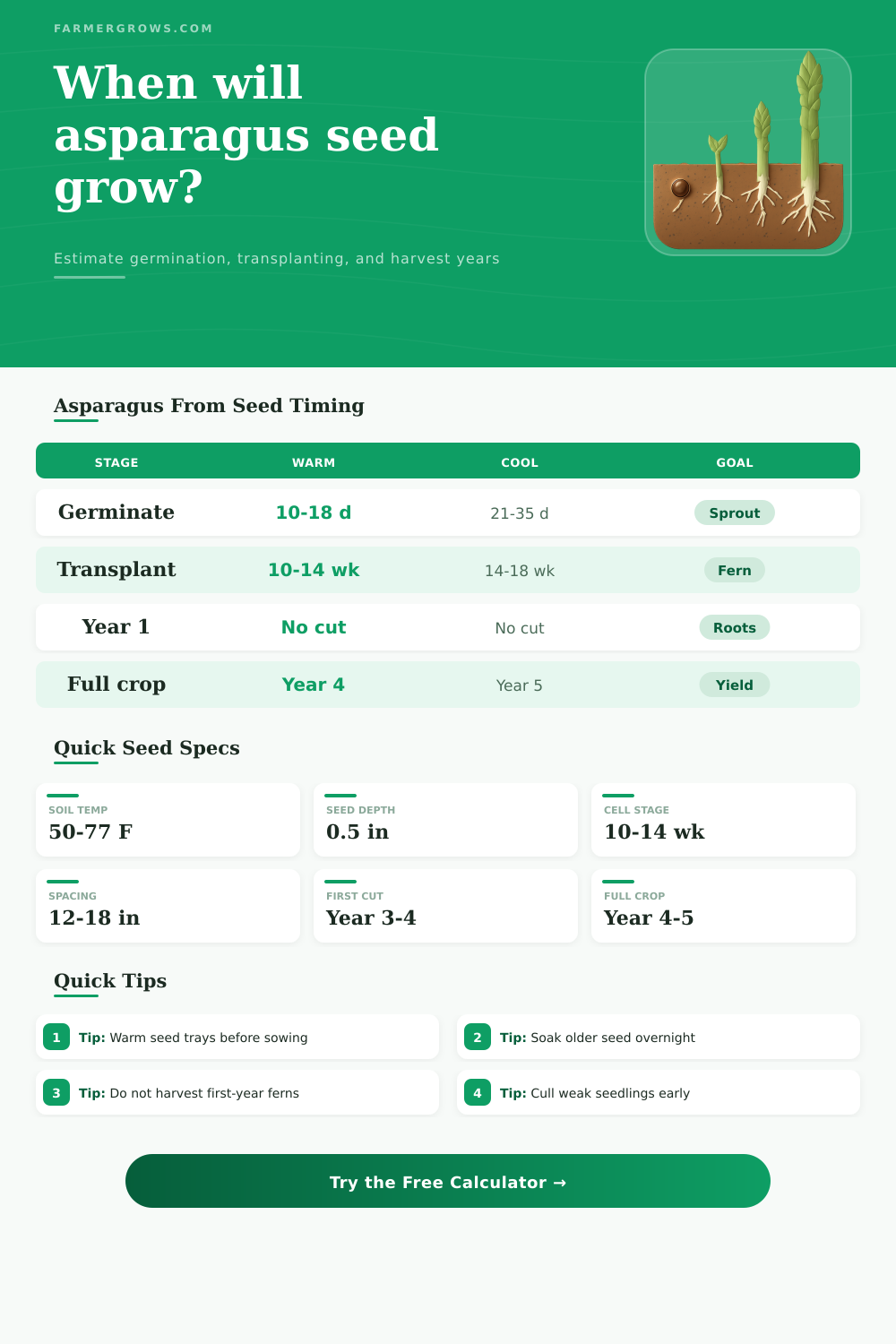
Asparagus Seed Growth Time Calculator
Estimate asparagus seed germination, seedling age, transplant window, fern establishment, first harvest restraint, full-production year, seed count, bed spacing, and mature yield from real seed-starting conditions.
Asparagus seed grows slowly at first, then spends several seasons building crowns. This calculator separates the germination phase, nursery phase, transplant stress, fern-building years, and harvest restraint so seed-grown beds are planned realistically.
Warm media and steady moisture shorten germination and help seedlings reach transplant size before summer stress.
Large cells reduce root circling and make it easier to cull weak seedlings before permanent bed spacing.
A temporary row lets seedlings grow one season, then the strongest crowns move to the final bed.
Direct sowing works best in warm, clean beds because slow asparagus seedlings are easy to lose in weeds.
Asparagus Seed Growth Timeline
Your seed-grown asparagus timing will appear here.
| Media temperature | Expected asparagus seed response | Typical germination | Planning note |
|---|---|---|---|
| Below 50°F / 10°C | Very slow and uneven | 30-45+ days | Delay sowing or use bottom heat; cold wet media can rot seed. |
| 50-59°F / 10-15°C | Slow but possible | 21-35 days | Use fresh seed and avoid saturated trays. |
| 60-68°F / 16-20°C | Reliable home-garden range | 14-28 days | Good for greenhouse flats and bright indoor starts. |
| 69-77°F / 21-25°C | Fastest common range | 10-18 days | Ideal for heat mats if moisture is even. |
| Above 82°F / 28°C | Can stress seedlings | 12-25 days | Remove heat once sprouted and increase airflow. |
| Stage | Approximate timing | What to watch | Calculator use |
|---|---|---|---|
| Radicle and first spear | 10-35 days after sowing | One thin spear appears first, then tiny fern growth. | Germination result card estimates this window. |
| Seedling fern building | 4-10 weeks after sprout | Bright light prevents stretched, weak ferns. | Care setting changes nursery speed and vigor. |
| Transplantable plug | 10-18 weeks after sowing | Several ferns and roots holding the cell together. | Transplant card estimates the best move date. |
| Nursery crown lift | After one growing season | Move the strongest small crowns while dormant. | One-season option delays final planting. |
| Permanent fern year | First year in final bed | No cutting; allow every spear to become fern. | Harvest card applies seed-grown restraint. |
| Final bed plan | Plant spacing | Rows | Seed-starting note |
|---|---|---|---|
| Home side row | 18 inches in-row, 48 inches between rows | 1-2 rows | Start 35-50% extra seed to cull weak seedlings. |
| Intensive raised bed | 12-15 inches in-row, 30-36 inches between rows | 2-3 rows | Use large cells and strong fertility to avoid crowding. |
| Market garden row | 12-15 inches in-row, 54-60 inches between rows | Multiple rows | Grow plugs evenly so final stand is uniform. |
| Nursery-to-bed system | 2-3 inches in nursery, 12-18 inches final | Temporary row first | Over-sow heavily, then transplant only vigorous crowns. |
| Season counted from seed | Bed priority | Typical cutting | Stop signal |
|---|---|---|---|
| Seed year / nursery year | Germinate, cull, and build fern | No harvest | Any spear should be left to fern. |
| Year 2 | Establish permanent crowns | No harvest for most seed beds | Thin fern or poor stand means no cutting. |
| Year 3 | Light sample only if vigorous | 0-14 days | Stop when spears drop below pencil diameter. |
| Year 4 | Regular but conservative harvest | 3-5 weeks | Stop before fern vigor declines. |
| Year 5 and older | Full mature bed harvest | 6-8 weeks | Stop when spear size or speed falls. |
| Variety or type | Seed-grown strength | Best-fit climates | Timing note |
|---|---|---|---|
| Millennium | Cold-tolerant fern and long-lived crowns | Zones 3-6 | Often a little slower early, strong after establishment. |
| Jersey Knight / Supreme | Productive hybrid rows | Zones 4-8 | Good all-purpose seed-grown bed when seed is available. |
| Mary Washington | Traditional, widely available seed | Zones 4-9 | Mixed male and female plants; cull weak or seedy plants later. |
| Purple Passion | Tender purple spears, moderate yield | Zones 4-8 | Protect seedlings from heat and harvest gently. |
| Atlas / UC 157 | Warm-climate adaptation | Zones 7-10 | Warm soil helps seed starts, but summer stress can shorten fern quality. |
Seed-grown asparagus varies. Extra seedlings help you choose the strongest ferns and discard slow, pale, or crowded starts before permanent spacing.
The seedling may look harvestable before it is ready. Leave early spears to fern so roots can store energy for future spring crops.
You need patience when starting asparagus from seed. It will be three weeks before anything seems to be going on aboveground, but the root is developing below. Knowing how long it takes will prevent you from splurging on costly crowns later. The entire sequence, from seed to eating; can be figured out with a calculator; no need to get lost in time.
The rate of germination is also affected by temperature. Below 50 F., asparagus seeds will rot in the cold, sodden soil. To get around this, some people use warming mats that hold soil at roughly sixty-five degrees, shortening wait time from up to a month down to ten or even eighteen days. With summer heat imminent, you want to jump-start the plant before it gets stressed out. A table of temperature variation and its effects on timeline helps you judge whether you need added heat.
Why Growing Asparagus from Seed is Worth the Wait
Once you get some spears, wait longer; your plant isn’t ready to harvest until its root system are well-developed. Don’t hurry this nursery stage. Allot at least 10-18 weeks for seedling growth (more time equals thicker, stronger roots with more fern mass). If you transplant too early, you’ll have stunted plants. Better that they grow big in a flat than littlee in the ground.
It’s hard not to cut those spears the first or second year, but don’t. Starving the crown of your plant means starving it for years to come. While in the fern stage, the plant is storing up root reserves to push out next spring. Interrupt that process with spear cutting and you’ll pay down the road. Don’t harvest at all in the first year; sample lightly in year three, then wait till year four or five for full production. These are estimates, which is why there’s a tool for them: haste now kills yield later.
Expect to provide enough spacing. Unlike carrots, don’t try to crowd asparagus. Allow room for those horizontal roots of each plant. Twelve or even eighteen inches apart is better. Spacing them wider apart in the row is also good. Vigorous, sprawling crowns results, and you’ll get bigger and stronger spears. Weaker ones are produced when crowded conditions cause competition for nutrition. Empty soil is a good thing early on, that’s where the eventual root mass is headed.
Success depends off the seed age: germination is slower and the coat is harder in older seeds. Pre-soak for a day or two before planting to break its dormancy. Even with fresh seed, start extra, since not all will come up. Remove the weak plant early. Give the strongest ones space to grow so that you get a good-looking bed instead of mess.
Sowing your own asparagus from seed takes more time at first, but it pays off in the long run. You get beds that yield spears for decades, and these is better than crowns bought elsewhere. You also have total control over your selection, spacing, and growing conditions from day one. Early on, it’s not about the feast; it’s about building the plant, which takes a few years. Then thick spears comes in year four, and waiting will pay off. So much quiet going on underground yields such big bounty later. You should of seen how naturaly they grow once established.