Hydroponic Spinach Growth Time Calculator
Estimate seed-to-harvest timing, baby leaf or bunching dates, heat and root-zone risk, daily light needs, EC and pH fit, cut strategy, and expected yield for hydroponic spinach crops.
Spinach is a cool-season crop even in a hydroponic system. This planner rewards fast, cool, well-oxygenated growth and adds delay or bolting pressure when light, air temperature, solution temperature, pH, EC, or dissolved oxygen drift away from spinach-friendly ranges.
Hydroponic Spinach Growth Estimate
Your harvest estimate will appear here after calculation.
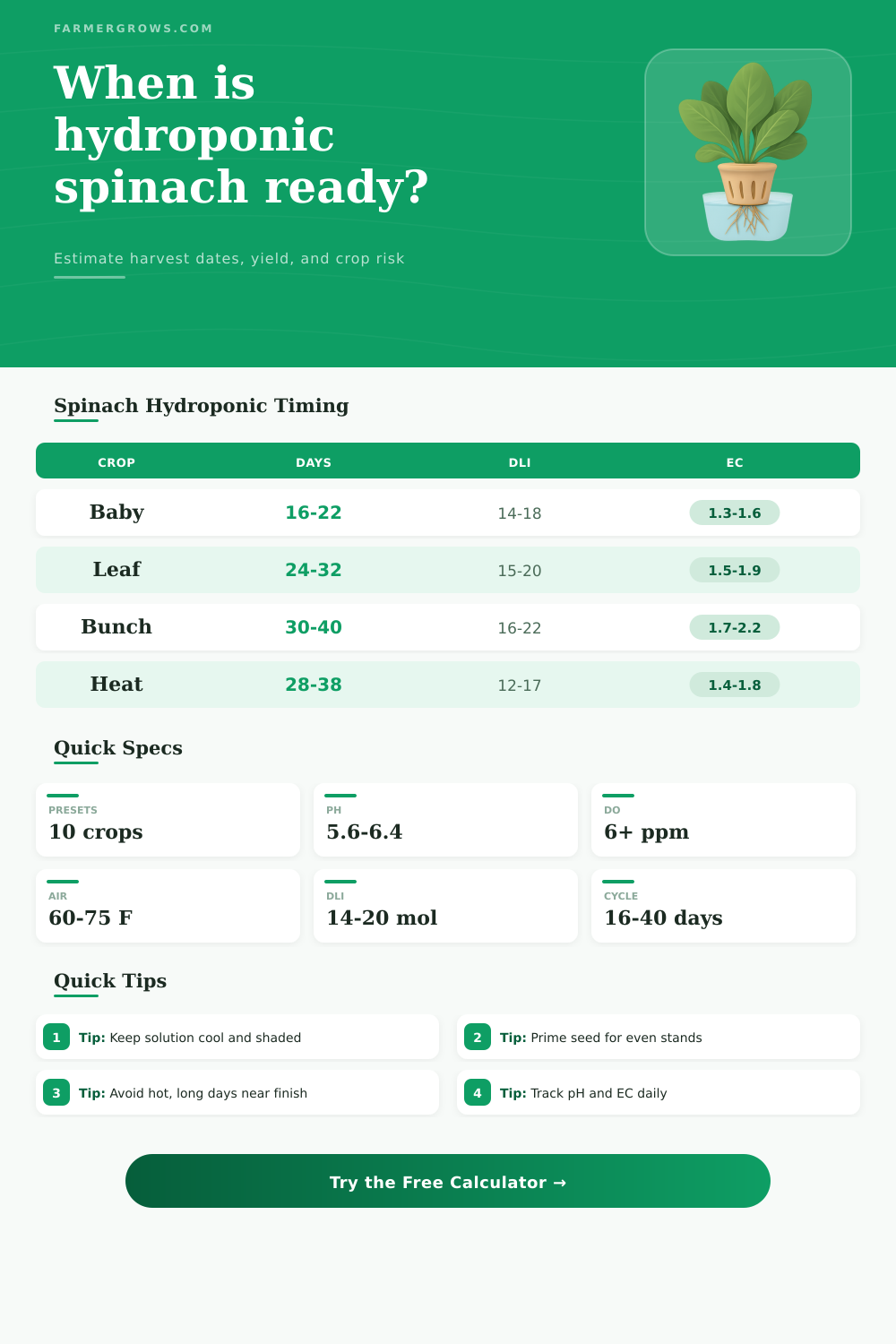
| Stage | Typical timing | Target condition | Delay warning |
|---|---|---|---|
| Seed priming or soak | 0.5-1 day | Moist, cool, sanitary seed handling | Old or dry seed causes uneven trays. |
| Germination | 2-7 days | About 65-70 F for strong emergence | Hot trays lower stand and slow uniformity. |
| Seedling establishment | 3-7 days | Gentle light, roots reaching water | Stretching means light is too weak or late. |
| Raft or channel growth | 14-30 days | Cool roots, steady EC, high oxygen | Warm solution invites root disease. |
| Harvest window | 2-10 days | Tender leaves before bolting or toughness | Long hot days narrow the quality window. |
| Parameter | Good range | Watch level | Why it matters |
|---|---|---|---|
| pH | 5.6-6.4 | Below 5.3 or above 6.8 | Outside range can reduce nutrient uptake and leaf quality. |
| EC baby leaf | 1.3-1.6 mS/cm | Below 1.0 or above 2.0 | Young spinach needs steady nutrition without salt stress. |
| EC mature leaf | 1.6-2.2 mS/cm | Above 2.5 | Older crops use more nutrients but can tip burn under stress. |
| Dissolved oxygen | 6+ ppm | Below 4 ppm | Low oxygen slows roots and raises disease pressure. |
| Solution temperature | 60-70 F | Above 74 F | Warm water holds less oxygen and speeds pathogens. |
| Condition | Fast range | Likely effect | Adjustment |
|---|---|---|---|
| Daily light integral | 14-20 mol/m2/day | Strong leaf growth with good color | Add hours or intensity if below 12 mol. |
| Photoperiod | 12-18 hours | Predictable growth without excess heat | Use lower intensity for very long days. |
| Air temperature | 60-75 F | Best balance of speed and quality | Vent or shade above 78 F. |
| Heat stress | Above 82 F | Bolting, bitterness, soft leaves | Switch cultivar, shade, or shorten cycle. |
| Relative humidity | 50-70% | Good transpiration and leaf texture | Move air if humidity stays above 80%. |
| System | Timing tendency | Best spinach use | Main risk |
|---|---|---|---|
| DWC raft | Fast if aerated | Baby leaf and weekly turns | Shared solution spreads root disease. |
| NFT channels | Fast to medium | Home racks and clean bunches | Pump outages dry roots quickly. |
| Kratky | Medium | Small home batches | Oxygen declines as roots fill the jar. |
| Ebb and flow | Medium | Tray seedlings and leaf harvest | Wet media can stay too warm. |
| Vertical tower | Variable | Compact living walls | Uneven light and warm upper sites. |
Keep the crop fast. Hydroponic spinach is less forgiving than lettuce when roots are warm or oxygen is low. Short baby-leaf cycles reduce disease time and keep leaves tender.
Separate germination from finishing. Germinate evenly in a cool, humid, clean area, then move strong seedlings into the raft or channel after roots are active.
Use heat-tolerant types in summer. Shade, airflow, and a cooler reservoir matter more than chasing high EC when spinach is near bolting temperatures.
Clean between crops. Reusing warm nutrient solution can turn a minor root problem into a system-wide failure before the next spinach batch reaches harvest.
Spinach is a cool season crop, and heat will do it no favors: The plants bolts out of nowhere, their leaves becomes bitter, and the wait seems endless. Of course, it’s not always about time. It’s about heat. Warm water does not agree with spinach, which is why your homegrown crop fights back. And when that happens, you are fighting biology instead of working with it if you grow your crop in a hydroponic system where you cannot closely control the root zone condition. Here’s how to get ahead of these hidden variables, before they sink your crop.
But here’s the thing about reservoir growing: The output date doesn’t really matter as much as the inputs that make you think about what is actualy happening inside the reservoir. First off, you choose a harvest style, baby leaf spinach goes fast (less than three weeks in ideal conditions). Bunching spinach take longer and needs better growing condition. Regardless, the tool shifts your time frame according to your goals: Do you want faster turnaround with baby leaves or bigger heads at maturity? Does your planting condition help or hurt either side?
How to Grow Spinach Successfully
It then considers where you begin. If you sow right onto raft, add the days it takes for them to germinate; if you use transplant plugs, you don’t need to. That difference between those two option could swing your harvest a week or more.
Where things really start to get dicey is with temperature. The ideal range is 60-70 degrees F. Is where spinach roots likes it to be wet. Go above that more than a bit, and dissolved oxygen drops out of the water. Even when the root zone has plenty of nutrients, roots can’t breathe. The calculator points this out specifically. If you input an eighty degree day outside and leave your pump on, the system would of probably tell you there’s danger of bolt. Spinach senses the combination of warm weather and long days and thinks it is time to make babies. And poof, no more eating spinach from here till forever. So, staying cool with the roots is absolutely necessary for success.
Similarly, there’s a balancing act between how much light and how many hours of it are best. Aim to have enough daily light integral to fuel photosynthesis, but not enough to push the plant into stressing from excess light. Not enough light, and you get leggy, weak plants that topple over in raft. Too intense, especially if your daylength is too long, and you’ll push the plants beyond the tender stage you desire. The reference tables on the page indicate the sweet spots by growing stage. These are not hard-and-fast rules; they’re more like guidelines of when to start tightening up those controls. Just as inconsistent temperatures do, inconsistent light confuses the plant. The key word here is consistency.
It’s no different with nutrient management. Gently feed young spinach plants. Electrical conductivity (EC) that is too high will kill delicate roots. It stunts early growth. The tool measures EC and pH against these ranges to tell you if you are feeding too little or to much. Dissolved oxygen levels are also measured. Root health depend on oxygen availability. Perfect nutrient ratio won’t matter without enough aeration.
I know, I know. You’re thinking, Why do I need to know all this about a bunch of spinach leaves? Because spinach doesn’t tolerate neglect, period. It rewards precision and punishes sloppiness promptly. A little overnight splash of warmth can cause Pythium root rot without showing any visible signs. By the time the leaves starts going yellow, it’s generally too late, and the plant goes down the hole. Avoiding that slide requires some planning, which is what will help you plan realistically for yield (with a given number of stands, knowing how many will get lost). And it includes making sure not to let things fester between crops so pathogens don’t build up, which would require extra cleaning. Sounds like overkill… But that’s what makes producers out of hobbyists.
What’s nice about having such a planning tool is that it takes the guesswork out of when things go in ground. You won’t have to wonder if you should of done that last month. Will next week be too late? It turns abstract gardening knowledge, the what, how, and why, into real-time action plans with clear target dates. It also shows places where your particular environment might trip you up along the way. It teaches you how to make the most of what you have; and also to honor its limits.
Spinach is not a crop that needs to be pushed; growing it hydroponically is more about providing an environment where nature can simply take its course. Balance the nutrition, provide steady light levels, and keep the roots between sixty and seventy degrees and then let time work for you instead of against you. When these ingredients fall into place, the crop will reward you with an easy and speedy harvest. When they don’t, time won’t solve the problem. Preparation is the key.