Grass Clippings Composting Time Calculator
Estimate how long fresh grass clippings will take to become usable compost, how much brown material to mix in, when to turn the pile, and whether the batch is likely to heat, mat, smell, or dry out.
Grass clippings are wet, nitrogen-rich, and quick to heat when mixed well. They also compact fast, so this calculator weighs volume, carbon balance, moisture, airflow, and turning frequency instead of using one fixed composting time.
Grass Composting Estimate
The estimate assumes clippings are mixed through the pile, not left as one compressed layer.
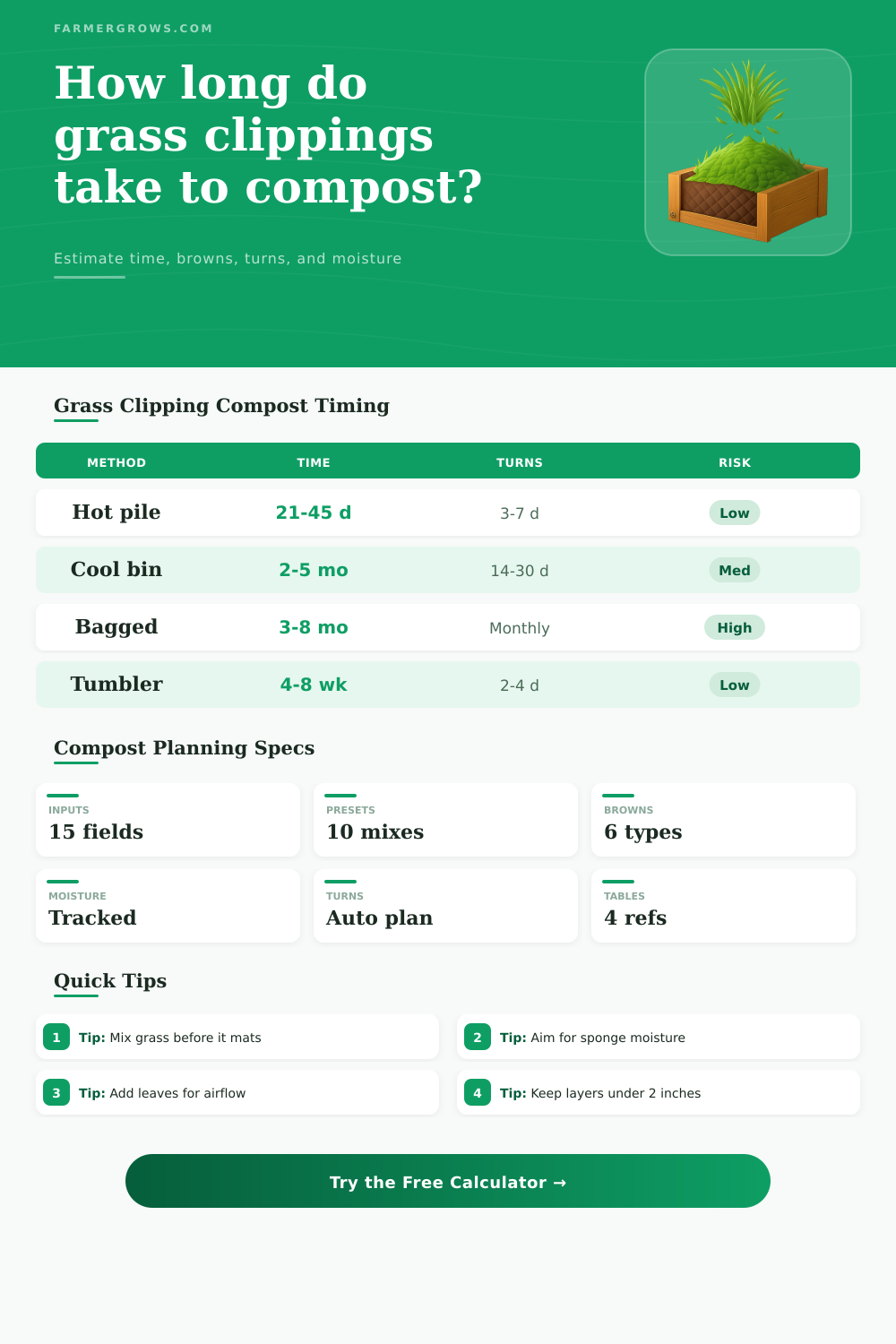
| Grass batch style | Typical time | Best turn interval | Brown mix | Watch for |
|---|---|---|---|---|
| Hot pile, well mixed | 21 to 45 days | Every 3 to 7 days | 2 parts dry browns | Dry edges after heating |
| Open cool bin | 2 to 5 months | Every 2 to 4 weeks | 2 to 3 parts browns | Slow center if too small |
| Closed plastic bin | 6 to 14 weeks | Every 7 to 14 days | 2 parts browns | Wet base and low oxygen |
| Tumbler batch | 4 to 8 weeks | Every 2 to 4 days | 1.5 to 2 parts browns | Grass balls and dryness |
| Aerated lawn bag | 3 to 8 months | Shake monthly | 3 parts browns | Sour odor if sealed |
| Brown material | Loose C:N | Best grass ratio | Airflow value | Notes |
|---|---|---|---|---|
| Dry shredded leaves | 50 to 80:1 | 2 to 3 parts | High | Best all-around partner for clippings |
| Shredded cardboard | 350 to 500:1 | 1 to 2 parts | Medium | Wet it first so sheets do not clump |
| Chopped straw | 60 to 100:1 | 2 to 3 parts | Very high | Excellent for keeping grass open |
| Aged sawdust | 200 to 500:1 | 0.5 to 1 part | Low | Use lightly; too much slows the pile |
| Fine wood chips | 150 to 400:1 | 1 to 2 parts | High | May leave woody pieces after grass breaks down |
| Condition | Moisture signal | Time effect | Fix | Calculator cue |
|---|---|---|---|---|
| Too wet | Drips when squeezed | Adds 20% to 45% | Mix dry leaves, open pile | Moisture above 70% |
| Ideal | Wrung sponge feel | Fast baseline | Keep covered from heavy rain | 55% to 65% |
| Too dry | Dusty or pale edges | Adds 10% to 30% | Water while turning | Moisture below 45% |
| Matted | Flat slimy layers | Adds 25% to 60% | Break layers, add bulky browns | Layer above 3 in |
| Cold | No heat after 3 days | Adds 20% to 50% | Increase size or insulate | Air below 55 F |
| Grass volume | Dry leaves to add | Mixed pile size | Fast method | Slow method |
|---|---|---|---|---|
| 10 cu ft | 20 to 30 cu ft | Small bin | 4 to 7 weeks | 3 to 5 months |
| 25 cu ft | 50 to 75 cu ft | Half cubic yard | 3 to 6 weeks | 2 to 4 months |
| 50 cu ft | 100 to 150 cu ft | 1.5 to 2 yd pile | 3 to 5 weeks | 2 to 4 months |
| 100 cu ft | 200 to 300 cu ft | Large pile | 4 to 7 weeks | 3 to 6 months |
| 1 cubic yard | 2 to 3 yards | Hot heap | 21 to 45 days | 2 to 5 months |
For odor control: Treat grass as the wet green ingredient. Mix browns through the clippings the same day, especially after rain or heavy mowing.
For faster compost: Build at least a 3 ft wide active pile when possible, turn before the center cools, and keep the mix damp but not dripping.
To most of us home gardeners, grass clipping are a disposal issue. Not a resource. You mow Saturday; come Monday, it’s not looking much like compost anymore but more like a slimy green brick. It stinks because it’s suffocating.
To go from foul to dark gold soil amendment is seldom a matter of adding some magical something. It is a question of balancing airflow. And that is where this tool comes into play: helping you solve it all before lifting a shovel.
How to Make Good Compost from Grass Clippings
Fresh grass have two problems: One is its physical structure; two is its high nitrogen content. Blades mat as soon as they get wet, sealing off any oxygen from entering. Aerobic microbes requires that oxygen to work their magic breaking it all down. Without airflow, anaerobic bacteria step in and do their thing, producing sulfides and methane, that’s what stinks up your compost and makes it smell like a swamp.
By forcing you to weigh your volume versus the brown material you’re using, the calculator above help estimate the time required for your particular batch. It also forces you to consider ratios (rather than simply piling on more green stuff atop old dirt). Every healthy pile have a structural skeleton of carbon. Dry, bulky materials like straw or shredded leaves is required to help aerate the wet grass matrix.
Your brown-to-green ratio (what the tool asks for) will determine if your pile heats up efficienty or simply sits there, cold and slow. Heat breaks down clippings in weeks… But only with accurate moisture control. Too much and the heat spikes too high, killing off the beneficial organisms… And then the whole process stalls. This is where the tool comes into play.
Its output also includes a risk assessment for matting and odor. Warning: When the inputs suggests a recipe for failure. People don’t think about this enough: Layering is important. Even if your compost surface appears OK (no anaerobic cores), thick layer will not be penetrated by oxygen. Compost will decompose faster when kept at two inches or less; there’s no need to turn regularly. Because the thickness of each layer affects microbe activity, calculator takes that variable into account.
If you’re tumbling, rather than having an open bin, you also has less control over interior aeration; the tool adjusts the timeline for that. Tumblers are handy, but they can get compacted if you overload them with wet greens.
Then there’s that pesky moisture thing. Clippings from mowing moistened lawns tend to be pretty heavy with water (even more so if the lawn has just been irrigated or rained on). Putting in too much water dilutes all the goodness as it replaces oxygen-filled pore spaces in the compost. Ideally, think of it as being about consistency of a wrung out sponge. If too dry, microbes dies off from starvation; if too wet, they drown.
The online calculator figures in your initial moisture content as a percent. It then tells you when to top up with brown material to soak up extra moisture, or to water if your grass is withered and dry.
Novices may not realize that the season affects the temperature of composting. Biology happens more slowly if it’s cold; a heap finished in July could take until November. The tool calculates the outside temperature and use it to adjust your finishing time. This gives you a realistic picture instead of an optimistic best case. From there, you can choose to either insulate the bin or plan for longer curing.
In the end: Good grass composting isn’t so much a recipe as a matter of relationships among the ingredients. It’s creating a habitat for microbes to flourish… Without starving them, or smothering them. See how different browns work in the reference tables below (for example, cardboard retains moisture unlike straw).
Start by entering your numbers into the calculator. Then observe the pile, keeping an eye out for cues such as smell, temperature and wetness. Add carbon, add air if it stinks. Adjust moisture if it’s chilly. Soon enough, once you understand how everything works together, you’ll stop guessing and begin to garden with intention.
By closing the loop at home, your clippings becomes free fertilizer instead of a chore. You should of tried this earlier!