Pumpkin Plant Spacing Calculator
Estimate pumpkin rows, hills, final plants, seed needs, vine room, harvest count, and total crop weight for mini pumpkins, pie pumpkins, carving pumpkins, field patches, and giant pumpkin mounds.
Pumpkins need more than a plant count. Vine length, row access, thinning, seed germination, expected fruit size, and variety habit all change how much ground a patch really needs.
Your Pumpkin Spacing Plan
Enter patch dimensions and spacing to estimate rows, hills, plants, seed needs, and crop potential.
| Pumpkin type | Plant spacing | Row spacing | Typical harvest goal |
|---|---|---|---|
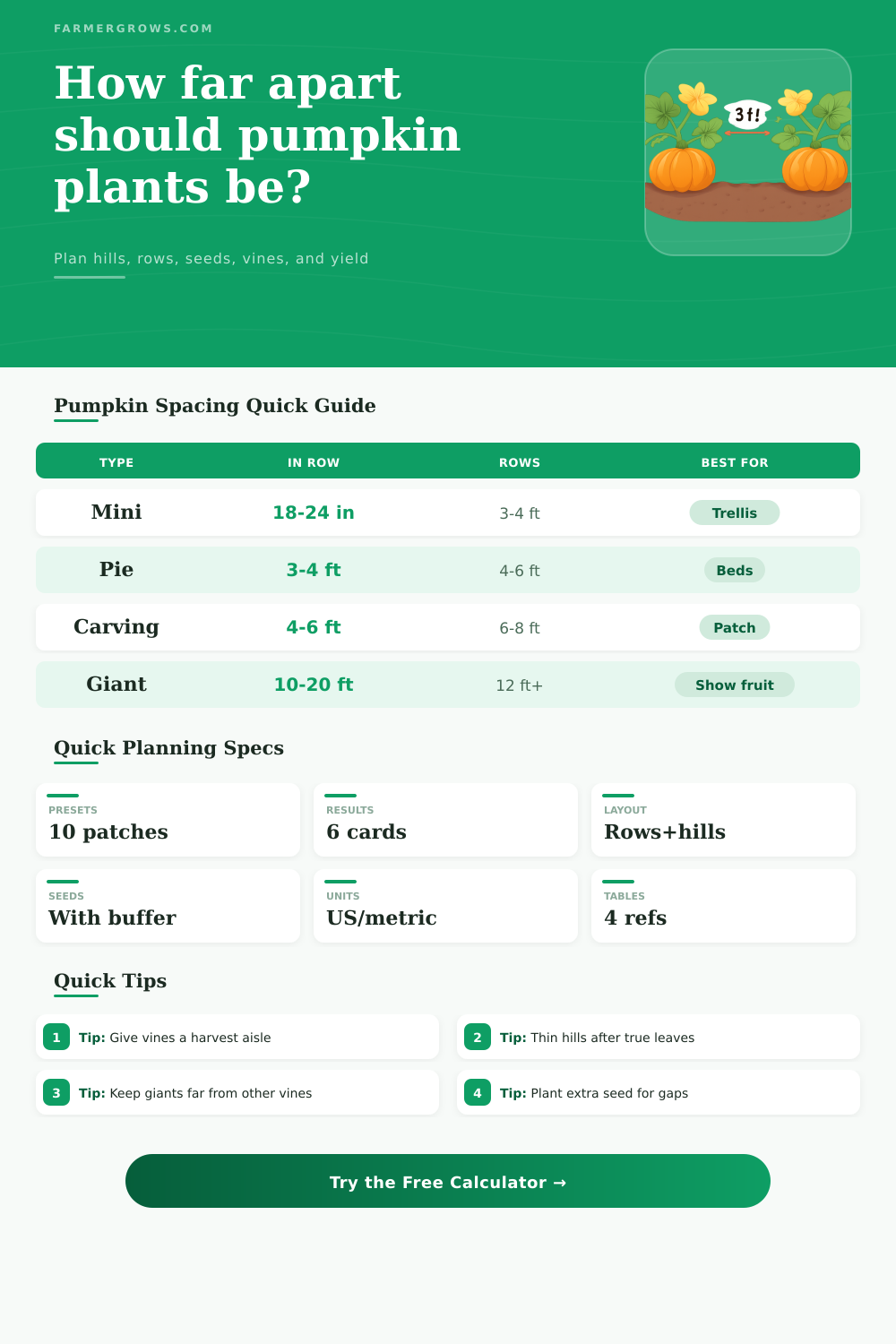
| Mini or ornamental | 18 to 24 in | 3 to 4 ft | 8 to 12 small fruit per plant |
| Pie or sugar | 3 to 4 ft | 4 to 6 ft | 3 to 6 fruit per plant |
| Bush or semi-bush | 2 to 3 ft | 4 to 5 ft | 2 to 5 fruit per plant |
| Carving pumpkin | 4 to 6 ft | 6 to 8 ft | 1 to 3 fruit per plant |
| Giant pumpkin | 10 to 20 ft | 12 to 20 ft | Usually 1 selected fruit |
| Patch size | Good use | Example spacing | Estimated plants |
|---|---|---|---|
| 4 × 8 ft bed | Mini trellis or bush type | 24 in plants, 36 in rows | 4 to 8 plants |
| 10 × 10 ft patch | Pie pumpkins or small hills | 4 ft hills | 4 to 6 plants |
| 20 × 30 ft patch | Home carving pumpkins | 5 ft plants, 6 ft rows | 20 to 30 plants |
| 30 × 60 ft field | Market mini or carving rows | 3 to 6 ft plants | 60 to 180 plants |
| 20 × 20 ft mound | Giant pumpkin training | One crown centered | 1 plant |
| Seed plan | Seeds per spot | Thin to | When to adjust |
|---|---|---|---|
| Direct sowing warm soil | 3 to 5 seeds | 1 to 2 plants | Use normal 10% buffer |
| Cool spring soil | 4 to 6 seeds | 1 to 2 plants | Increase buffer to 15% or 20% |
| Transplants | 1 seed per cell | 1 plant | Add backup seedlings separately |
| Giant pumpkin | 2 to 3 seeds | 1 strongest plant | Start extras, then select one vine |
| Vine habit | Root zone | Vine reach | Spacing caution |
|---|---|---|---|
| Bush | Compact crown | 3 to 5 ft | Still needs airflow at leaf canopy |
| Semi-bush | Moderate crown | 4 to 8 ft | Good for smaller gardens |
| Full vine | Large crown | 8 to 15 ft | Plan aisles before vines run |
| Giant vine | Very large crown | 15 to 30 ft | Use one plant per large training area |
Thin on time: Sow extra seeds, then thin after true leaves appear. Keeping every seedling can turn a good pumpkin patch into a tangled leaf mat.
Leave harvest room: Vines can cover the row middles by midsummer. If you need a cart, mower, or spray path, treat row spacing as working space.
Match variety to space: Mini and bush pumpkins are better for raised beds. Large carving and giant pumpkins need open ground and wider feeding area.
Pollination matters: A perfect spacing plan still needs bee activity and fresh flowers. Avoid spraying open blossoms and plant nearby nectar flowers when possible.
One little seed planted in the soil when it’s just right means a pumpkin, and then the vine spreads across the lawn. You put one thing in, and many things must be tendeded. How do you plan where things go so it doesn’t get crazy?
The answer: Plan your layout, before you dig. Otherwise things may crowd each other out or miss getting enough sun as they struggle to find space. You enter the types of varieties you’ll grow and size of your patches into the calculator on this page, and forget the arithmetic; it will do the geometry for you. It calculates how much seed you’ll need, how many hill to plant, and also whether there’s enough room between vines for them all.
How to Plan Your Pumpkin Garden Layout
Why should you care about such calculations? Pumpkins aren’t exactly a dill; or any other smallish vegetable that fills a pot or some sort of container neatly. Instead, they produce an extended arm (called a “runner”) as they search for food, and if those runners hits another plant too soon, energy is wasted on competition rather than fruit development. But it all depends based off what kind of pumpkin(s) you choose.
Powdery mildew will stain those leaves white if they lack air circulation, and mini pumpkins in particular depend on it. For pie pumpkins, whose vines don’t get quite so long, you can manage with somewhat narrower beds different than what is needed for traditional carving pumpkins. You’ll want wide aisles for carving pumpkins, as those vines can stretch ten feet or more if left unchecked.
Change your row spacing input into the calculator, and you can see how that affects space requirements. Wider row spacings means less trampling of emerging pumpkins later in the season. It also makes mulching or spraying easier. No one wants to be crawling around amid scratchy vines to inspect a squash blossom.
Another unseen variable is seed strategy. For this, the tool adds a germination-failure buffer percentage. (Because, of course, no seeds ever sprout with perfect efficiency.) Final number depends on soil conditions, temperature, moisture, critters. Standard practice is to start three or four seeds in each spot and then thin out to just one strong plant. You get your starter even if one doesn’t make it. Thin them early so that none of those roots has time to compete and stunt the others. Many beginners learn this lesson too late when everything looks full of potential but yields nothing.
On a larger scale, giant pumpkin growers lives in a world of their own. They often train the vine to form a kind of high-wire act around a large mound devoted to just one plant, so they do indeed require huge space between plants. That’s reflected in the calculator, where you can input crazy spacing. However, what we’re after at home is the usual density without sacrifice. Even bush types (ideal for smallish places), benefit from having breathing room. When you crowd them, less light penetrates, weakening the plant’s immune system and inviting more mildew and rot.
Consider how you’ll get at your crop when planning where it goes. Will you really want to haul a full squash or pumpkin over an area that’s grown up in a tangle of stems? A clean pass means the work will be fun, not torture. How does what you have planned compare to typical set-ups? Use the reference tables on the tool to do a fast check-up on most common layouts. Don’t undervalue how much area can be covered by mounds of foliage by high summer.
Spacing out pumpkins is ultimately about letting each one have room to express itself (without stepping on anyone else’s toes). It’s about finding balance between ambition and reality: Of course you want a bountiful crop, but you also need a garden you can work with. The more things get set up right at planting time, the less stressful it will be as the fruit starts to size up. All those early choices carry through the growing season, transforming what could of easily become a hot mess into a happy, productive patch of both flavor and fall color for all your hard work to enjoy.