Daylily Bulb Bloom Time Calculator
Estimate the first flower date, peak bloom week, and likely delay for newly planted daylily bulbs, bare roots, divisions, or potted starts.
Daylilies are usually sold as crowns, fans, bare roots, or container plants rather than true bulbs. This calculator keeps the common daylily bulb wording while estimating bloom from real planting and growth factors.
Estimated Daylily Bloom Forecast
The forecast combines normal daylily season timing with the establishment delay caused by planting date, stock type, roots, light, and soil conditions.
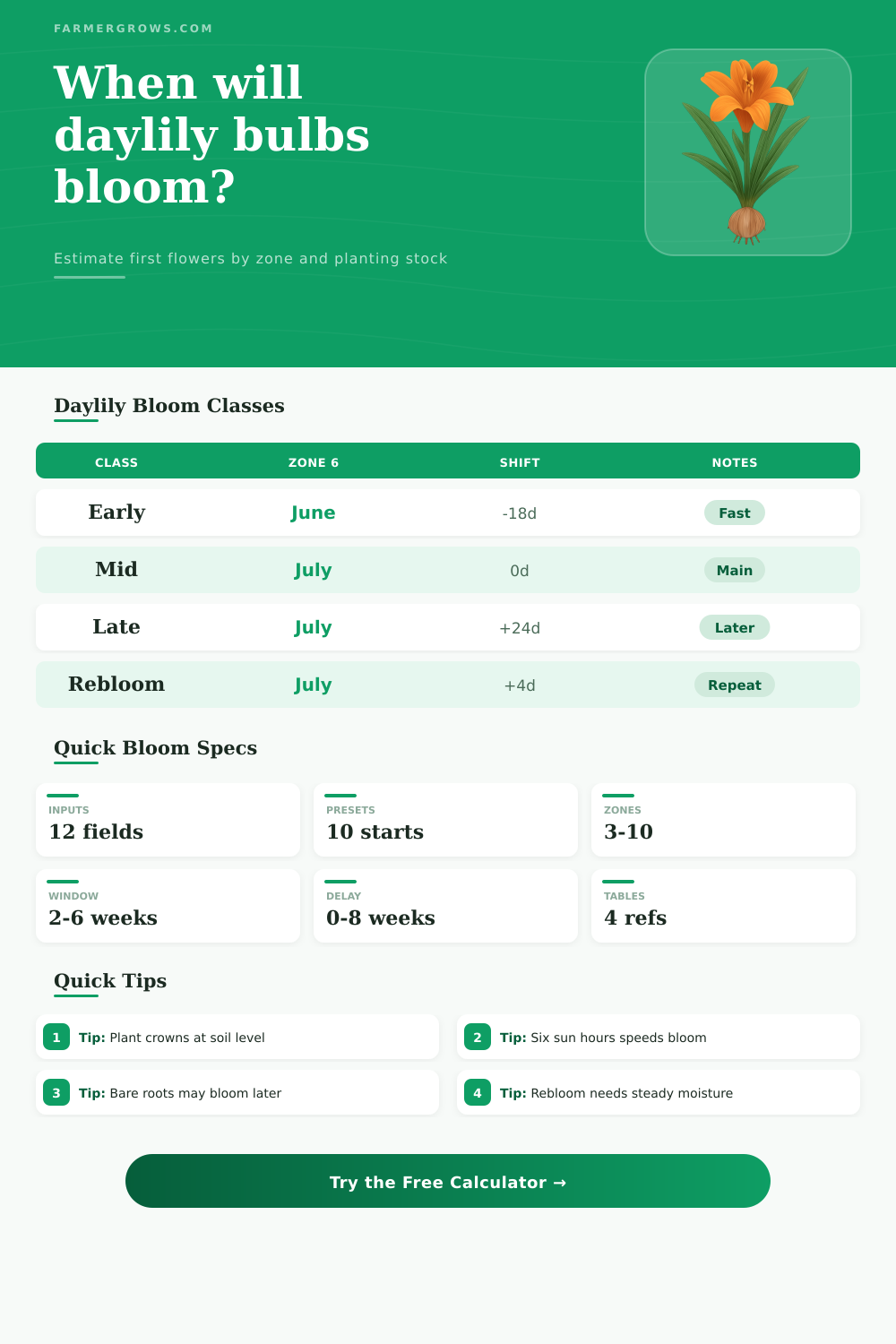
| Bloom class | Approximate zone 6 first bloom | Calculator offset | Best use |
|---|---|---|---|
| Extra early | Late May to early June | 30 days before midseason | Opening a long daylily sequence |
| Early | Early to mid June | 18 days before midseason | Reliable first color in mixed beds |
| Early-midseason | Mid to late June | 10 days before midseason | Bridging early and main bloom |
| Midseason | Late June to early July | Local baseline | Main daylily bloom period |
| Late-midseason | Early to mid July | 12 days after midseason | Extending the main show |
| Late | Mid to late July | 24 days after midseason | Keeping bloom after early types fade |
| Rebloomer | Near midseason first flush | 4 days after midseason | Potential second flush in warm conditions |
| USDA zone | Season shift from zone 6 | Typical midseason anchor | Bloom timing note |
|---|---|---|---|
| Zone 3 | About 24 days later | Late July | Short season favors early and midseason cultivars |
| Zone 4 | About 16 days later | Mid July | Dormant cultivars usually match winter conditions well |
| Zone 5 | About 8 days later | Early to mid July | Spring planting often blooms if roots establish quickly |
| Zone 6 | Baseline | Late June to early July | Good reference for most catalog bloom classes |
| Zone 7 | About 7 days earlier | Late June | Fall planting gives strong first-year root growth |
| Zone 8 | About 14 days earlier | Mid June | Rebloomers often perform well with steady moisture |
| Zone 9 | About 22 days earlier | Early June | Evergreen types fit mild winters better |
| Zone 10 | About 30 days earlier | Late May | Heat and dry spells may shorten the first flush |
| Planting stock | Establishment days used | Bloom delay used | Practical reading |
|---|---|---|---|
| Established clump | 15 days | 0 days | Blooms close to normal class timing |
| Mature potted plant | 20 days | 8 days earlier | May already have stored energy for scapes |
| Fresh field division | 34 days | 2 days | Usually blooms if divided early and kept watered |
| Bare-root fans | 45 days | 12 days | Needs root recovery before strong scapes form |
| Small nursery liner | 55 days | 18 days | Often grows foliage first, then flowers later |
| Dry packaged crown | 68 days | 26 days | Most likely to bloom late or wait until next year |
| Growing condition | Fast bloom signal | Delay signal | Calculator effect |
|---|---|---|---|
| Sun exposure | 6 to 8+ direct hours | Less than 5 hours | -3 to +21 days |
| Soil temperature | 60°F to 75°F | Below 50°F or above 80°F | 0 to +18 days |
| Water pattern | Even moisture | Dry swings or wet crown | 0 to +12 days |
| Crown depth | At soil level | Buried 2+ inches deep | 0 to +20 days |
| Fertility | Moderate balanced feed | Low fertility or heavy nitrogen | -2 to +8 days |
| Mulch | Light mulch off crown | Heavy mulch over crown | -1 to +8 days |
Bloom date check: A first-year daylily can grow well and still skip bloom if planting happens near its normal scape-forming window. The forecast flags that delay instead of forcing a same-season date.
Planting depth check: Keep the crown near soil level and mulch around, not over, the crown. Deep planting is one of the most common avoidable bloom delays.
It’s spring; you plant the crown and hope for an explosion of color in June. Weeks become months: Green leaves push up… But still no scapes. One of gardening’s most common sources of frustration: Daylilies aren’t a strict calendar creature. Their timing depends on two factors that differ based off what type of plant reached your door: its root mass, and the soil temperature it’s planted in.
Based on care conditions, zone, stock type, and planting date, the calculator above estimates when your own batch will eventually open its flowers… And thus separates real problems from the normal growth delays.
Why Your Daylilies Are Taking So Long to Bloom
First, know this: Not all daylily plants comes into bloom quickly. A dry-shipped, winter-dug bare-root fan doesn’t have any energy storage for blooming whatsoever; it needs all spring just to establish new roots before thinking about pushing up a flower scape. Why the question about stock type? That’s the most important variable of all for first-year results. Planting a potted, more mature plant with an established root system may bloom in weeks because it already has enough energy. Otherwise, it will take quite a while for the plant to recover. This assumes you got your stuff by mail order and recieve dried-out crowns. Gardeners tend to forget this till the season closes, but it makes sense.
The other thing is variety within variety. If you select early bloomers, they’ll hit their stride fast when weather finally warms, frequently beating the midseason varieties in the same bed by three or four weeks. And then there are the late bloomers, who don’t give a hoot about warm weather: Their genetics tell them it’s go time, and they’re going to take their sweet time whether the season lasts long enough for them or not. This is spelled out clearly on reference table on the page (where you see how each class shifts relative to a midseason standard). You can use this to space your plantings if you wish to enjoy extended color. It also helps keep late bloomers from getting planted in a zone too far north, where they may not have time to finish growing before frost takes down the foliage.
What is the secret sauce? This whole thing depends on light and soil heat: Daylilies need at least six hours of direct sun to produce strong scapes, but even more important, the roots must grow fast as they establish; they cannot do that if the soil around them is cool, below 50ish degrees F. No amount of watering will speed their progress. To account for different conditions, the calculator looks at sunlight exposure and average soil temperature. These factors will change when the estimated bloom day occur. So don’t uproot perfectly good plants under the belief that they’re goners, since the tool can push back the estimate of when things might emerge in a cooler-than-normal spring, or earlier with a sunnier bed. It is a tiny tweak that spares a lot of freakouts.
When I ask “what did you do right?,” one critical (but subtle) factor comes up: Did you keep your watering steady and even? Overwatering is a problem many gardeners have with new transplant (the roots are suffocated; they require oxygen to take hold). Underwatering (letting them get really dry) stresses the plant to such an extent that it may shut off reproduction altogether. You want even, steady moisture; that’s the sweet spot.
Mulch and fertility inputs also fine-tune this guesswork, since excess Nitrogen promotes lots of foliage at the expense of bloom, and correct mulching moderates soil temperature. Biology is messy. Instead of one single date, you get a range. This tells you when to expect your first flower and when peak bloom should arrive. It also tells you how many weeks after that you can expect all of this to happen.
This might be a longer wait then expected, but it doesn’t mean something went wrong. The plant simply needs some time to establish itself before it wants to think about reproducing). Once we get past the idea that things take time to establish, you realize that waiting patiently (and having faith in the process) is actualy rewarding, looking out for those first scapes is no longer something to make you anxious, but something to look forward to. Roots are quietly getting to work down below while you await the show.