
You planted your favorite cherry tomato next to an heirloom tomato last year so you’d have a rainbow of flavors. The fruits was all the same size and shape. However, the ones you harvested had dull colors and odd shapes when you went to sow seeds this season. What happened? It’s called cross pollination.
It means that even though you didn’t do anything wrong. Planting or otherwise, the genes of one plant got mix up with those of another via invisible pollen floating on wind between them. Here’s why it matters: How you save your seed changes when there’s been such mixing.
How to Stop Plants from Mixing Up
Most gardeners has a rule of thumb for seed-saving. They think two plants are separate enough if they’re physically distant. This keeps their genetics separate. This is true for some, but not true for all. Knowing what crosses and what doesn’t help you maintain an honest seed stash (and avoid unexpected harvests).
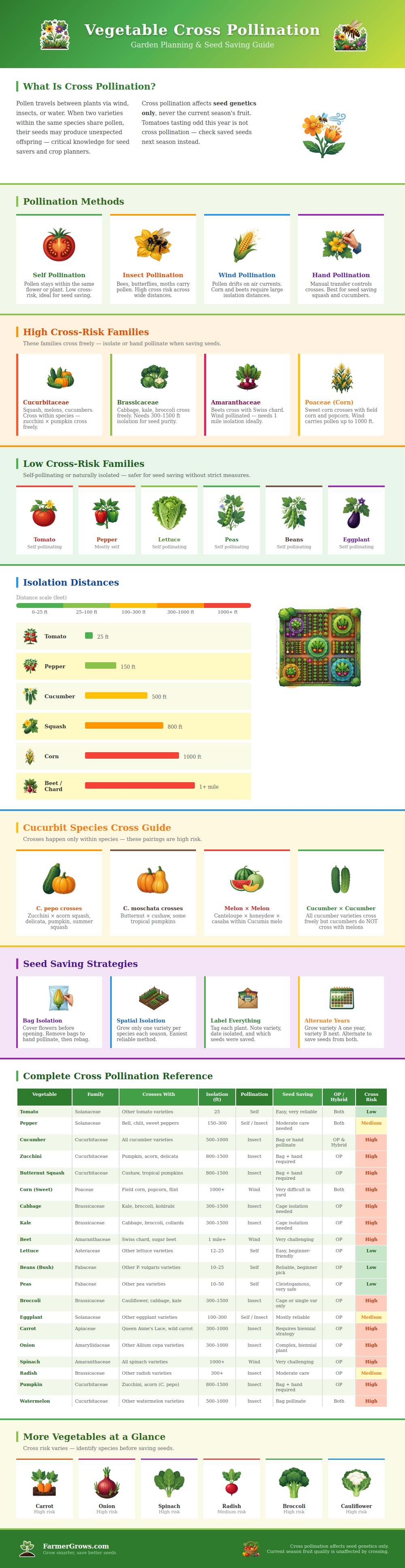
First, let’s look at the mechanics: pollen transport begins here. There are some flowers whose male and female parts is so close together they don’t need any assistance at all in fertilizing one another, lettuce, peas, tomatoes, beans, for instance. Many such flower never even open fully; no visitors required. Grow five kinds of tomato next to one another, and chances are the resulting seed will be true to itself, every time. It is a little thing but it is nice if you’re starting out and want results you know are coming.
Peppers gets a bit more finicky (because they may depend on bees to help with some cross-pollination), but still not so much that most home gardeners has to fret about it unless they intend to save seed for resale. And then there are the heavy hitters. Squash and pumpkins loves company, specifically the company of their own species. Since they are biologically related. Zucchini shares the same biological family name as acorn squash or delicata (they’ll freely cross with one another).
That cross pollination doesn’t affect flavor or texture of the fruit you’ll be eating this summer. Only its seeds… Once they’re saved; will have changed genetically. Next year’s crop of zucchini could resembles a crookneck pumpkin if the seeds are used. That’s what folks don’t understand. Why does my vegetable taste funny? It is not because of something I did in the soil (like put down too much fertilizer), but because I didn’t realize that culprit was already waiting in the seed packet for me to plant it come springtime.
With corn, things gets downright extreme, since wind carries its pollen for miles. Grow some sweet corn among field corn and before long your sweetness get all mucked up by mixed-up genes right on the tassel. Here is a visual breakdown of those isolation distances. Look at how much space spinach and beets require compared to self-pollinating beans! You also need all that space between kale and broccoli because insects. Including bees, is so good at doing their job and visiting each plant in the neighborhood. Unless you have barriers in place… Like livig in a densely suburban setting… You can’t expect to get pure seed isolation from things like beets or corn.
Meet your new best friends: pollinating by hand. You can bag flowers before they open and use a small brush to apply pollen by hand. Whatever your neighbor’s growing, it doesn’t matter; you’ve got complete control over the genetic lineage. Sounds tedious, but it works.
To avoid any of that mix-up, plan ahead. If you have limited space, rotate what you’re growing. Plant the white corn one year, the blue another. Save the resulting seeds from each plant, and label them carefuly in envelopes with dates and variety names (so you don’t think a mutant crop of some kind). Note down carefully which ones bloom together. It’s not just dirt-under-your-fingernails gardening; it’s record keeping, too.
Once you know the unseen links between flowers via pollen, you no longer guess what’s going on; you grow with intention. You curate your seed library instead of buying a genetic lottery ticket. The payoff is that year after year, you will see a clear picture emerge where before there was chaos, and your harvest will be both rewarding and predictable.
You should of planned ahead to avoid this.