
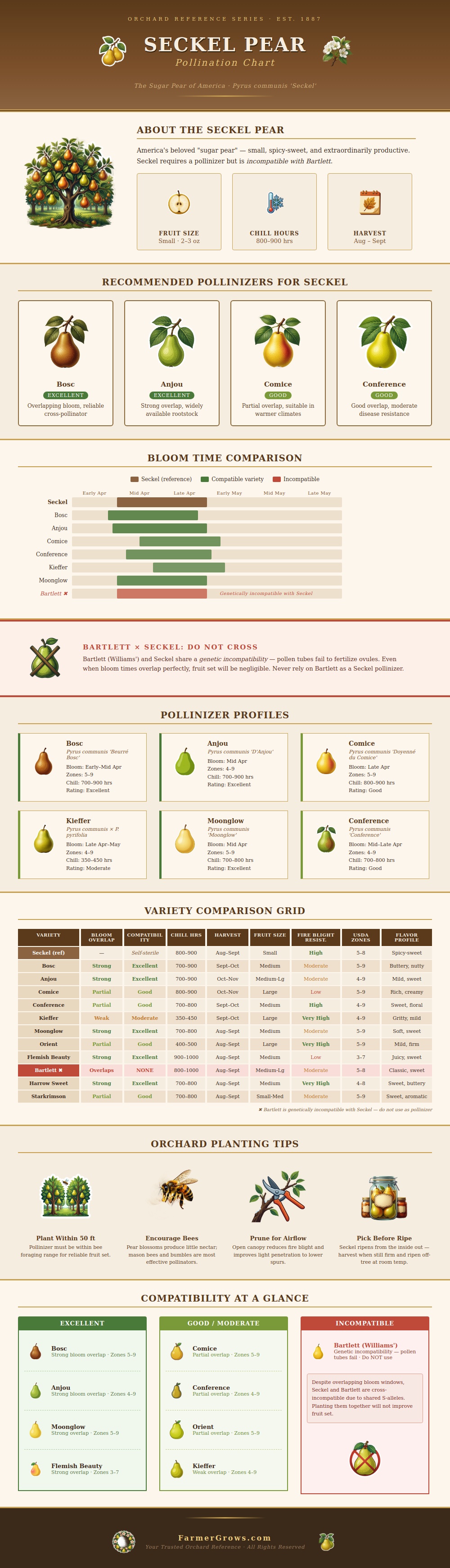
Why a Seckel pear tree? Who doesn’t crave a little concentrated autumn sunshine on the tongue, in the form of sweet and tiny fruits from a Seckel pear tree? Because it is small and has such a spicy sweetness, it is one of the most loved heritage American garden plants.
But there’s a hitch, and it will trip even the most careful gardener the first time around. Even if your pear have perfect conditions. Ideal sun exposure, the healthiest of soils, you’ll still be left with barren limbs unless you know how pears really propagate themselves.
How to Grow Seckel Pear Trees
Like many fruit trees, Seckels is also self-sterile (meaning they cannot use their own pollen). They require a helping hand from a nearby tree…but not just any old one. Which ones work? Which don’t? Which actualy thwart your efforts? The chart makes it clear by breaking everything down.
Planting your Seckel alongside a Bartlett is perhaps the most well-known mistake, and with good reason: Bartletts are everywhere and flower at the same time; so why not? But it’s a genetic dead end. (Specifically, the two varieties share specific alleles that prevent fertilization; the pollen tubes just won’t make it to the ovule.) Watch as the bees goes to and fro all day long, but don’t expect much fruit set. This incompatibility is clear in the visual guide.
And if you’re hoping for fruit, you’ll save yourself three years’ worth of growing time on a tree that never delivers. This is a harsh fact of plant life that has nothing at all to do with how long they bloom or how far apart they are.
So where do you want to look? Not Bartlett. Look more toward ones like Anjou or Bosc. Any time you have a combination like Seckel plus one of those two types, you’re looking at the heavy lifters in your orchard rotation. These is varieties whose blooms line up, which is called “overlapping bloom. They are not just overlapping, but also open when the other is receptive.
This is labeled on the chart above as a good pairing for cross-pollination, different than the way genetic barriers stop many other pairings. If you note that a particular variety has an excellent rating, what it really means is: genetics and timing couldn’t be better; you’ve got your best shot at getting those little luscious fruits to set without having to hand-pollinate every blossom.
The second part of the equation is timing: Your pollinizer tree has to be in bloom at the same time as the pear flowers, which are short-lived and easy to miss. If the trees blooms two weeks apart, they’ll completely miss one another. To help see the window more clearly, there is a bloom timeline visualization.
You’re looking for when their flowering periods overlap substantially, that’s your sweet spot. It’s not just about having a different variety; it’s about having a compatible schedule. It is important to check names, but it is equally important to check those dates. A tree that blooms too soon or too late can be just as useless as a tree that’s genetically incompatible.
And it turns out placement matters, as well. The bees are doing the work here, and there’s only so far they will fly between trees. If you plant your pollinator within 50 feet, bees can move pollen easily back and forth through the orchard. It doesn’t need to be right next door, but close enough that one foraging trip encompasses both branches.
To help the process even more, encourage native bees or install some mason bee houses. Unlike apples, pears aren’t a high-nectar crop. They depend on good pollination by hardworking bees rather than just random visits.
Pay attention when pruning. By opening up the canopy, more light reaches the lower spurs (where most flowers are produced) and there is less humidity (inviting fire blight). You’re not just making a shape on the tree, you’re also creating an environment in which diseases have no place to hide, and in which pollinators can do their job. That may be a small thing, but it matters immensely for your final yield.
The more air that moves through the branches, the drier and thus more accessible the blossoms will remain. Seckels are patient fruits. You pick them on the vine while they are still hard, but leave them at room temperature to soften before eating because the fruit ripens from the inside out. Waiting also concentrates the sugars, which is why you get that hallmark of a Seckel: a peppery note.
Pick too soon (when soft on the tree), and you’ll end up with something bland and mealy. It’s all part of learning to honor the biology of the tree, not rushing things to fit your calendar.
Bottom line: Seckels are not a brute force garden thing; they’re a strategic partnership. A set of conditions has to come together genetically (the tree), timewise (you), and bee-wise (bees) for their success. You should of seen that coming. If you do, those little fruits will reward you with some flavor that few others can equal.
That’s why I say do the homework beforehand, you don’t want to be staring at bare branches year after year again. Get the right neighbor in place from the beginning, and the difference between no fruit and lots of it may depend on this.