
Think of an anthurium as something that functions like a living factory, not just a houseplant to decorate your home. Thinking this way transforms a passive houseplant collection into a purposeful breeding program. This requires more accuracy than a casual gardener provide with a simple watering schedule. As breeder, you are also a genetic designer: You determine which characteristics gets passed along, and which don’t. That’s why timing is everything. Where most novices falter, and where things begin.
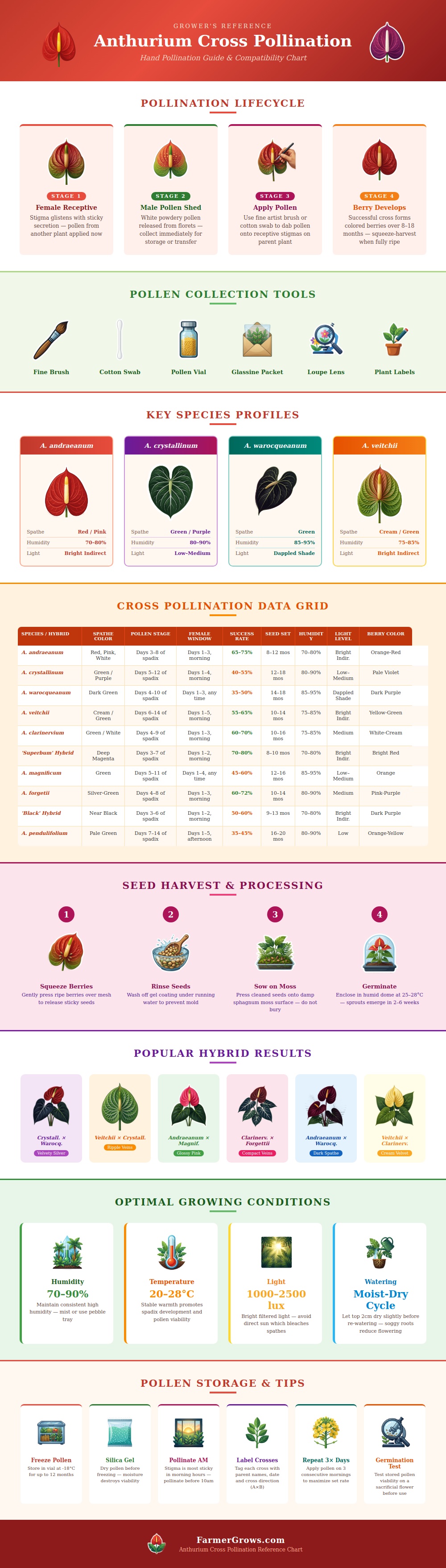
The infographic above shows how the flower of an anthurium is actualy a single spadix, divided into male and female sections. In both section, there is a momentary phase of openness on the part of the other sex; more often than not, however, one doesn’t meet the other at the right time for self-pollination. First you must observe a bit of shine, like shining morning dew on the tip of the spadix; then go! Because it’s such a tiny thing that makes all the difference in terms of success rates, if you miss a second, you’re probably too late for fertilization once the anther is ready to pop.
How to Breed Anthuriums
But not just any two nice-looking plant will do for parent choices. To help you strategize what to pair, the chart explains which species prefer which amount of light and humidity, so that you’ll generally select ones whose needs overlap, so that the offspring seeds will thrive in the same conditions. If one is a high-humidity type (such as A. If one is a high-humidity type (such as A. Warocqueanum) and the other is less tolerant (a low-humidity lover), for instance, you’re likely to end up with weak babies that won’t root well. Better match them and make life after pollination easier by far: You’re still at the mercy of nature’s genetic dice-rolling, but you can gets to roll the dice only under conditions you control.
The pollination method is low tech. Transferring pollen from one spathe to another is easily achieved with a clean cotton swab or a fine artist brush. Consistency is key (the visual guide makes this clear), and applying pollen for three consecutive mornings increase fertilization rates by leaps and bounds. Sounds tedious, but hey, that’s how we’re going to make sure the stigma gets saturated with enough viable grains before closing up shop. Save any leftover pollen in a vial containing some silica gel, and freeze. With this approach, you can make your crosses even if your desired partner plants don’t bloom at the same time.
This is where the separation between amateur grower and serious breeder begins: planning ahead. If a cross does happen to be fertilized, patience becomes your best weapon now. Depending on species, it can take up to 18 months for berries to ripen. Even then, as the chart shows, there is no guarantee of success. Some hybrids hit seventy percent, but others barely make it past forty. Expect to lose seeds. Expect some to go moldy. Expect some to just not take; that’s what folks fail to understand. They think it’ll work right away, and when the flower spike fails to form fruit and wilts they give up. It’s not how real breeding works; it’s about seasons, more then weeks.
To harvest, simply rub over a mesh to split the pulpy fruit away from gummy seeds, rinse well (the gel coat promotes rot), and place the seeds on a moist bed of sphagnum moss. Don’t cover; these babies require light and will not emerge if covered. Maintain humidity and warmth, expect to have some sprouting within several weeks. These first-generation plant may bear no resemblance to their parents whatsoever, which is half the fun. They are living examples of evolution happening right before your eyes, and all because of you.
No exceptions: Every cross must be labeled. What good will it do if you don’t even know who mated whom? How can you have any idea about success or failure without recording that information? Label them in the right direction (which was mom, which was dad) and with a date, because unless you remember to do this before you forget, nothing has meaning. This isn’t just planting stuff; it’s creating a long-term experiment, and there are data points being collected along the way.
Once you start down that path, you can’t help but change the way you regard all of your flowers. Suddenly they are not just possessions but also potential parents. Every spathe contains a collection of genetic information that’s begging to be revealed. This shift in perspective would of paid off in spades, even if no hybrids come out of it.